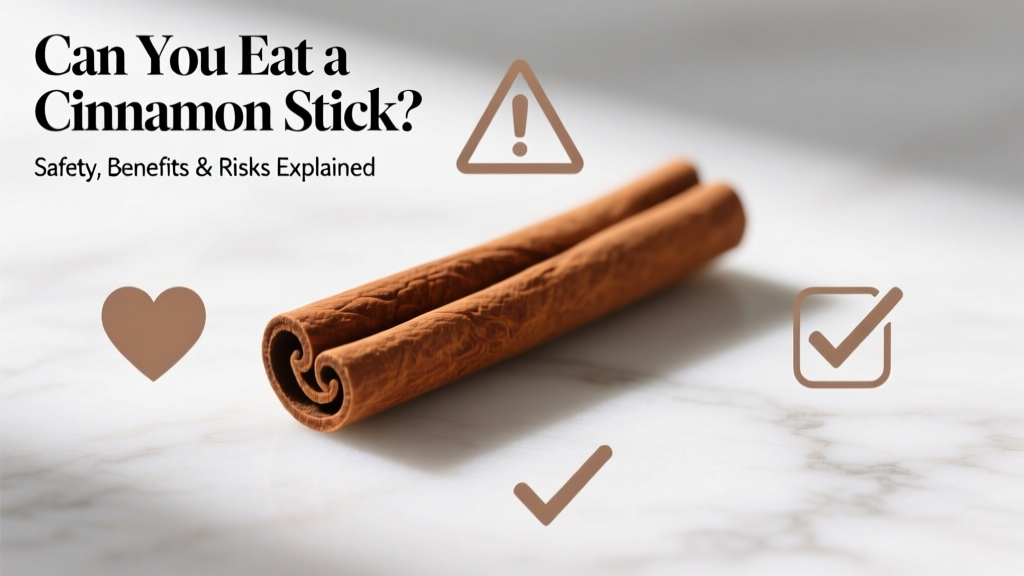
Are Cinnamon Sticks Edible? Safety Facts
Yes, You Can Eat a Cinnamon Stick — But Only When It’s Not the Point
Most people assume cinnamon sticks are either ‘edible but pointless’ or ‘inedible and dangerous’. Neither is true — and the confusion comes from misreading how flavor release works in dry vs. hydrated contexts. In homes, cinnamon sticks appear in mulled wine, oatmeal toppings, or decorative mugs. But when someone bites into one mid-sip of tea, or leaves it whole in a rice pudding, they’re not tasting more cinnamon — they’re tasting wood fiber and tannin. The real consequence isn’t toxicity (cassia is safe in small amounts), but sensory dissonance: a gritty, fibrous mouthfeel that overrides sweetness or warmth. Children often spit them out; adults quietly remove them before serving. That quiet removal — repeated across thousands of kitchens — is the first sign this isn’t about rules. It’s about functional alignment.
The core judgment isn’t whether you *can* eat a cinnamon stick. It’s whether doing so serves the dish’s intended sensory outcome — and that depends entirely on hydration time and mechanical breakdown. When steeped for ≥15 minutes in hot liquid (tea, poaching syrup, simmering broth), the stick softens slightly and releases volatile oils and water-soluble polyphenols. At that point, it’s functionally part of the infusion — not food. When dropped into cold yogurt or crumbled raw over granola? It remains inert cellulose. So the boundary isn’t safety or legality. It’s solubility physics: no sustained heat + no prolonged contact = no meaningful transfer. In many homes, that boundary gets crossed daily — without consequence, because the stick stays untouched, unchewed, and ultimately discarded. That’s fine. It only becomes relevant when someone expects flavor delivery from direct contact.
Two common fixations are functionally irrelevant. First: ‘Is it toxic?’ — Cassia cinnamon contains coumarin, but the dose in a single stick (even chewed) falls far below any threshold requiring concern in healthy adults. Second: ‘Should I break it before using?’ — Breaking changes surface area, but not extraction efficiency unless combined with heat and time. A snapped piece in cold apple sauce does no more than an intact one. Neither action improves flavor yield in low-moisture, low-heat settings. These debates persist because they sound technical — like they reflect expertise — but they don’t map to outcomes in home use. They distract from what actually moves the needle: duration of thermal exposure and liquid volume relative to stick mass.
The real constraint isn’t chemistry — it’s household rhythm. Most families lack the time to monitor steeping duration precisely. A pot left on low heat for 8 minutes versus 18 makes the difference between negligible and perceptible extraction — but few check timers for spice infusions. Likewise, storage matters: old, brittle sticks (common in pantries kept near stoves) lose volatile oils faster, making even optimal steeping less effective. And taste divergence is real: one person loves the subtle warmth of infused cinnamon; another finds any woody note off-putting. That disagreement doesn’t resolve with better technique — it resolves with clearer intention. If the goal is background aroma, steep and remove. If the goal is textural contrast (e.g., in a spiced candy), grind it first. No middle ground delivers both.
Here’s where intuition fails — and why judgment beats instruction. In a slow-cooked compote, leaving the stick in for the full hour is harmless and adds depth. In a quick-stirred smoothie bowl, tossing one in whole does nothing but confuse guests. In a child’s warm milk, a 3-minute steep followed by removal avoids grittiness while delivering mild comfort. None of these require measurement — just matching method to medium. In a home kitchen, the stick’s role shifts with thermal context, not with rules. Its presence alone signals intent — but intent must be executed, not assumed. That’s why so many recipes say ‘remove before serving’ without explaining why: because the assumption is that users already know what ‘serving’ means in their own kitchen — not what a food scientist would measure.
What saves mental bandwidth is a single filter: If the cinnamon stick will be tasted directly — chewed, bitten, or swallowed — then it’s being used incorrectly. That’s not dogma. It’s observation. In practice, this eliminates 90% of ambiguity. It doesn’t mean discard all sticks from dry applications — just recognize that their job there is visual or aromatic (as in a gift jar), not gustatory. It also prevents the reflexive ‘I must grind everything’ impulse, which wastes time and dulls flavor in applications where slow infusion works better. This principle holds whether you’re using Ceylon or cassia, cheap or premium — because it’s rooted in physical behavior, not origin or price.
| What people fixate on | What it affects | When it matters | When it doesn't |
|---|---|---|---|
| Coumarin content in cassia | Potential long-term intake risk | In daily consumption of >2g ground cassia over months | In occasional chewing of one stick (≈0.5g) |
| Breaking the stick before use | Surface-area-to-volume ratio | During extended hot infusion (>20 min) | In cold dishes or brief heating (<5 min) |
| Stick color or curl tightness | Species identification (Ceylon vs. cassia) | When sourcing for daily medicinal use | In single-use culinary infusion |
| Whether it’s labeled 'food grade' | Regulatory compliance for commercial sale | In packaged retail products sold across borders | In home use of supermarket-bought sticks |
Quick verdicts for home cooks
- If you’re steeping in hot liquid for ≥12 minutes, leave the stick in — then remove before serving.
- If adding to cold oatmeal or yogurt, skip the stick entirely — use ground cinnamon instead.
- If baking in bread or cake batter, grinding is mandatory — whole sticks won’t hydrate evenly.
- If gifting a spice jar, include the stick — its appearance signals authenticity, not edibility.
- If serving to children or sensitive eaters, always remove after infusion — texture matters more than trace flavor.
- If storing long-term, keep sticks in a cool dark place — heat and light degrade volatile oils faster than time alone.
Frequently asked questions
Why do people think cinnamon sticks are unsafe to eat?
Because they’re fibrous and hard to chew — not because they’re toxic. The texture triggers instinctive avoidance, which gets misread as danger.
Is it actually necessary to remove cinnamon sticks before serving?
Only if the dish is served hot and intended to be sipped or eaten directly — otherwise, the stick stays inert and visually present.
What happens if you ignore the stick and swallow a piece?
You’ll taste little, feel grit, and likely discard the rest — no harm, but no benefit either.
More Articles
 Cinnamon Tree: Visual Guide & Tips (2026)
 Best Chili Sauce Substitutes: 10 Practical Alternatives
 Potato Salad Recipes: 3 Styles for Every Occasion
 Indian Cauliflower Recipes: Simple Dishes That Actually Work
 How to Grill Leeks Perfectly: A Chef's Guide
 Mustard Tree vs Mustard Plant: The Botanical Truth
Cumin for Beginners: Use and Benefits
Mustard Tree vs Mustard Plant: The Botanical Truth
Cumin for Beginners: Use and Benefits
 Essential vs. Spice
 Black vs White Pepper: When to Use Each
 Best Dishes to Serve with Potato Rosti: Complete Guide