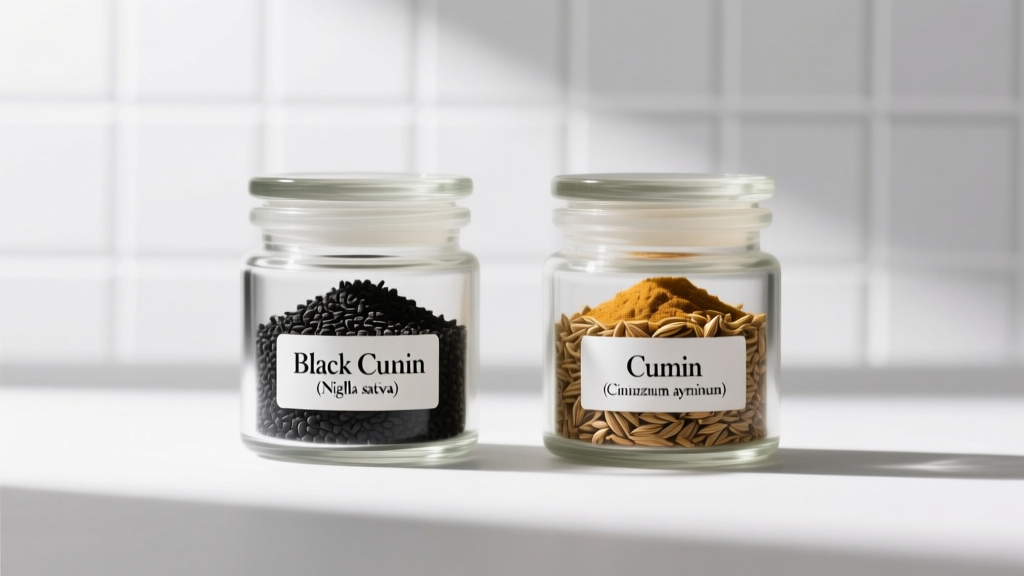
Black Cumin vs Cumin: Clear Botanical & Culinary Differences
Black Cumin Is Not a Upgrade — It’s a Separate Tool
Most people assume black cumin is just a ‘darker’, ‘stronger’, or ‘healthier’ version of regular cumin. That belief comes from packaging language (‘black cumin seeds’, ‘Nigella sativa’, ‘kalonji’) and wellness blogs that treat both as interchangeable pantry staples. In reality, they’re botanically unrelated: cumin (Cuminum cyminum) is a spice; black cumin (Nigella sativa) is a seed with medicinal lineage and a volatile, bitter-earthy aroma. The confusion causes real kitchen consequences: dishes taste unexpectedly sharp or medicinal, family members reject meals without knowing why, and leftover black cumin sits unused in jars for months — mislabeled, misunderstood, and mistaken for ‘cumin you haven’t tried yet’.
The distinction rarely matters when heat and time erase nuance — like in long-simmered stews, roasted vegetable batches, or spice blends baked into flatbreads. In those cases, both seeds lose their defining edges: cumin’s warm earthiness blurs; black cumin’s volatile oils evaporate. What remains is mostly toasted nuttiness — functionally similar enough that substitution goes unnoticed. This isn’t about ‘tolerance’ — it’s about thermal threshold. Below 350°F (175°C) and under 8 minutes of dry roasting, black cumin asserts itself. Above that? Its signature notes vanish faster than cumin’s do. So if your routine involves heavy browning or extended cooking, the difference collapses — not by design, but by physics.
Two common fixations are actively unhelpful. First: ‘Which has more antioxidants?’ — irrelevant unless you’re grinding and consuming raw seeds daily (which almost no home cook does). Second: ‘Is one safer for kids or sensitive stomachs?’ — neither is contraindicated in typical culinary use, and neither poses risk at teaspoon-level doses in cooked food. These questions divert attention from what actually shapes outcomes: how the seed behaves *in your pan*, not in a lab report. Antioxidant counts don’t alter whether your lentil soup tastes balanced or off-kilter. Safety profiles don’t explain why your spouse suddenly dislikes your chili — even though you ‘just switched to the ‘better’ cumin’.
The real constraint isn’t flavor or health — it’s shelf life under typical home conditions. Black cumin’s essential oils oxidize rapidly once jarred open, especially in humid or warm kitchens. Within 3–4 months, its aroma flattens and turns faintly rancid — not dangerous, but perceptibly dull or sour. Cumin, by contrast, holds stable for 12–18 months in the same cabinet. That means black cumin demands either frequent small-batch buying or refrigeration — a step most home cooks skip. So the ‘choice’ between them often defaults to convenience: if you bought black cumin last winter and forgot it, using it now may introduce a stale, discordant note — not because it’s ‘wrong’, but because it’s degraded. No label warns you. No recipe notes it. It just quietly undermines the dish.
Here’s where judgment shifts: For garnishing finished dishes (yogurt sauces, flatbread toppings, lentil dal), black cumin wins — its raw, peppery lift cuts through richness. For building base flavors (tempering in oil, sautéing onions, spice pastes), cumin is more reliable — its deeper roast stability gives consistent warmth. For baking savory breads (naan, pita), either works — but only if freshly toasted and added late. And for anyone managing mild histamine sensitivity, cumin is the safer default: black cumin’s volatile compounds occasionally trigger subtle reactions in susceptible individuals, even in small amounts — not an allergy, but a low-grade intolerance that shows up as post-meal fatigue or mild bloating. None of this is absolute — but all of it is observable, repeatable, and tied to household conditions, not doctrine.
Forget ‘which is better’. Ask instead: ‘What job does this seed need to do *right now*?’ If the task is anchoring heat and depth across a long cook, cumin carries the load. If it’s adding a bright, aromatic punctuation at the end, black cumin delivers — provided it’s fresh. That single question bypasses identity debates, wellness noise, and label confusion. It treats spice as functional hardware, not symbolic upgrade. In a home kitchen, the right choice isn’t the ‘premium’ one — it’s the one whose behavior matches your timing, tools, and tolerance for surprise.
| What people fixate on | What it affects | When it matters | When it doesn't |
|---|---|---|---|
| Nutritional comparisons | Perceived health value | When consuming raw or uncooked (e.g., sprinkled on salads) | In cooked, spiced dishes — nutrients degrade similarly; taste dominates outcome |
| Botanical naming (‘Nigella’ vs ‘Cuminum’) | Label reading confidence | When sourcing from bulk bins or international markets | Once purchased and stored — name doesn’t change how it behaves in your pan |
| Color intensity (black vs brown) | Visual expectation of strength | When used raw or lightly toasted as garnish | In long-cooked soups, curries, or roasted veg — color fades; aroma divergence vanishes |
| Price difference (black cumin often costs more) | Budget allocation per jar | When buying small quantities for occasional use | If the jar sits >4 months — degradation negates cost advantage |
Quick verdicts for home cooks
- Use black cumin only if you’ll finish the jar within 3 months — otherwise, cumin delivers more consistent flavor over time.
- Swap black cumin into yogurt-based dips or fresh chutneys — its raw bite shines where cumin would taste muddy.
- Never substitute black cumin into slow-cooked dals or tomato-based stews — its top notes vanish, leaving behind faint bitterness.
- If your kitchen stays above 75°F (24°C) and humidity exceeds 60%, refrigerate black cumin — cumin needs no such care.
- When cooking for children or guests with unknown sensitivities, default to cumin — black cumin’s volatility can cause subtle digestive mismatch.
- For tempering spices in oil, choose cumin — black cumin burns faster and develops acrid tones before fully blooming.
Frequently asked questions
Why do people think black cumin is just ‘stronger cumin’?
Because both appear as small, dark seeds in Indian, Middle Eastern, and North African markets — and many recipes list ‘kalonji’ or ‘black cumin’ without clarifying it’s Nigella sativa, not a cumin variant.
Is it actually necessary to toast black cumin before using it?
No — unlike cumin, which benefits significantly from dry roasting, black cumin’s best qualities emerge raw or very lightly warmed; over-toasting destroys its delicate top notes.
What happens if you ignore the freshness window for black cumin?
It doesn’t spoil, but its aroma turns flat and faintly soapy — introducing an off-note in otherwise balanced dishes, especially cold preparations.
Can you grind black cumin and cumin together safely?
Yes, but the blend won’t behave like either alone — cumin’s warmth dominates heat applications, while black cumin’s volatility makes the mix unstable in storage.
Does black cumin work in Mexican or Tex-Mex dishes?
Rarely — its profile clashes with oregano, chipotle, and lime; cumin remains the structurally appropriate anchor there.
More Articles
 Oven Filet Steak Guide: Perfect Roast Every Time
 Whole vs Ground: When to Use Each Form
 Ground Beef Potato Casserole with Cheese (2026)
 Cardamom Spice Basics Essentials: Origins, Varieties, Uses, and Storage Tips
 Chipotle Meats Spicy Level Guide: Heat Ratings Explained
 Plant Garlic Correctly: Fall Planting Guide for Big Bulbs
 Where to Find Chia Seeds in Grocery Stores: Aisle Guide
 How to Grill Leeks Perfectly: A Chef's Guide
 5 Practical Recipes Using Tomato Soup (With Pro Tips)
 Best Frozen Creamed Spinach: Top 5 Quality Picks Revealed