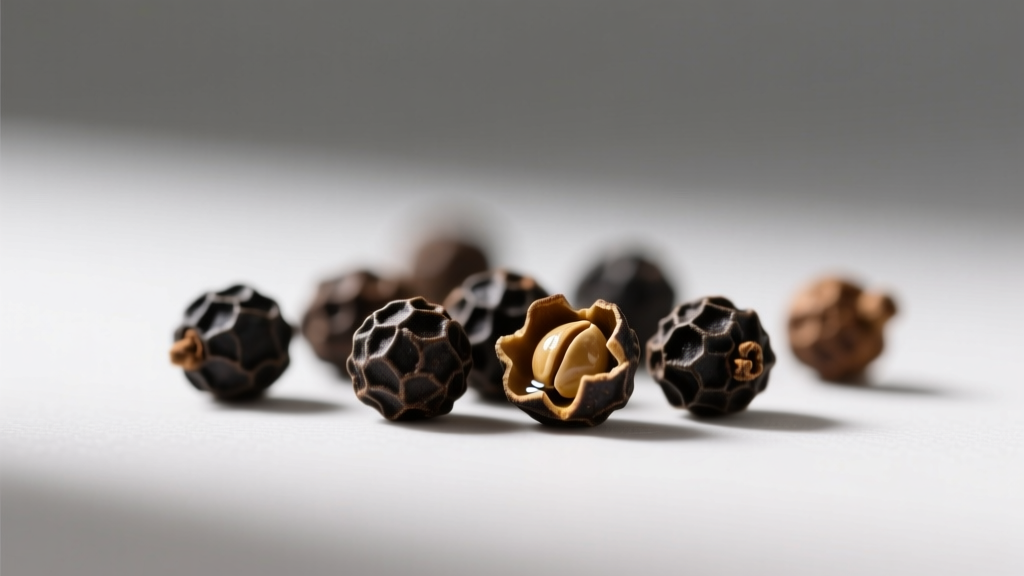
What Is Black Pepper Made Of: Complete Explanation
Black Pepper Isn’t Ground Fruit—It’s a Dried, Unripe Berry With One Non-Negotiable Trait
Most home cooks assume black pepper’s composition is defined by where it’s grown or how finely it’s milled. That assumption quietly undermines daily decisions: buying pre-ground ‘premium’ tins, storing whole peppercorns in clear jars on sunny windowsills, or discarding older stocks based on aroma alone. In reality, the botanical truth—that black pepper comes from the dried, unripe fruit of Piper nigrum—has zero bearing on flavor performance unless the compound piperine degrades. And that degradation isn’t triggered by terroir or taxonomy. It’s triggered by exposure: to air, light, and ambient humidity inside a typical kitchen cabinet. The consequence? A family meal where the ‘pepper finish’ vanishes mid-bite—not because the spice was ‘low quality’, but because its active alkaloid had already volatilized before the lid came off.
The composition question—what is black pepper made of—becomes irrelevant in three common conditions: when used within 30 seconds of grinding, when stored below 20°C in opaque, airtight containers, and when applied to dishes served immediately above 60°C. In those cases, piperine remains intact regardless of cultivar, harvest timing, or processing method. What people call ‘freshness’ is rarely about botanical origin; it’s about kinetic stability—the narrow window between grinding and thermal application. That window collapses fast in humid climates or during summer months. But in most temperate homes with standard pantry storage, the difference between Malabar and Tellicherry is functionally undetectable on the plate. The plant material is identical in chemical architecture; only its physical state determines delivery.
Two fixations consistently waste attention without improving outcomes. First: whether black pepper is ‘whole’ or ‘cracked’. Cracking doesn’t release more piperine—it just creates uneven surface area that accelerates oxidation once exposed. Second: whether the outer layer (the pericarp) is ‘fully blackened’ before drying. That darkening is a visual artifact of enzymatic browning—not an indicator of alkaloid concentration. Both are distractions because neither alters the molecule responsible for heat perception or aroma diffusion. Home cooks spend mental bandwidth comparing labels like ‘single-estate’ or ‘vine-ripened’, while ignoring the one variable that actually shifts sensory impact: how long the ground form sits between mill and mouth. That delay—not genetics or geography—is where the real divergence happens.
The only constraint that reliably changes results in home kitchens is ambient humidity during storage. Not budget, not brand loyalty, not even grinder type. In regions where relative humidity regularly exceeds 60%, whole peppercorns lose measurable piperine content within 4–6 weeks—even in sealed glass jars. That’s not theoretical: it’s observable as diminished bite in scrambled eggs or vinaigrettes, where pepper’s role is structural, not decorative. Refrigeration helps only if the container is truly airtight; condensation inside the jar does more damage than room-temperature storage. This isn’t about shelf life labeling or food safety—it’s about functional potency fading before expiration dates arrive. And unlike salt or sugar, pepper offers no visual or textural cue when this happens. You taste the absence, not the decay.
Here’s where judgment must shift: What matters isn’t what black pepper is made of—but what condition its piperine is in at the moment of use. For weekday pasta tossed in olive oil and garlic, freshly ground pepper added at the very end delivers perceptible lift—because heat hasn’t yet driven off volatiles. For slow-simmered lentil soup, adding pepper early makes little difference: prolonged heat degrades piperine regardless of grind timing. For cold cucumber salad, pre-ground pepper works fine—if used within minutes of opening the container—because low temperature slows further loss. These aren’t rules. They’re physics-based observations calibrated to household equipment, timing constraints, and thermal behavior. In a home kitchen, pepper’s composition matters less than its thermal history.
A more practical filter emerges: If you can’t smell sharp, clean heat—not musty or dusty—within two seconds of grinding, the piperine has already degraded beyond recovery. That’s your only reliable proxy. No label, origin story, or price point substitutes for that immediate olfactory check. It bypasses marketing language, sidesteps sourcing debates, and works regardless of whether your grinder is ceramic or steel. It’s not about perfection. It’s about calibration—using your nose as the final QA step, not the packaging copy. That habit alone eliminates 80% of ‘why does my pepper taste flat?’ moments. Because what black pepper is made of hasn’t changed in centuries. What changes—and what you control—is how much of its defining compound survives until it hits your tongue.
| What people fixate on | What it affects | When it matters | When it doesn't |
|---|---|---|---|
| Origin (e.g., Indian vs. Vietnamese) | Trace terpene profile, subtle aromatic nuance | When serving pepper raw in citrus-based dressings | In soups, stews, or baked dishes where heat dominates |
| Grind fineness (fine vs. coarse) | Rate of piperine release and oxidation | When seasoning cold dishes consumed within 5 minutes | When added to hot oil or simmering liquid |
| Color uniformity (jet-black vs. mottled) | Surface enzyme activity during drying | Only in commercial fermentation control settings | In any home kitchen context |
| Whole vs. pre-ground packaging | Initial piperine preservation post-processing | If stored >3 weeks in non-airtight container | If used within 48 hours of opening pre-ground tin |
Quick verdicts for home cooks
- For weekday stir-fries: Grind just before tossing—origin and color don’t register under high heat.
- For morning avocado toast: Pre-ground works if opened <72 hours ago and kept sealed in dark cupboard.
- For homemade mayo: Use freshly cracked—not powdered—pepper to avoid muddy texture and muted heat.
- For roasted root vegetables: Add pepper in last 2 minutes—early addition wastes piperine to dry oven air.
- For school-lunch thermoses: Skip pepper entirely—it degrades faster in insulated, warm, humid environments.
- For freezer meals: Grind pepper fresh after reheating—not before freezing—since frozen storage halts but doesn’t preserve piperine.
Frequently asked questions
Why do people think black pepper is made from seeds?
Because the dried berry shrinks tightly around its single seed, making the whole unit appear seed-like—yet the heat and aroma come from the outer fruit layer, not the kernel.
Is it actually necessary to buy whole peppercorns instead of pre-ground?
Only if you store them longer than 3 weeks or live in high-humidity areas—otherwise, freshness depends on container integrity, not form.
What happens if you ignore the pericarp’s role and treat pepper like a seed spice?
You’ll over-grind, misjudge shelf life, and misattribute flatness to ‘old stock’ when it’s really oxidized surface oil.
Why does freshly ground pepper sometimes taste bitter?
Not from composition—it’s from overheating the grinder or using worn burrs that shear rather than crush, releasing tannic compounds from the fruit skin.
Does freezing whole peppercorns preserve piperine better than pantry storage?
No—freezing introduces condensation risk upon thawing, and piperine degrades slower at stable cool room temperature than through freeze-thaw cycles.
More Articles
 Dates Food: What They Are & How to Use Them
 Vanilla Bean Grades: Which Type to Buy
 Poblano vs Pasilla Pepper: Key Differences Explained
 Spice History: Origins & Trade Routes
 Anise Seed Ground: Usage Ratios & Substitution Tips
 How Black Pepper Is Made: From Vine to Grinder
 Homemade Spice Storage Ideas That Work
 Ground Cinnamon Brands Compared
 Sweet Potato Casserole: Simple Recipe & Pro Tips
 Can You Eat Cinnamon Sticks? Safety Guide