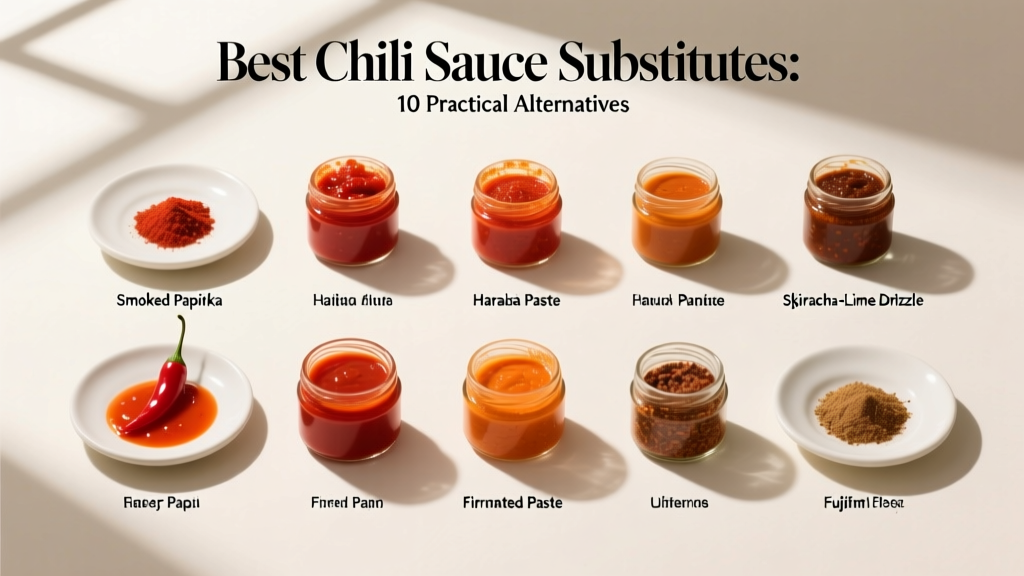
Best Chili Sauce Substitutes: 10 Practical Alternatives
Chili Sauce Substitutes Are Not a Flavor Swap — They’re a Context Switch
In many homes, the idea of a ‘chili sauce substitute’ comes from pantry panic: the bottle’s empty, takeout is delayed, and someone reaches for sriracha, gochujang, or even tomato paste with cayenne. That reflex isn’t wrong — it’s misframed. Chili sauce (U.S.-style, mild-sweet-vinegary, like Heinz or Frank’s RedHot *Chili Sauce*, not hot sauce) occupies a narrow functional niche: it adds tangy body, not heat; background sweetness, not fruitiness; and emulsified texture, not sharp acidity. When people treat it as a heat-delivery vehicle, they overlook its structural role — and end up with sauces that separate, dominate, or leave food tasting unbalanced. The consequence isn’t spiciness gone wrong — it’s cohesion gone missing. A stir-fry glaze thickens unevenly. A meatloaf binder dries out. A baked bean topping pools instead of clinging.
The core judgment is this: Chili sauce substitution only matters when the recipe relies on its viscosity and pH balance — not its capsaicin level. In dishes where it functions purely as a condiment (e.g., served alongside dumplings), almost any tangy-spicy liquid works. But in recipes where it’s folded into batter, simmered into a glaze, or blended into a marinade base, swapping without accounting for sugar-to-vinegar ratio and thickening behavior changes outcomes — often invisibly at first, then decisively in texture and mouthfeel. This distinction isn’t about authenticity or tradition. It’s about whether the sauce’s physical behavior under heat and dilution holds the dish together — or lets it fall apart.
Two common, ineffective fixations dominate home kitchens. First: ‘Is it spicy enough?’ — irrelevant, because U.S. chili sauce is rarely above 200–500 SHU, and heat is seldom the reason it’s called for. Second: ‘Does it look the same color?’ — misleading, since visual match (red-orange hue) has zero correlation with binding capacity or acid stability. Both distract from what actually determines success: how the substitute behaves when heated, diluted, or emulsified. A glossy red gochujang may look closer than yellow mustard, but its starch-thickened body breaks down differently under prolonged simmering — while mustard’s vinegar-forward profile can sharpen acidity beyond what the original formulation tolerates. Neither is ‘better’ — both are mismatched if judged by appearance or burn.
The real constraint isn’t flavor preference or regional availability. It’s refrigerator space and shelf-life friction. Most substitutes — gochujang, doubanjiang, sambal oelek — require refrigeration after opening and degrade noticeably within 3–4 weeks. In contrast, U.S. chili sauce stays stable for 6+ months unrefrigerated, and most households keep it in the pantry, not the fridge. So the ‘substitute’ you grab today may be unusable next week — not because it’s wrong, but because it won’t survive your storage reality. That mismatch between theoretical suitability and actual kitchen logistics is what derails more attempts than taste error ever does. You don’t fail because you chose wrong — you fail because you forgot your fridge is already full, and you won’t use that jar again before it dulls.
Here’s where intuition flips: In a quick weeknight stir-fry, using ketchup + vinegar + garlic powder works — not because it mimics chili sauce, but because the high-heat, short-cook context makes viscosity irrelevant. In slow-simmered baked beans, however, that same mix separates and leaves a sugary film on top. For meatloaf binder, tomato paste thins with water is functionally closer than sriracha — not due to spice level, but because its reduced water content and natural pectin resist drying during baking. And for dipping sauces meant to sit out for hours, a stabilized blend (like mayo-thinned gochujang) outperforms fresh chili-garlic paste — not for flavor, but for emulsion integrity. These aren’t compromises. They’re physics-based adaptations.
Stop asking ‘What tastes closest?’ Ask instead: ‘Does this hold up where I’m using it — physically, not just sensorially?’ That single question bypasses 80% of substitution anxiety. If the sauce will be boiled, stirred, or baked into something, prioritize viscosity retention and acid stability over heat or hue. If it’ll be dolloped cold or added at the last second, prioritize brightness and clean finish — not thickness. This isn’t about mastering global condiments. It’s about reading the thermal and mechanical demand of your own cooking moment — and matching material behavior, not marketing labels.
| What people fixate on | What it affects | When it matters | When it doesn't |
|---|---|---|---|
| Spice level (SHU or perceived burn) | Heat perception in final dish | When chili sauce is used as primary heat source (rare in U.S. recipes) | In 90% of home applications — glazes, binders, simmered bases — heat is secondary |
| Color match (red-orange tone) | Visual consistency in plated food | For commercial plating or photo documentation | In family meals, leftovers, or reheated dishes — no one notices hue shift |
| Brand loyalty (e.g., ‘only Heinz works’) | Consistency across batches | When replicating a specific published recipe exactly | In improvisational cooking — minor formula variations rarely alter outcome |
| Sugar content (grams per serving) | Caramelization speed and browning depth | In oven-baked applications where surface glaze sets | In stovetop sautés or cold dips — sugar load has negligible effect |
Quick verdicts for home cooks
- If you’re making meatloaf and only have sriracha: thin it with tomato paste — not water — to restore binding density.
- For baked beans simmering over 90 minutes: skip gochujang — its fermented starch breaks down and clouds the liquid.
- When whipping up a last-minute dipping sauce: mix ketchup with rice vinegar and smoked paprika — skip the chili flakes.
- If your household includes kids or low-heat eaters: use mild harissa diluted with olive oil — not hotter alternatives — to preserve sweetness without burn.
- For meal-prepped lunch bowls stored 3+ days: avoid fresh chile-garlic pastes — they oxidize and turn metallic faster than shelf-stable chili sauce.
- When substituting in a pan sauce reduced to syrup: choose tomato paste + apple cider vinegar over hot sauce — viscosity trumps heat every time.
Frequently asked questions
Why do people think chili sauce and hot sauce are interchangeable?
Because both are red, bottled, and labeled ‘chili’ — but hot sauce delivers volatile capsaicin and minimal body, while chili sauce delivers stabilized acidity and thickening power. Their roles in cooking are structurally opposed.
Is it actually necessary to match sugar-to-vinegar ratio when substituting?
Only when the sauce undergoes reduction or baking — otherwise, small imbalances correct themselves during eating. In simmered or baked applications, mismatched ratios cause separation or excessive sweetness.
What happens if you ignore viscosity and just chase flavor?
The dish may taste fine at first bite — then collapse texturally: glazes weep, binders crumble, marinades slide off instead of adhering.
Lately, grocery store shelf labels have started adding ‘chili sauce’ subheadings under ‘Asian condiments’ — grouping gochujang and sambal with U.S. chili sauce. That visual conflation reinforces the misconception. But the shift isn’t culinary — it’s logistical. Retailers are optimizing for aisle real estate, not cooking function. Home cooks noticing this alignment often assume equivalence. They don’t — and shouldn’t — pause to check ingredient lists. That’s the signal: when packaging starts blurring categories, the functional gap widens.
In a home kitchen, texture failure is rarely caused by poor seasoning — it’s caused by mismatched rheology. In most American households, chili sauce is used less for heat than for gloss, grip, and gentle tang. In a slow-cooked barbecue glaze, its pectin content helps cling; in meatloaf, its mild acidity tenderizes without curdling eggs. Its role is architectural — not aromatic. That’s why swapping based on Scoville charts or Instagram aesthetics misses the point entirely.
Over the past year, more home cooks report ‘weird separation’ in homemade versions — not bitterness or blandness, but physical instability: sauces splitting, glazes sliding off, marinades failing to coat. That’s not a flavor problem. It’s a material science mismatch. The fix isn’t better ingredients — it’s clearer functional framing.
Don’t ask ‘What’s the best substitute?’ Ask ‘What job is this sauce doing right now — and which alternative performs that exact mechanical task?’ That’s the only filter that prevents silent failure.
More Articles
 Poblano vs Pasilla Pepper: Key Differences Explained
 3 Cloves of Garlic = How Many Teaspoons? Exact Conversion Chart
 Oven Roast Cauliflower: Simple Steps for Crispy Results
 Cheesy Chicken Potato Casserole: Simple Recipe & Pro Tips
 How to Make Tea from Cloves: Simple Recipe & Benefits
 How to Store Turmeric Root: 3 Best Methods for Freshness
 Frozen Tomatoes Perfect Tomato Soup Recipes
 Thyme vs Rosemary: Best Herb for Cooking Steak
Sumac Spice: A Complete Overview
Thyme vs Rosemary: Best Herb for Cooking Steak
Sumac Spice: A Complete Overview
 Indian Spice FAQ: Practical Answers