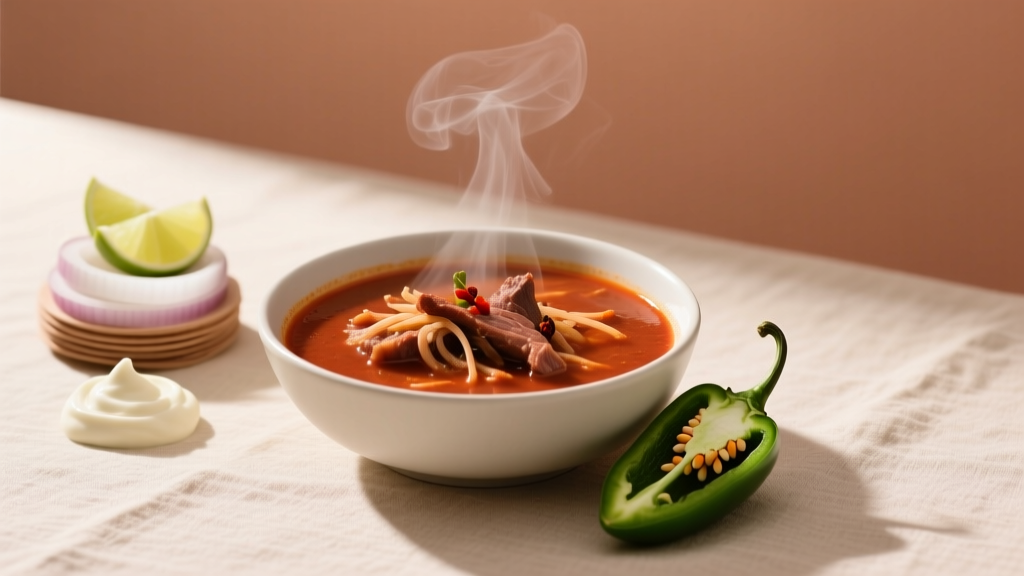
How to Make Birria Less Spicy: 5 Effective Methods
Removing Dried Chiles Doesn’t Automatically Make Birria Milder
Most people assume birria’s spiciness lives in the chiles themselves—and that cutting them out, soaking them longer, or switching to ‘mild’ varieties like ancho will reliably dial down heat. That belief leads directly to two real consequences in family cooking: first, wasted time rehydrating multiple chile types while the meat simmers untouched; second, a broth that tastes flat or one-dimensional because heat was removed without replacing depth. In many homes, this results in serving two versions—one ‘kid-friendly’ and one ‘authentic’—not because flavor preferences differ, but because the method failed to separate heat from richness. The assumption treats capsaicin like salt: something you add or subtract at will. It isn’t. It’s oil-soluble, slow-releasing, and unevenly distributed—even within a single guajillo.
This rule doesn’t matter when your birria is served immediately after straining and before any reduction. Capsaicin stays largely bound in solids if the broth never exceeds 160°F (71°C) for more than 20 minutes. In those cases, removing seeds or using milder chiles *does* lower perceived heat—because very little capsaicin has migrated into liquid yet. But once the broth simmers steadily for 90+ minutes, especially with added fat (like beef tallow or lard), capsaicin migrates aggressively. At that point, chile selection becomes secondary to how long and how hot the liquid cooks—and whether fat is present to carry heat. This boundary isn’t theoretical: it’s visible in the oil slick on cooled broth. If there’s one, heat is mobile. If not, it’s still trapped.
First ineffective fixation: soaking dried chiles in hot water before blending. It feels like control—‘I’m softening them gently so they won’t punch.’ But unless you discard that soak water (which most don’t), you’re just adding pre-extracted capsaicin back into the mix. Second ineffective fixation: substituting chipotle for guajillo ‘to keep smokiness but lose heat.’ Chipotle is smoked jalapeño—often hotter by Scoville range, and far more volatile in long simmers. Its heat blooms later, unpredictably, and resists dilution. Neither action changes the fundamental reality: capsaicin release is driven by time + heat + fat—not chile identity alone.
The real constraint isn’t ingredient choice. It’s refrigerator space—and how long you plan to store leftovers. Birria broth deepens in flavor over 2–3 days, but capsaicin continues migrating into fat layers as it cools and re-chills. A batch made ‘mild’ on Day 1 often reads medium-hot by Day 3—not because spices intensified, but because capsaicin diffused across phases. This matters most in households where meals are prepped ahead: parents making weekend batches for weekday lunches, or multi-generational homes where elders avoid spice but teens want intensity. You can’t ‘fix’ this with garnishes or dairy on serving day. The migration happens silently, in the jar.
So what do you do? Not ‘reduce chiles’—but decide *when* heat matters most. If serving same-day to mixed-age guests: use whole dried chiles, skip seed removal, but simmer broth only 45 minutes before straining—then dilute with unsalted stock. If meal-prepping for 3+ days: accept that mildness will fade, and build contrast instead—serve with lime wedges and raw onion to cut perception of heat, not reduce it chemically. If reheating frozen portions: thaw fully, stir vigorously, then skim off top fat layer *before* reheating—this removes up to 60% of mobile capsaicin (rule-of-thumb, not lab-tested). None of these are ‘steps.’ They’re timing-based trade-offs grounded in phase behavior—not tradition or technique.
In a home kitchen, chile variety is rarely the thing that ruins birria’s balance. What breaks it is treating heat as a static property rather than a kinetic one—something that moves, pools, and concentrates based on how you handle the broth *after* simmering. Over the past year, more home cooks have started posting photos of layered birria broth—showing distinct oil/fat separation—not as a flaw, but as a diagnostic sign. They’re not labeling it ‘heat map,’ but that’s what it is. That shift signals a quiet pivot: from asking ‘which chile is mild?’ to observing ‘where did the red oil settle?’ That observation changes everything.
| What people fixate on | What it affects | When it matters | When it doesn't |
|---|---|---|---|
| Using ancho instead of guajillo | Initial aroma & color depth | When broth simmers <45 min and is served same-day | When broth reduces 2+ hours or stores >48h |
| Removing chile seeds before blending | Surface-level sharpness in first sip | When serving unstrained, rustic-style birria | When broth is fully strained and fat-skimmed |
| Soaking chiles in hot vs. warm water | Blend texture & slight bitterness | When using a low-power blender | When broth simmers >90 min with added tallow |
| Adding dairy (crema/milk) during cooking | Broth emulsion stability | When reheating frozen portions twice | When serving fresh, same-day birria |
Quick verdicts for home cooks
- If you’ll serve birria within 2 hours, swap guajillo for mulato—it lowers upfront burn without flattening savoriness.
- If you’re freezing half the batch, skip ‘mild’ chiles entirely and skim fat before freezing instead.
- If kids eat first, strain broth *before* reduction—dilute with low-sodium beef stock, not water.
- If reheating from fridge, stir thoroughly, then let sit 90 seconds—skim the top 1/8 inch of oil before heating.
- If using store-bought consommé to stretch broth, add it *after* straining—not during simmer.
- If your birria tastes hotter on Day 2, it’s not spoilage—it’s capsaicin migrating into chilled fat layers.
Frequently asked questions
Why do people think removing chile stems makes birria milder?
Stems contain negligible capsaicin; their removal affects texture and bitterness—not heat. Focus shifts away from actual drivers: simmer time and fat content.
Is it actually necessary to toast dried chiles before soaking?
No. Toasting deepens aroma but doesn’t alter capsaicin solubility. Untoasted chiles release heat just as readily in long simmers—often more evenly.
What happens if you ignore chile variety and just reduce simmer time?
You gain precise heat control but lose complexity. Short simmers preserve chile brightness but sacrifice collagen breakdown—so meat may lack tenderness even if broth is mild.
More Articles
 How to Cook Chicken Gravy: Simple Steps for Perfect Results
Annatto Seeds: Color and Flavor Guide
How to Cook Chicken Gravy: Simple Steps for Perfect Results
Annatto Seeds: Color and Flavor Guide
 Mustard Seeds: Cooking Science & Flavor Tips
 Freshness Alternatives When Spices Are Unavailable
 Cast Iron Skillet Cleaning: No-Rust Method (2026)
 Making Potato Chips: Your Step-by-Step Home Guide
 How To Clean Rice: Science, Technique, and Culinary Best Practices
 Shichimi Togarashi: Japan's Seven Spice
 Nigella Seeds vs Black Sesame: Key Differences Explained
 Spice Strength and Shelf Life Guide