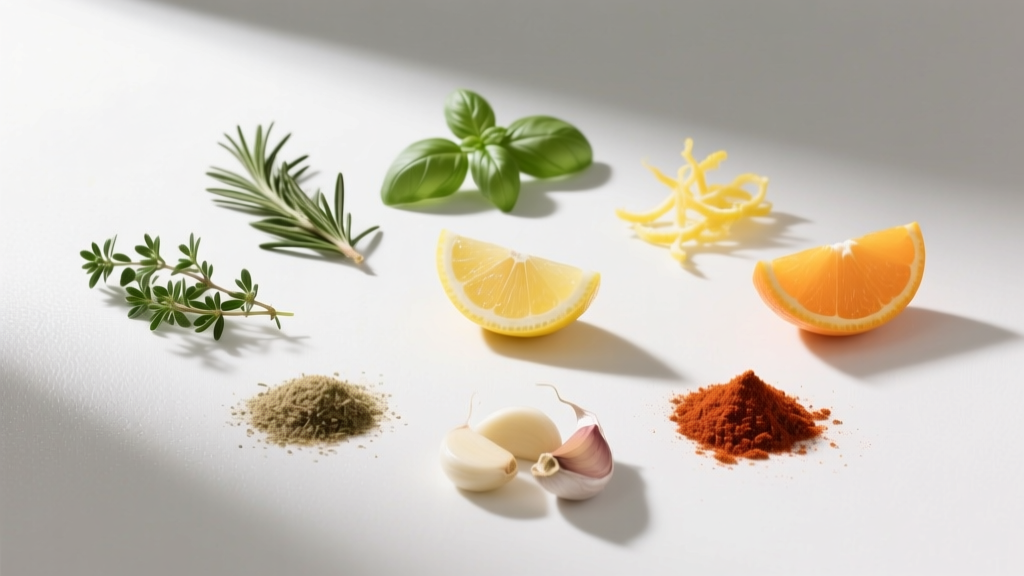
Best Accent Seasoning Substitutes: 7 Natural Alternatives
Accent seasoning substitutes don’t need to match — they need to resolve
People assume accent seasoning substitutes must replicate the original’s flavor profile because cooking shows, recipe blogs, and ingredient labels all reinforce ‘authenticity’ as a default virtue. But in actual home kitchens — where dinner is made after work, with two kids arguing over broccoli and the pantry half-empty — that assumption creates real friction: wasted time comparing paprika grades, second-guessing whether smoked salt counts as ‘smoky enough’, or discarding a perfectly usable spice because its label says ‘Hungarian’ instead of ‘Spanish’. The consequence isn’t ruined food — it’s delayed meals, unused jars gathering dust, and quiet resignation toward blandness. That resignation becomes habitual: if you’ve ever skipped adding a finishing touch because ‘nothing here matches’, you’ve already let fidelity override function.
The core judgment — that matching isn’t required — only collapses under one condition: when the accent is structurally non-negotiable to the dish’s identity. This happens rarely in home cooking. It applies to dishes like Thai nam prik (where dried shrimp paste anchors the entire balance) or Mexican mole negro (where ancho and mulato chiles provide irreplaceable depth). But for 90% of weekday uses — a pinch of something bright on roasted carrots, a dusting over grilled fish, a stir into yogurt dip — the substitute doesn’t need to echo; it needs to interrupt monotony. In those cases, fidelity is irrelevant. What matters is whether the substitute introduces contrast, lifts fat, or cuts richness — not whether it smells like the original.
Two ‘invalid’ fixations dominate home decisions: first, the belief that ‘smoked’ must mean ‘wood-smoked over oak chips’, ignoring that many supermarket smoked paprikas are cold-smoked over unspecified woods or even flavored with liquid smoke — yet still deliver the functional cue (earthy, low-sweetness, umami lift) needed in lentil soup. Second, the insistence that ‘umami’ requires MSG or fermented soy, overlooking that nutritional yeast, sun-dried tomatoes, or even toasted sesame oil can trigger the same mouth-coating sensation in a salad dressing — without requiring fermentation knowledge or shelf-stable storage conditions. Neither fixation changes the outcome at the table. Both distract from what actually moves the needle: whether the bite tastes more alive than before.
A real constraint — not theoretical, not aesthetic — is pantry turnover rate. In most homes, accent seasonings sit unused for 8–12 months. That means oxidation, volatile loss, and diminished aromatic impact — especially in ground spices, citrus zests, and dried herbs. A ‘perfect’ substitute bought last winter may now be inert, while a less-ideal but fresher option (e.g., lemon thyme instead of fresh dill) delivers stronger effect. This isn’t about preference — it’s about physics. You cannot compensate for stale aroma with precision sourcing. No amount of ‘correct’ substitution fixes volatility decay. And unlike salt or sugar, accent seasonings lack clear visual or textural cues for degradation. You won’t notice until the dish feels flat — and then blame the choice, not the shelf life.
Contrary to expectation, recent shifts aren’t driven by new ingredients or global access. Lately, home cooks are quietly abandoning ‘match-first’ logic not because they’ve discovered better alternatives, but because they’re noticing how often the ‘wrong’ substitute — a splash of fish sauce in vegetarian ramen broth, a grating of aged Gouda over lentil stew — produces more consistent satisfaction than the ‘right’ one. There’s no fanfare, no social proof. Just repeated small wins: faster decisions, fewer leftovers, fewer ‘meh’ bites. The signal isn’t louder — it’s quieter, more frequent, and unshared.
In practice, resolution depends entirely on context — not chemistry. For a quick weeknight stir-fry, go for contrast: use tamarind paste instead of rice vinegar if you need sourness with body, not just acidity. For a slow-simmered bean pot, prioritize persistence: choose toasted cumin seeds over ground cumin — they hold up longer in heat and release flavor gradually, avoiding the bitter edge ground versions develop after 45 minutes. For a raw garnish on avocado toast, favor volatility: fresh lime zest beats bottled lime juice every time, because its oils hit the nose before the tongue — a critical advantage when serving cold, fatty food. None of these choices are ‘better’ universally. Each resolves a specific tension: speed vs. depth, heat stability vs. brightness, fat saturation vs. aromatic lift.
| What people fixate on | What it affects | When it matters | When it doesn't |
|---|---|---|---|
| Exact regional origin (e.g., Aleppo vs. Marash pepper) | Subtle fruitiness, heat curve | In a finished sauce served immediately, where texture and temperature amplify nuance | In roasted vegetable tosses or grain bowls eaten at room temperature |
| Smoking method (hot vs. cold) | Intensity, bitterness risk | In dry-rubbed meats cooked low-and-slow for >3 hours | In soups, stews, or dips where liquid dilutes and fat buffers |
| Grind size (whole vs. flaked vs. powdered) | Release speed, mouthfeel | In finishing applications (e.g., flaky sea salt on chocolate tart) | In blended dressings or marinades where uniform dispersion matters more than texture |
| Fermentation duration (e.g., 6-month vs. 12-month fish sauce) | Complexity, salt-forwardness | In minimalist preparations like dipping sauce for spring rolls | In tomato-based sauces or curries where other strong flavors dominate |
Quick verdicts for home cooks
- If your main goal is cutting through richness, a squeeze of yuzu kosho works better than mirin — even though neither is ‘traditional’ for the dish.
- When reheating leftovers, skip the ‘authentic’ finishing herb and use whatever fresh green has the strongest aroma today — basil, parsley, or even cilantro stems.
- For creamy dips, swap smoked paprika for chipotle powder only if you want heat + smoke; otherwise, use sweet paprika + a drop of liquid smoke — the effect is functionally identical.
- If your household includes someone with histamine sensitivity, avoid fermented substitutes (like miso or fish sauce) even if they ‘match’ — freshness trumps fidelity when health is involved.
- When time is under 15 minutes, prioritize shelf-stable options with high aromatic volatility — lemon zest, toasted sesame oil, or crushed Sichuan peppercorns — not ‘closer’ but slower-releasing ones.
- If you’re using the substitute more than once a month, choose the version with longest realistic shelf life — not the most ‘accurate’ one — because staleness ruins more meals than mismatch.
Frequently asked questions
Why do people think accent seasoning substitutes must taste identical to the original?
Because flavor descriptions — ‘bright’, ‘earthy’, ‘floral’ — are taught as fixed traits, not situational effects. In practice, ‘bright’ means different things on hot tofu versus cold cucumber salad.
Is it actually necessary to source region-specific versions for home use?
No — unless the dish relies on that region’s terroir-driven nuance (e.g., Pimentón de la Vera in authentic chorizo). Most home applications use accent seasonings for contrast, not provenance.
What happens if you ignore the ‘recommended’ substitute and use something cheaper or older?
You’ll often get better results — if the older item is still aromatic, and the cheaper one delivers stronger volatility. Cost and age correlate poorly with functional impact in home settings.
More Articles
 Allspice vs Mixed Spice: Why They're Not the Same Thing
 Mace vs Nutmeg: Same Seed, Different Spice
 Turmeric vs Curry Powder: What's the Actual Difference?
 How to Repair Five Spice: A Practical Culinary Guide
 Cumin vs Coriander: Differences & Pairings
 How to Make Pumpkin Seeds: Simple Roasting Guide
 Ancho vs Guajillo vs Chipotle: Chile Guide
Fenugreek: Seeds vs Leaves Differences
Ancho vs Guajillo vs Chipotle: Chile Guide
Fenugreek: Seeds vs Leaves Differences
 Best Cooking With Spices for Science: Evidence-Based Flavor, Function, and Precision
 McCormick Cinnamon: Cassia vs Ceylon (2026)