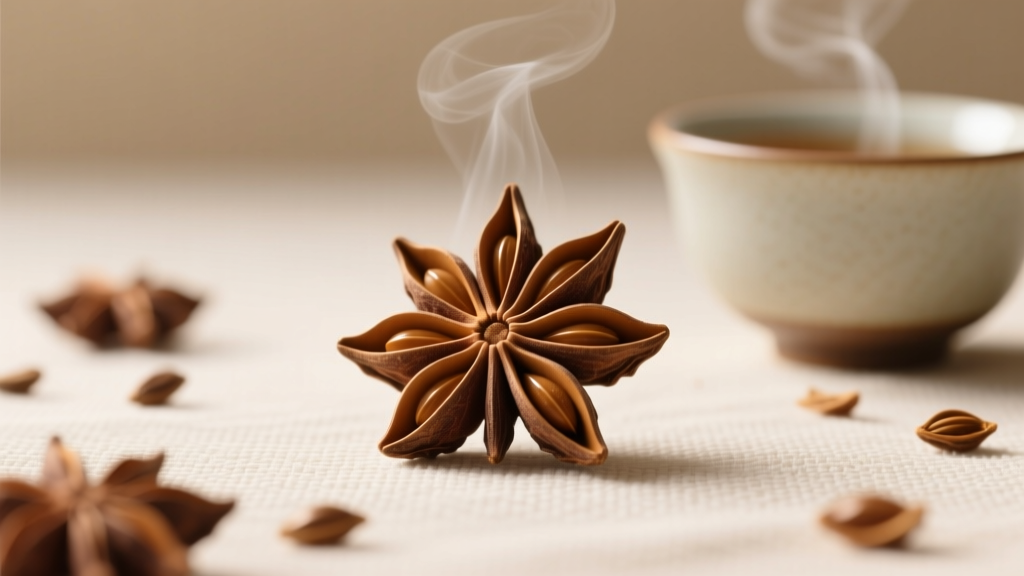
Star Anise: Spice Basics & Uses (2026)
Star Anise Is Not a Substitute—It’s a Threshold Ingredient
Most people treat star anise as interchangeable with other warm spices—especially anise seed or fennel—because they share a licorice note. That assumption collapses the moment it hits simmering liquid. Unlike ground anise seed, which diffuses quickly and fades, whole star anise pods release compounds slowly, unevenly, and only under sustained moist heat. In a rushed weeknight braise, that delay means no flavor integration; in a slow-simmered broth left unattended, it means bitter, medicinal overextraction. The consequence isn’t subtle: family members push bowls away, leftovers go uneaten, and the spice jar gathers dust—not because it’s disliked, but because its behavior defies expectation. This isn’t about preference. It’s about timing mismatch disguised as taste mismatch.
Star anise doesn’t need to be ‘used correctly’—it needs to be recognized as threshold-sensitive. Below a certain heat-and-time threshold, it contributes almost nothing. Above it, it dominates. That threshold isn’t fixed: it shifts with pot material (thin stainless vs. heavy enameled cast iron), liquid volume (a quart vs. two cups), and even ambient humidity (drier air accelerates volatile loss pre-cooking). So the question isn’t ‘how much?’ but ‘under what thermal conditions does this pod cross from inert to active?’ In many homes, that crossing point falls outside typical cooking windows—meaning the spice often sits unused not from disinterest, but from repeated failure to activate it reliably.
Two common fixations waste mental bandwidth. First: ‘Should I crush the pods?’ Crushing increases surface area—but unless you’re steeping in cold liquid for hours (rare in home cooking), it just invites bitterness without boosting usable aroma. Second: ‘Do I remove them before serving?’ Removal matters only if texture is a concern—but the real risk isn’t grittiness; it’s pulling them too early and losing depth, or leaving them too long and gaining off-notes. Neither decision changes the core issue: activation timing. These aren’t technique errors. They’re distractions from the actual variable—the thermal envelope—that determines whether star anise functions at all.
The single reality constraint that overrides all others is storage stability in non-climate-controlled environments. Star anise loses volatile oils faster than clove or cinnamon, especially when exposed to light and fluctuating room temperature—common in most pantry cabinets. A jar left near a stove or window may retain only half its aromatic impact after six months, even if sealed. This isn’t theoretical: it means the same measured amount behaves differently across seasons. You don’t taste inconsistency because you misjudged dosage—you taste it because last winter’s jar was potent, and this summer’s is muted. No label date, no batch code, no visual cue tells you this. You just get unpredictable results, then blame the recipe.
Here’s where intuition fails—and why judgment replaces measurement. In a quick stir-fry with raw meat, star anise adds little beyond background sharpness; its compounds don’t have time to migrate. In a bone-in pork shoulder braise cooked 2.5–3.5 hours, it becomes structural—removing it mid-cook creates a noticeable flavor drop-off, not just a subtle shift. And in a vegetarian tomato-based stew? Its presence can clash unless acidity is tightly balanced—yet many assume ‘umami depth’ applies universally. These aren’t preferences. They’re chemical thresholds made visible through outcome: cohesion versus fragmentation, resonance versus dissonance.
Forget ‘how to use star anise.’ Ask instead: ‘Does my current method sustain the thermal window it requires?’ If your stovetop simmers at a true low (not a gentle bubble), and your pot holds heat evenly, and your cook time exceeds 45 minutes in liquid, then star anise works predictably. If any one condition fails—especially time—its role shrinks to negligible or disruptive. That’s not a flaw in the spice. It’s a mismatch between domestic equipment constraints and botanical chemistry. Most home cooks don’t lack knowledge. They lack feedback loops: no lab, no calibrated thermometer, no side-by-side tasting. So they default to avoidance—or overuse as compensation.
| What people fixate on | What it affects | When it matters | When it doesn't |
|---|---|---|---|
| Number of whole pods used | Overall intensity | In broths simmered >90 min with bones | In 20-min sauces or dry rubs |
| Whether pods are cracked or whole | Bitterness onset speed | In slow-cooked braises with high collagen content | In quick-steeped tea or short marinades |
| Removal before serving | Mouthfeel & lingering aftertaste | In dishes served hot with delicate textures (e.g., silken tofu) | In shredded-meat applications or grain bowls |
| Brand or origin (Chinese vs. Vietnamese) | Top-note brightness vs. woody depth | In clear, reduced stocks where nuance is tasted solo | In layered spice blends or heavily spiced stews |
Quick verdicts for home cooks
- If your soup simmers less than 40 minutes, skip star anise—it won’t integrate meaningfully.
- For weeknight chicken stir-fry, use toasted fennel seed instead; star anise needs time you won’t give it.
- When doubling a braising recipe, don’t double the pods—add only one extra, then taste at 60 minutes.
- If your pantry gets warm near the stove, replace star anise every 8 months regardless of ‘best by’ date.
- In vegetarian stews, pair star anise only with roasted tomatoes or dried mushrooms—not raw carrots or zucchini.
- When kids reject a dish you seasoned with star anise, don’t adjust salt—check simmer duration first.
Frequently asked questions
Why do people think star anise works like anise seed?
Because both smell like licorice—but anise seed dissolves fast in heat while star anise releases in stages, demanding sustained contact with liquid and time.
Is it actually necessary to toast star anise before using it?
No—toasting helps only in dry applications like spice blends; in wet cooking, moisture and heat do the work more effectively than dry heat ever could.
What happens if you ignore the simmer time requirement?
You’ll get either no perceptible flavor or a sharp, medicinal bitterness—neither reflects the spice’s intended role in balance.
More Articles
 Five Spice Powder: Ingredients and Uses
 How to Use a Pressure Cooker: Safe Step-by-Step Guide
 Cardamom vs Cloves: Key Differences, Uses & Substitutions
 Fried Cabbage and Bacon with Onion: Simple Skillet Guide
 Honey Garlic Pork: Reliable Recipe & Pro Tips
 Sweet Potato Recipe Guide: Foolproof Baking and Cooking Tips
 Red Onion Chutney: Homemade Guide and Pairings
 Sumac: The Tangy Berry You Should Try
 Best Chili Sauce Substitutes: 10 Practical Alternatives
 Sesame Tahini: Uses, Quality Tips, and Common Mistakes