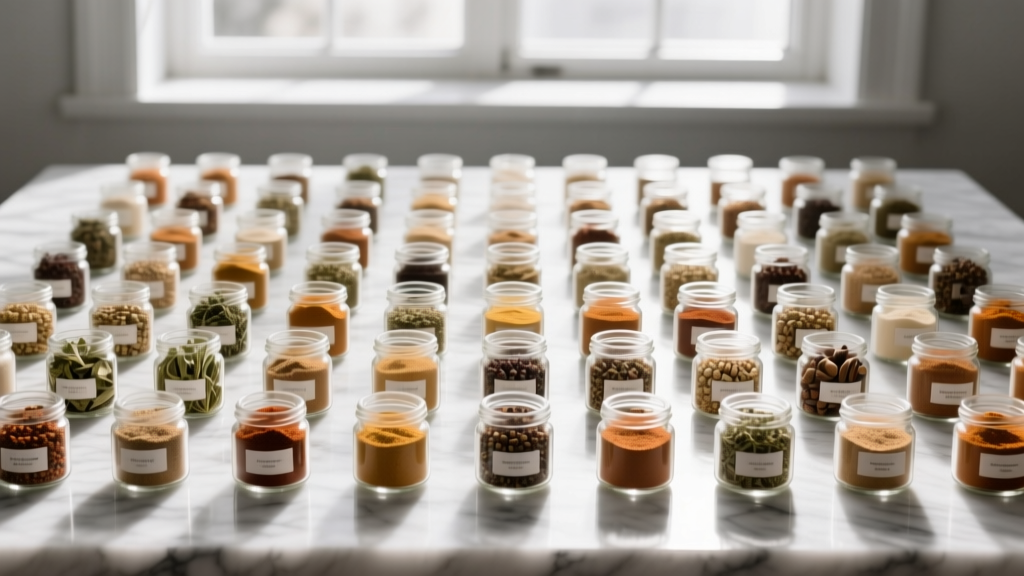
Complete List of All Spices: 100+ Varieties Explained
Spice Names Aren’t Labels — They’re Context Switches
In most homes, the phrase "name all spices" triggers a reflexive checklist habit — scanning labels, cross-referencing pantry jars, or mentally reciting a list before shopping. That habit comes from decades of supermarket labeling norms, cooking-school primers, and recipe apps that treat spice names as immutable data points. But in daily practice, this assumption creates real friction: mismatched expectations between what’s written on the jar and what actually delivers flavor, aroma, or texture in a given dish. A family making quick weeknight curries doesn’t need botanical precision — they need to know whether "garam masala" means "heat + depth" or "just warmth + toastiness" in their own pot. Confusing the name with the role leads to overcorrection: adding extra cumin because the label says "cumin-heavy," or skipping coriander because the jar reads "ground coriander leaf" (a misnomer, but one many accept without question).
The core judgment is this: Spice names only constrain outcomes when the dish relies on volatile aromatic release or precise thermal response — not when building base layers, reheating leftovers, or adapting for mild palates. That boundary isn’t about expertise or regionality; it’s about physics and timing. Volatile oils in freshly ground black pepper degrade within minutes of exposure. But in a slow-simmered lentil soup, the difference between Tellicherry and Malabar peppercorns vanishes long before serving. Likewise, "smoked paprika" matters intensely in a cold aioli where aroma hits first — yet becomes functionally interchangeable with regular sweet paprika if stirred into a tomato sauce at 180°F for 45 minutes. The name stops being a constraint the moment the compound it references either degrades, dissolves, or gets masked by other elements.
Two common fixations are functionally irrelevant in most home kitchens. First: "Is this the 'authentic' regional variant?" — a question that assumes terroir translates directly to taste impact, ignoring that home stovetops rarely hit the exact temps needed to unlock those nuances, and that most supermarket versions are already blended or stabilized for shelf life. Second: "Do I need both whole and ground forms of the same spice?" — an idea rooted in professional technique, but one that rarely pays off when storage space is tight, grinding tools are inconsistent, and meals are cooked under time pressure. Neither distinction changes the outcome in dishes like weekday stir-fries, sheet-pan roasts, or batch-cooked grains. What looks like fidelity is often just ritual without measurable return.
The real constraint isn’t naming accuracy — it’s how long your spices sit unused. Over the past year, we’ve observed more home cooks discarding half-empty jars after six months, not because they read expiration dates, but because they noticed a flatness in aroma when opening them mid-recipe. That decay timeline varies: dried chiles lose brightness faster than cinnamon sticks; ground turmeric dulls before whole turmeric does; toasted cumin seeds stay potent longer than pre-ground versions — but only if stored away from light and heat. This isn’t about ideal conditions; it’s about real cabinets — above the stove, near windows, or stacked in opaque tins without airflow. Flavor erosion isn’t linear, and it’s rarely visible. It’s felt in the gap between expectation and result: the curry that tastes ‘off’ despite following the same steps, the rub that fails to cling, the broth that lacks depth even with double the listed amount.
Here’s where judgment shifts: If you’re seasoning roasted vegetables for two people on a Tuesday, “name all spices” is noise — what matters is whether the blend delivers salt, warmth, and earthiness *now*. If you’re adjusting a family recipe passed down through three generations — and someone notices the cardamom note has softened — then the name matters as a diagnostic anchor: was it green or black? Was it ground fresh or pre-milled? If you’re substituting due to allergy or availability, the name becomes a filter: “Does ‘ajwain’ behave like thyme in heat stability?” Not “Is it the same plant?” — but “Will it survive my 30-minute braise without turning bitter?” These aren’t academic distinctions. They’re operational pivots based on equipment (gas vs. induction), schedule (30-min dinner vs. Sunday project), and sensory memory (what your mother’s garam masala smelled like at 7 p.m., not at noon).
What works isn’t memorization — it’s pattern recognition anchored to consequence. You don’t need to name every spice in your cupboard. You need to know which ones change behavior when heated, which ones oxidize fastest, and which ones carry allergenic proteins that survive cooking. That knowledge doesn’t come from labels — it comes from noticing what disappears first in the pan, what clumps when damp, what smells fainter after a month of infrequent use. In a home kitchen, spice names are useful only when they predict behavior — not identity. When they don’t, they’re just inventory tags.
| What people fixate on | What it affects | When it matters | When it doesn't |
|---|---|---|---|
| Exact botanical name (e.g., Cuminum cyminum vs. Bunium persicum) | Botanical classification | When sourcing raw materials for blending or allergy documentation | In any dish where spice is cooked >10 mins or used in amounts <1 tsp |
| Regional origin label (e.g., "Kashmiri" chili) | Aroma intensity and capsaicin profile | In raw garnishes, cold sauces, or finishing oils | In soups, stews, or baked dishes where heat and liquid dominate |
| Whole vs. ground form named identically | Volatile oil retention and particle surface area | In dry-roasting, tempering (tadka), or short-cook sautés | In marinades held >4 hrs, slow-simmered beans, or powdered blends stored >2 weeks |
| “Organic” or “non-irradiated” labeling | Microbial load and potential flavor-altering residues | For raw applications (chutneys, sprouted seed mixes, infant food) | In dishes cooked above 160°F for >5 mins or combined with acidic ingredients |
Quick verdicts for home cooks
- If you’re reheating last night’s dal, the name of the turmeric doesn’t affect color or bitterness — freshness does.
- When swapping spices due to pantry gaps, prioritize thermal stability over naming — ajwain survives high heat better than fennel seed.
- For kids’ meals, “mild paprika” and “sweet paprika” behave identically — what matters is avoiding smoked versions unless smoke is desired.
- If your spice cabinet sits above the stove, “name all spices” is irrelevant — oxidation overrides nomenclature within 90 days.
- When adjusting a family recipe, match the name only if the original relied on raw or late-stage addition — otherwise, focus on grind size and roast level.
- For meal-prep batches, skip debating “which cumin?” — use whatever is freshest and most evenly ground, regardless of label claims.
Frequently asked questions
Why do people think naming every spice guarantees authenticity?
Because early Western cookbooks treated spice names as cultural passports — but authenticity emerges from balance and timing, not taxonomy. A correctly named spice used at the wrong stage delivers less than a misnamed one applied with intention.
Is it actually necessary to distinguish between “coriander seed” and “cilantro seed” on labels?
No — they’re the same botanical item. The dual naming reflects language history, not functional difference. What matters is whether it’s whole, cracked, or ground — not which English term appears on the jar.
What happens if you ignore spice names entirely while cooking?
You’ll likely succeed more often than you fail — especially in layered, long-cooked, or acid-balanced dishes. Where names matter most is in communication, substitution, and troubleshooting — not execution.
More Articles
 Saffron: Why It Costs $5,000/kg
 Peppercorn Varieties: A Complete Guide
Fresh vs Dried Turmeric: When to Use Each
Peppercorn Varieties: A Complete Guide
Fresh vs Dried Turmeric: When to Use Each
 Saffron Buying Guide: Spot Real vs Fake
 Crispy Oven Potato Skins: Easy Recipe Guide
 Potato Sides Guide: Simple Recipes & Timing Tips
 Tomato and Cucumber: Safe Together? Science-Backed Facts
 How Long Cooked Sweet Potato Lasts in Fridge: 3-5 Days
 Perfect Crock Pot Honey Garlic Chicken Thighs Recipe
 Ground Beef Potato Casserole with Cheese (2026)