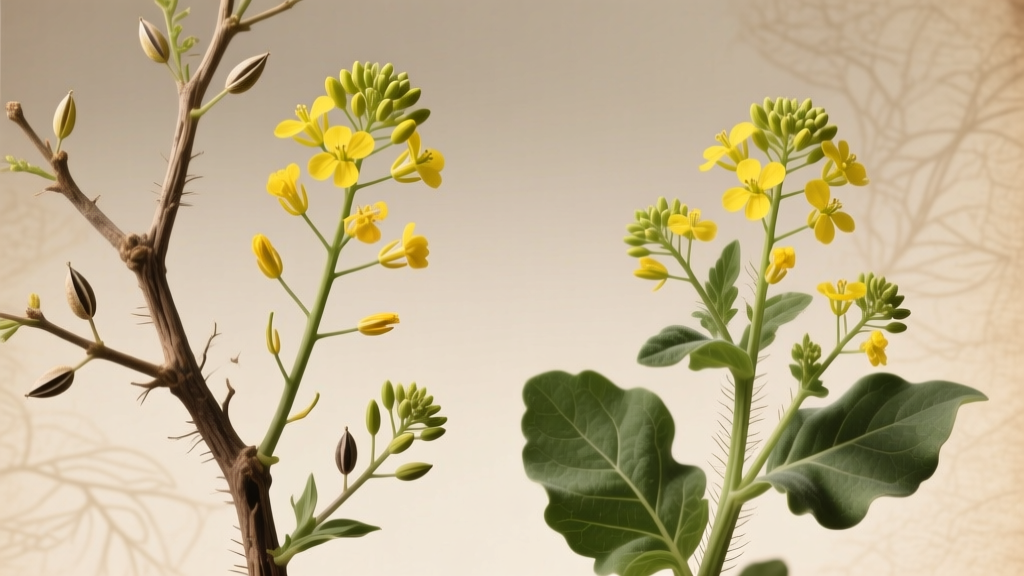
Mustard Tree vs Mustard Plant: The Botanical Truth
Why the \"Mustard Tree\" Confusion Exists
Many encounter \"mustard tree\" through religious texts or historical gardening accounts, creating persistent myths. In ancient Palestine, black mustard (Brassica nigra) grew exceptionally tall—up to 10 feet—dwarfing other garden plants. This \"tree-like\" stature relative to its tiny seed (1-2mm) led to metaphorical descriptions in Jewish agrarian contexts. Modern botany, however, classifies it strictly as an herb due to its soft, non-woody stems and annual lifecycle. The Biblical Archaeology Society clarifies this was intentional hyperbole for teaching, not botanical classification.
Botanical Reality: Mustard Plant vs. Tree Characteristics
| Characteristic | Mustard Plant (Brassica nigra) | True Tree |
|---|---|---|
| Height | 6-10 feet (annual growth) | Typically 15+ feet (perennial) |
| Stem Structure | Soft, green, herbaceous (non-woody) | Woody, lignified tissue |
| Lifespan | Annual (dies after seeding) | Perennial (lives years/decades) |
| Growth Cycle | Completes in 1 season | Multi-year maturation |
| Botanical Family | Brassicaceae (cabbage family) | Varies (e.g., Rosaceae, Fabaceae) |
This distinction is critical for gardeners: Brassica nigra won\'t develop woody trunks or survive winters like trees. The USDA Plants Database explicitly lists it as \"an annual herb\" with \"erect, branched stems,\" confirming its non-arboreal nature.
When to Use Each Term: Practical Guidance
Understanding context prevents errors in gardening, cooking, or theological discussion:
✅ Correct Applications
- \"Mustard plant\" for gardening/cooking: When planting seeds, harvesting greens, or sourcing mustard seeds. Black mustard (B. nigra) yields pungent seeds for condiments.
- \"Mustard tree\" only in historical/religious contexts: When analyzing biblical parables (e.g., \"kingdom of heaven is like a mustard seed...\"), always clarifying it refers to the herb\'s relative size.
🚫 Critical Avoidances
- Avoid \"mustard tree\" in horticulture: No nursery sells \"mustard trees\"—seeds labeled as such are scams. The Missouri Botanical Garden warns such claims exploit biblical confusion.
- Never expect perennial growth: Mustard plants die after seeding; they won\'t regrow like fruit trees.
Debunking 3 Common Misconceptions
Misconception 1: \"Mustard plants become trees in warm climates.\"
Fact: Even in tropical zones, Brassica species remain herbaceous annuals. The Biblical Archaeology Society confirms no mustard variety develops woody tissue.
Misconception 2: \"Brown mustard is a tree.\"
Fact: Brown mustard (B. juncea) grows 5-7 feet—tall for an herb but still non-woody. USDA classifies all commercial mustard varieties as herbs.
Misconception 3: \"Mustard tree seeds are stronger.\"
Fact: \"Mustard tree seeds\" don\'t exist. All mustard seeds come from herbaceous plants. Fraudulent sellers often repackage standard black mustard seeds.
Everything You Need to Know
No. Botanically, mustard trees don\'t exist. The term stems from biblical metaphors describing the mature black mustard plant\'s height (6-10 ft) relative to its tiny seed. All mustard species (Brassica nigra, B. juncea) are herbaceous annuals with soft stems, as confirmed by the USDA.
Ancient Jewish teaching used hyperbolic language. In 1st-century Palestine, black mustard was the tallest garden plant (reaching 10 ft), so calling it a \"tree\" emphasized its dramatic growth from a \"smallest of seeds\"—a common rhetorical device. The Biblical Archaeology Society notes this wasn\'t literal botany.
Black mustard (B. nigra) reaches 6-10 feet in ideal conditions (full sun, fertile soil), while brown mustard (B. juncea) grows 5-7 feet. Yellow mustard (Sinapis alba) stays shorter (3-5 ft). All die after seeding and lack woody tissue—key distinctions from trees per the Missouri Botanical Garden.
No. Mustard plants are obligate annuals or biennials—they complete their lifecycle in one season and die. Even in tropical climates, they never develop woody trunks. Attempting to overwinter them fails; replant seeds yearly. Avoid sellers claiming \"perennial mustard trees\"—these are scams.
Black mustard (B. nigra) provides the most pungent seeds (used in Dijon mustard), while brown mustard (B. juncea) is common in spicy mustards. Yellow mustard (Sinapis alba) yields milder seeds for classic ballpark mustard. All come from herbaceous plants, not trees. The USDA confirms no \"tree mustard\" species exists for commercial seed production.
More Articles
 Granulated Onion vs Onion Powder: Flavor Face-Off
 Roasted Sweet Potato & Brussels Sprouts Guide
 Dry Brine Chicken: Flavor-Boosting Method (2026)
 Turmeric Shelf Life: When It Loses Potency (Not Expiration)
 Chipotle vs Ancho vs Guajillo: Chili Guide
 How to Bake a Garlic Clove: Simple Steps for Mellow Flavor
 How to Cook Perfect Poached Eggs: Step-by-Step Guide
 Creamy Cauliflower Cheese Soup Recipe: Simple & Healthy
 Italian Pizza Sauce Recipe: 3-Ingredient Simplicity
 Broccoli and Garlic Cooking Guide: Science-Backed Tips