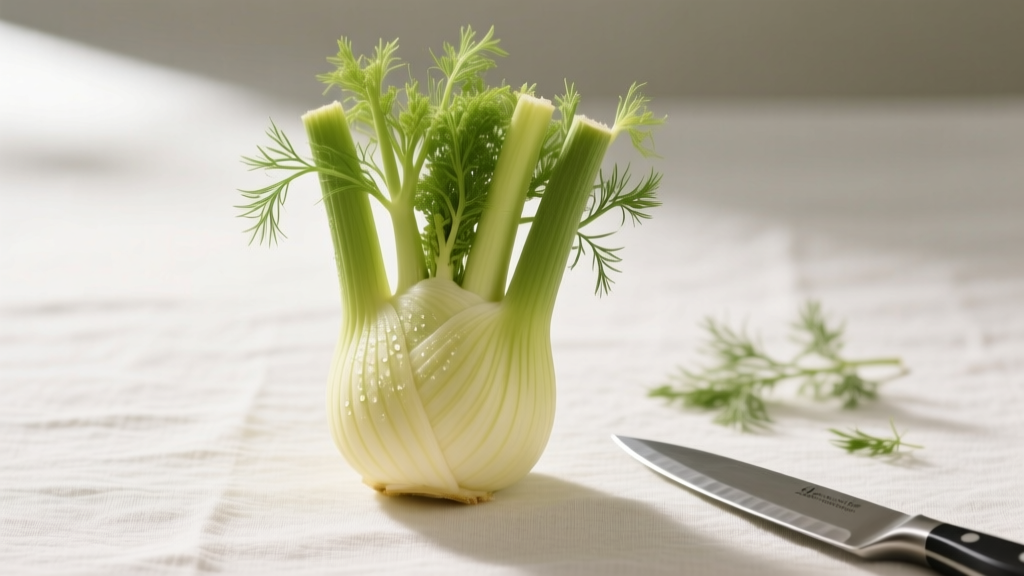
How to Prepare Fennel: Complete Step-by-Step Guide
Fennel Preparation Rules Are Meaningless—Until One Specific Condition Appears
In most homes, fennel preparation starts with confusion—not flavor. People reach for recipes, watch videos, or ask friends, assuming there’s a ‘correct’ way to handle the bulb: peel? core? blanch? slice thin or thick? The assumption is that precision here guarantees success. But in practice, those choices rarely change whether dinner works. What actually happens is quieter and more consequential: people delay cooking because they’re stuck on a step they think matters, or they discard edible parts out of misplaced caution. A child refuses the roasted fennel not because it was sliced wrong—but because the outer layer wasn’t trimmed enough to remove fibrous resistance. The real cost isn’t flavor loss; it’s hesitation, waste, and meals served lukewarm while someone re-trims a bulb for the third time.
The core judgment—that fennel prep rules are irrelevant until one condition appears—is not about technique. It’s about sensory alignment. When fennel is cooked (roasted, braised, sautéed), its structural integrity, fiber distribution, and surface texture converge toward neutrality. Heat transforms crunch into tenderness, sharpness into sweetness, and bitterness into depth. In that context, peeling, coring, or slicing direction has no measurable impact on outcome. You can leave the core intact in a 350°F oven roast and still get even tenderness. You can use a dull knife and still achieve caramelization. The rule doesn’t vanish—it simply ceases to apply. Its irrelevance isn’t theoretical; it’s baked into how heat interacts with fennel’s cellular matrix under typical home conditions: moderate oven temps, standard pans, unmeasured oil, and variable timing.
Two fixations dominate home prep—and both misdirect attention. First: whether to remove the tough outer layer. Many believe this is mandatory for texture. In reality, it’s only necessary if the bulb is mature, stored too long, or destined for raw use. For cooked applications, that layer softens fully and contributes body. Second: slicing direction relative to the core. Some insist radial cuts (from center outward) preserve structure; others swear by horizontal slices for even cooking. Neither affects doneness, browning, or mouthfeel in home ovens or skillets. The blade angle changes nothing when heat penetrates slowly and unevenly—a reality of domestic equipment. These aren’t minor details; they’re decision traps disguised as craftsmanship. They consume mental bandwidth better spent on seasoning balance or timing coordination.
The single constraint that consistently overrides all prep theory is household taste divergence—not personal preference, but active disagreement at the table. One person loves fennel’s anise note; another finds it medicinal. That split forces a functional choice: either suppress the flavor (via blanching, pairing, or dilution) or isolate it (serve raw as a garnish, not integrated). No amount of perfect slicing compensates for that mismatch. And unlike temperature control or pan selection, this constraint can’t be optimized—it must be acknowledged and worked around. Budget, time, or fridge space might limit options, but taste divergence dictates *how* fennel enters the meal, not just how it’s cut. It’s the difference between ‘I’ll try it’ and ‘I’ll push it aside.’ That’s where prep stops being mechanical and becomes diplomatic.
Lately, the fixation on ‘proper’ fennel prep has softened—not because people know more, but because they’ve stopped serving it raw as a centerpiece. Roasted wedges, shaved ribbons in grain bowls, and slow-braised shreds now appear more often than raw slaws. That shift quietly invalidates half the old rules: no one debates core removal when the whole bulb goes into a Dutch oven with olive oil and lemon. The signal isn’t in food blogs or recipe apps; it’s in what ends up on weeknight plates. When fennel moves from salad bowl to sheet pan, the prep conversation changes—not in volume, but in weight. The questions become ‘How long until tender?’ not ‘Which end faces up?’ That’s not progress. It’s adaptation to what actually fits.
Here’s how to resolve the ambiguity—not by learning more, but by matching method to moment:
| What people fixate on | What it affects | When it matters | When it doesn't |
|---|---|---|---|
| Peeling the outer layer | Texture in raw applications | Raw salads or crudités | Cooked dishes (roasting, braising, stewing) |
| Removing the hard core | Bite resistance in raw or quick-sautéed uses | Thin raw shavings or stir-fries under 3 minutes | Oven roasting, slow braising, soups |
| Slicing direction (radial vs. horizontal) | Negligible structural difference | Never—no observable effect in home kitchens | All scenarios |
| Blanching before roasting | Mild reduction of anise intensity | When serving to someone highly sensitive to licorice notes | Family meals where no one objects |
Quick verdicts for home cooks
- If you’re roasting fennel for soup, keep the core—it dissolves into richness and saves prep time.
- If you’re serving raw fennel in a shared salad, trim outer layers and core—even if the bulb looks small afterward.
- If your partner hates anise flavor but tolerates cooked fennel, skip blanching and pair it with strong umami elements instead.
- If you’re short on time and fennel is going into a skillet with onions and garlic, slice thick—thin slices burn before softening.
- If kids are eating, shave raw fennel very thin and soak briefly in citrus water to mute intensity without losing crunch.
- If you’re using fennel fronds as garnish, harvest them just before serving—refrigerated fronds lose aroma within two days.
Frequently asked questions
Why do people think fennel must always be peeled?
Because early food media treated raw fennel like celery—emphasizing crispness over adaptability. Peeling became synonymous with ‘clean prep,’ even though cooked fennel doesn’t need it.
Is it actually necessary to remove the core before roasting?
No. In a home oven, the core softens fully and adds subtle sweetness. Removing it creates unnecessary waste and increases prep time without benefit.
What happens if you ignore slicing direction entirely?
Nothing changes—no difference in browning, tenderness, or flavor release. Home heat sources don’t discriminate based on cut orientation.
More Articles
 Fried Cabbage and Bacon with Onion: Simple Skillet Guide
 Smoked vs Regular Paprika: When to Use Each
 Natural MSG Substitutes: 7 Healthy Flavor Alternatives
 What Is a Clove of Garlic? Simple Cooking Guide
 Cilantro Coriander
 Sweet Storage Ideas: Keep Sugar Fresh and Clump-Free
 Allspice vs Mixed Spice: Key Differences
 Global Spice Traditions: A Practical Field Guide
 Cardamom Spice Basics Essentials: Origins, Varieties, Uses, and Storage Tips
Sumac: The Tangy Mediterranean Spice
Cardamom Spice Basics Essentials: Origins, Varieties, Uses, and Storage Tips
Sumac: The Tangy Mediterranean Spice