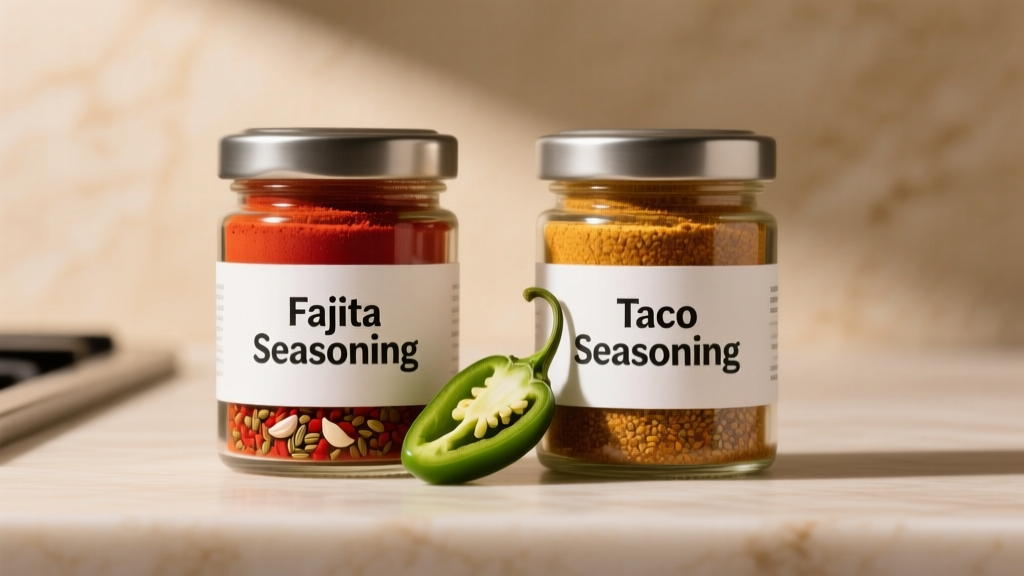
Fajita Seasoning vs Taco Seasoning: Key Differences
Fajita Seasoning Isn’t a Substitution Problem—It’s a Heat-and-Texture Signal
Most people fixate on ingredient lists because they’ve seen side-by-side comparisons online: paprika here, cumin there, garlic powder in both. But that fixation misses how these blends behave—not what they contain. In real use, the difference isn’t flavor profile; it’s thermal response. Fajita seasoning usually includes more dried onion and less cornstarch or anti-caking agents. That means it clings to surface moisture longer, delaying crust formation. Taco seasoning, by contrast, often contains fillers that accelerate drying—and therefore browning—on medium heat. The consequence? A family dinner where chicken strips labeled 'fajitas' turn rubbery not from overcooking, but from being tossed into a cold pan with too much seasoning clinging to wet surfaces.
This distinction rarely matters when you’re using pre-cooked proteins or adding seasoning after cooking—like sprinkling onto grilled shrimp or folded into refried beans. It also doesn’t matter if your stove runs hot and inconsistent, or if you’re using a nonstick skillet with minimal oil: under those conditions, neither blend delivers reliable sear control. What looks like a ‘flavor choice’ is actually a thermal interface decision—one that only activates when raw protein hits direct heat. That’s why the label confusion persists: packaging implies culinary identity, while kitchen physics dictates outcome.
The first invalid fixation is ingredient ratios—especially cumin vs. chili powder percentages. In practice, cumin volatility drops sharply above 325°F (163°C), and most home stovetops don’t sustain that range long enough for ratio differences to register as distinct aromas. The second invalid fixation is salt content. Yes, some taco blends list sodium chloride first; others bury it mid-list. But unless you’re seasoning for someone on strict sodium restriction—or using the entire packet on under-100g meat—salt variance won’t shift taste perception. What *does* shift perception is texture collapse: when spice coating traps steam instead of letting it escape, the meat never reaches the Maillard threshold. That’s not a flavor failure. It’s a physics mismatch.
The real constraint isn’t shelf life or brand loyalty—it’s pan temperature stability. Most electric stoves and budget induction units take 90–120 seconds to recover heat after adding cold meat. Fajita seasoning’s higher hygroscopicity extends that recovery window by another 20–30 seconds—enough to drop surface temp below 275°F (135°C) just as browning should begin. That’s when juices pool instead of evaporating. No amount of post-cook garnish fixes that. You can’t compensate with high smoke-point oil or longer cook time: the coating itself becomes the thermal barrier. This isn’t theoretical—it’s observable in any kitchen where the burner dial stays at ‘medium-high’ and the pan never visibly shimmers before food hits it.
Here’s how the judgment flips across actual home scenarios:
• If you’re stir-frying thin-cut skirt steak on gas, fajita seasoning wins—it holds onto surface oils just long enough to promote even charring.
• If you’re browning ground turkey in a heavy-bottomed pot for tacos, taco seasoning gives faster, drier crumble—less steam interference.
• If you’re marinating chicken breast overnight, either works—but only if you pat dry *after* marinating, not before.
• If you’re air-frying pre-seasoned strips, taco seasoning yields crispier edges; fajita tends to leave a faint tackiness.
• If you’re reheating leftovers in a microwave, neither matters—the thermal signal is gone.
• If your household includes a child sensitive to garlic intensity, fajita blends (often heavier on dried garlic) may trigger stronger reactions than taco versions—even with identical listed ingredients.
Stop asking which blend is ‘more authentic.’ Ask instead: does my pan reach and hold >300°F (149°C) *before* I add food? If yes, fajita seasoning functions as intended. If no—or if you’re cooking in batches and the pan cools between loads—taco seasoning’s faster-drying chemistry reduces the risk of steamed, gray-edged results. That’s not a compromise. It’s aligning the blend’s physical behavior with your equipment’s thermal reality. In a home kitchen, seasoning isn’t about origin—it’s about interface fidelity.
| What people fixate on | What it affects | When it matters | When it doesn't |
|---|---|---|---|
| Chili powder vs. smoked paprika ratio | Aroma release during initial sizzle | Gas stovetop, cast iron, preheated >325°F | Electric coil, nonstick pan, or when adding cold meat directly from fridge |
| Salt concentration | Perceived saltiness in final bite | Seasoning lean ground beef under 200g without added broth | Using full packet on 400g+ chicken thighs, or adding cheese/salsa post-cook |
| Presence of cornstarch or maltodextrin | Surface drying speed and crust integrity | Browning raw strips or cubes over direct heat | Stirring into cooked rice, folding into scrambled eggs, or dusting on roasted vegetables |
| Garlic-onion balance | Post-meal breath intensity and child tolerance | Family dinners where kids eat same meal, no separate prep | Adult-only meals or when serving with strong dairy (e.g., queso fresco) |
Quick verdicts for home cooks
- If your stove struggles to maintain heat when adding meat, taco seasoning reduces steaming risk more reliably than fajita.
- When grilling skirt or flank steak over open flame, fajita seasoning’s cling helps build char without premature ash formation.
- For ground meat in a Dutch oven, taco seasoning yields drier crumbles—fajita often leaves clumps that steam instead of brown.
- If you air-fry weekly and notice uneven crispness, switch to taco seasoning: its faster-drying agents improve edge definition.
- When marinating overnight, either works—but always pat dry *after* marinating, not before applying seasoning.
- If a household member reports stronger garlic aftertaste with one blend, check dried garlic position in the ingredient list—not total garlic content.
Frequently asked questions
Why do people think fajita seasoning must be used only with skirt steak?
Because early U.S. restaurant menus tied the blend to that cut—but the blend’s function is thermal, not anatomical. It works with any thin, fast-cooking protein exposed to direct heat.
Is it actually necessary to buy separate packets for fajitas and tacos?
No—if your cooking method avoids raw-protein searing (e.g., slow-simmered fillings, baked casseroles), the blends are functionally interchangeable in home use.
What happens if you ignore the label and use fajita seasoning for ground beef tacos?
You’ll likely get softer crumbles and slightly more surface moisture—unless you extend cook time and stir more aggressively to drive off steam.
Lately, grocery store shelf tags have started listing 'sear-ready' and 'simmer-safe' icons next to seasoning packets—quietly acknowledging that consumers now treat them as thermal modifiers, not just flavor sources. That shift didn’t come from chefs or influencers. It came from home cooks noticing that the same chicken breast turned out differently depending on which yellow packet they grabbed—then realizing the pan, not the palate, was doing the judging.
More Articles
 Honey and Bread: Safe Pairing Tips & Common Mistakes
 Turmeric Storage and Usage Hacks (2026)
 Smoked vs Regular Paprika: When to Use Each
 Sesame Seed Types: White, Black & Golden Compared
 Spice Strength and Shelf Life Guide
 Paprika Types: Sweet, Hot, and Smoked
 Sweet Potato Sweet: Natural Sweetness Guide & Cooking Tips
 How to Cook Korean Sweet Potato: Foolproof Baking Guide
 Shichimi Togarashi: Japan's Seven Spice
 Granulated Onion vs Onion Powder: Flavor Face-Off