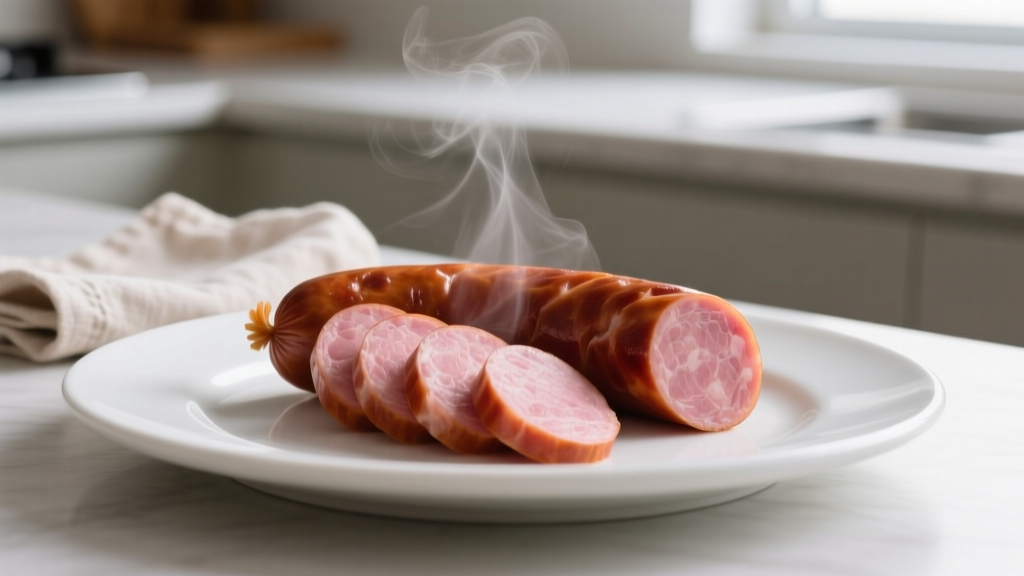
Can Sausage Be Pink? Food Safety Facts Explained
Why Pink Sausage Sparks Safety Fears
That unexpected pink hue in your cooked sausage triggers instant panic. You've been told "pink means raw," and raw meat risks Salmonella or E. coli. But here's what USDA food safety experts confirm: color alone can't determine safety. Many home cooks toss perfectly safe sausages due to this myth, while others dangerously assume browned exteriors guarantee safety. The real danger? Undercooked ground meat where bacteria thrive internally.
The Science Behind Persistent Pink
Sausage stays pink for reasons completely unrelated to doneness:
- Nitrites in cured meats form heat-stable pink pigments (nitrosylhemochrome) that won't fade when cooked
- Spices like paprika or cayenne create reddish hues that mask browning
- Fat content cooks faster than lean meat, browning the exterior while interior remains pink
- Natural myoglobin variations in meat retain pink tones even at safe temperatures
As Michigan State University's food science department explains: "The cured meat color... is a pink colored pigment that is heat stable. This pink 'cured meat' color will continue to be pink when cooked." (canr.msu.edu)
When Color Deceives: Critical Scenarios to Avoid
Never trust visual cues in these high-risk situations:
- Smoked or cured sausages (kielbasa, andouille): Nitrites lock in pink color
- Poultry sausages: Naturally lighter meat appears pink even when cooked
- High-fat blends (pork belly mixes): Fat renders quickly, browning exterior prematurely
- Grill marks: Searing creates false appearance of doneness
Conversely, never assume browned sausage is safe. Ground meat's increased surface area allows bacteria to penetrate deep inside—unlike whole cuts like steak. As Thermometer.co.uk warns: "Minced meat must be cooked thoroughly all the way through... unlike steaks and roasts" (thermometer.co.uk).
| Type of Sausage | Safe Internal Temperature | Verification Source |
|---|---|---|
| Pork & Beef Sausages | 160°F (71°C) | thermapen.co.uk |
| Poultry Sausages | 165°F (74°C) | souschef.co.uk |
| Pre-cooked Smoked Sausages | 140°F (60°C) to serve | getlabtest.com |
Your Only Reliable Safety Tool: The Digital Thermometer
Follow these steps for foolproof results:
- Insert probe horizontally into sausage's thickest part
- Wait 15 seconds for accurate reading (digital models)
- Verify temperature meets USDA standards (see table above)
- Sanitize probe between sausages
"Relying on color is sadly mistaken," confirms Braised and Deglazed. "The easiest, simplest and most consistent method is to use a digital thermometer" (braisedanddeglazed.com). This isn't chef preference—it's food science necessity.
3 Dangerous Myths That Risk Food Poisoning
These misconceptions cause thousands of illnesses yearly:
- "No juice means done": Fat renders clear liquid that isn't blood
- "Browning = safety": Exterior can brown at 140°F while interior remains dangerous
- "Pink always means raw": Causes safe sausages to be wasted (and unsafe ones to be eaten if thermometer isn't used)
Remember: Ground meat requires higher temperatures than whole cuts because grinding distributes surface bacteria throughout. As Thermometer.co.uk emphasizes, this applies to "burgers, sausages and kebabs" (thermometer.co.uk).
Everything You Need to Know
Nitrites in cured sausages create heat-stable pink pigments, while spices like paprika or natural meat variations can retain pink tones. This is normal and safe when internal temperature reaches 160°F (71°C) for pork/beef or 165°F (74°C) for poultry.
Pink sausage is safe if it reaches proper internal temperature. It becomes dangerous only when undercooked (<160°F/71°C). Color alone doesn't indicate safety—always verify with a thermometer to avoid Salmonella or E. coli risks from undercooked ground meat.
Cooking time varies by method and thickness. Pan-frying takes 15-20 minutes, grilling 12-18 minutes. Never rely on time—always check internal temperature with a thermometer. Poultry sausages require higher temperatures (165°F/74°C) than pork/beef (160°F/71°C).
160°F (71°C) destroys harmful bacteria in pork and beef sausages. Poultry sausages require 165°F (74°C). This temperature must be reached in the sausage's thickest part, as grinding distributes bacteria throughout the meat—unlike whole cuts.
Yes, fully cooked smoked sausages (like kielbasa) are safe to eat cold if stored properly. Reheat to 140°F (60°C) for best texture. Always check packaging labels—"cook before eating" varieties require full cooking to 160°F (71°C).
More Articles
 Honey Baked Ham Guide: Perfect Recipe & Pro Tips
 Simple French Onion Soup: Authentic in 45 Minutes
 Sweet Potato Scalloped Potatoes: Recipe Guide & Tips
 Tomato Avocado Salad: Pro Tips for Zero Browning
 The Ultimate Storage Guide
 Spinach Dishes: Quick Weeknight Meals (2026)
 Spice Powder Quality Checklist (2026 Guide)
 Authentic Mexican Prawn Soup: Recipe & Cultural Guide
Best Pepper Varieties: Uses & Sourcing
Authentic Mexican Prawn Soup: Recipe & Cultural Guide
Best Pepper Varieties: Uses & Sourcing
 Baked Cauliflower Dishes: Crispy Tips & Common Mistakes