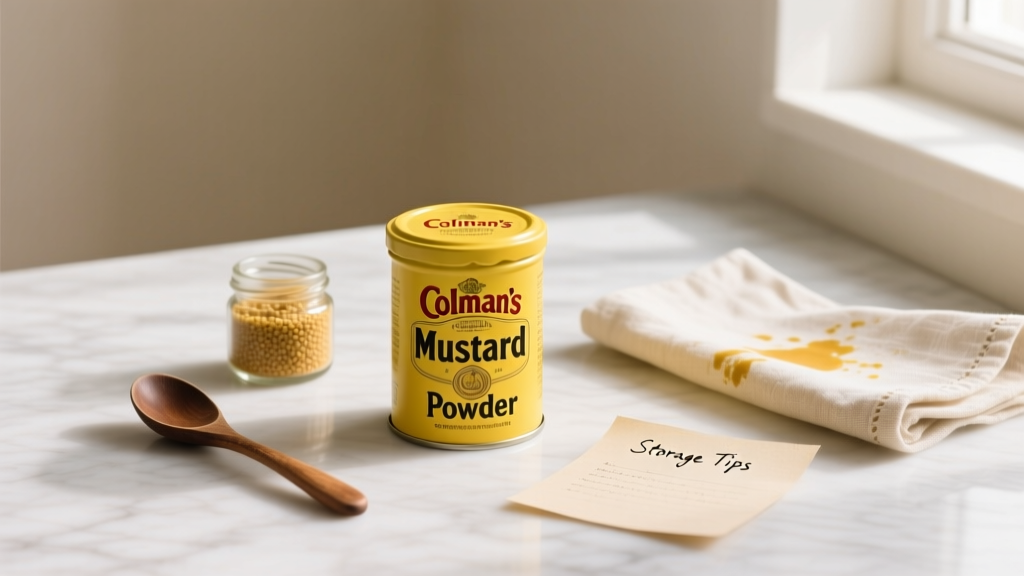
Colman's Mustard Powder: Uses, Substitutes & Storage Guide
Colman’s Mustard Powder Isn’t a Flavor Ingredient — It’s a Timing Switch
Most people treat Colman’s mustard powder like a spice: something you add, stir, and expect to behave. That assumption collapses the second moisture hits it — not during prep, not in the jar, but in the mouth. The sharpness isn’t delayed; it’s deferred. And that deferral is what makes home cooks misdiagnose their own results. They blame the batch, the brand, or their palate — then double the amount next time, worsening the imbalance. In reality, the powder delivers its full effect only after 90–120 seconds of contact with saliva or warm liquid. That lag isn’t a flaw; it’s the mechanism. So when someone says their ‘mustard sauce tastes flat until the third bite’, they’re not tasting inconsistency — they’re tasting physics.
Colman’s mustard powder becomes irrelevant when used in applications where heat or acidity suppresses enzymatic activity before it peaks — think baked glazes, boiled dressings, or anything simmered longer than 3 minutes. The myrosinase enzyme deactivates above 70°C (158°F), and vinegar below pH 3.2 slows hydrolysis enough to mute the burn. In those cases, the powder behaves more like inert starch than active agent. You can substitute it freely with dry mustard blends or even turmeric for color — no one will notice the missing heat. What matters isn’t authenticity, but whether the dish crosses the activation threshold *after* serving. If it doesn’t, Colman’s offers zero functional advantage over cheaper alternatives. Its reputation survives only in contexts where timing remains uncontrolled: cold sauces, raw marinades, and last-minute finishing.
Two fixations waste home cooks’ attention. First: ‘Is it fresh?’ — irrelevant unless the jar has been open >18 months and stored near a stove. Colman’s is stabilized with wheat flour and salt; degradation is slow and tasteless, not volatile. Second: ‘Do I need cold water?’ — a myth born from early 20th-century packaging instructions. Tap water temperature has negligible impact on initial dissolution; what matters is whether the mixture sits undisturbed for ≥90 seconds before use. Stirring hot water into it doesn’t ‘kill’ it — it just shortens the window for peak pungency. Neither variable alters the core behavior: activation delay is fixed, not adjustable.
The real constraint isn’t shelf life or water temperature — it’s household refrigeration discipline. Colman’s mustard paste (powder + liquid) loses ~40% of its peak heat within 4 hours if left at room temperature. But most homes don’t refrigerate small-batch condiments between uses. That means the same jar of prepared mustard may deliver full intensity on Day 1, muted burn on Day 2, and mostly aroma by Day 3 — not due to spoilage, but enzymatic decay. No label warns about this. No recipe accounts for it. It’s invisible until someone tries the same sauce two days apart and assumes the powder ‘went bad’. This isn’t about expiration dates — it’s about fridge access, habit, and how often a household actually finishes a 100g batch.
Recent shifts in usage patterns reveal this misunderstanding softening — not through education, but through behavior. Lately, more home cooks are skipping the ‘resting step’ entirely and applying Colman’s directly to meats before roasting, or folding it into butter at room temperature without pre-hydration. These aren’t ‘wrong’ methods — they’re workarounds that bypass the delay problem by embedding the powder where heat or fat will modulate release. The change isn’t driven by blogs or influencers; it’s visible in forum posts where users describe ‘accidentally leaving it out overnight and liking the result more’. That’s not a trend — it’s a quiet recalibration of expectations.
Here’s the structural truth: Colman’s mustard powder does not scale linearly. Doubling the dose doesn’t double the heat — it extends the duration of the burn and raises the threshold for perceived ‘balance’. In a vinaigrette, 1 tsp gives clean cut; 2 tsp makes the dressing dominate the salad, not complement it. In a cheese sauce, excess powder creates a lingering bitterness that clashes with dairy sweetness — not because it’s ‘too strong’, but because the delayed peak arrives after swallowing, disrupting flavor memory. That mismatch between intention and sensory arrival is why so many home attempts feel ‘off’. The powder doesn’t misbehave — it obeys rules nobody told them applied.
| What people fixate on | What it affects | When it matters | When it doesn’t |
|---|---|---|---|
| Expiration date on jar | Perceived freshness | Open >18 months in humid kitchen | First 12 months, sealed or dry-stored |
| Cold vs warm water | Dissolution speed | When preparing large batches for storage | In single-use applications (<10 min shelf life) |
| Resting time before use | Peak pungency timing | In cold, unheated sauces served immediately | In cooked dishes or room-temp fats |
| Brand loyalty vs generic | Consistency of delay curve | When replicating a known recipe across years | In improvised seasoning or heat-adjusted dishes |
Quick verdicts for home cooks
- If you’re making a potato salad for lunch tomorrow, mix Colman’s with vinegar tonight — the delay works in your favor.
- For roast lamb rubbed with mustard, skip hydration — dry powder + fat delivers smoother, later heat.
- When thickening a cheese sauce, add Colman’s off-heat and stir — boiling neutralizes its bite unpredictably.
- If your kids reject mustard sandwiches, try sprinkling dry powder on buttered bread instead of premixing — texture and timing shift perception.
- Don’t refrigerate unused paste if you won’t finish it in 24 hours — make smaller batches instead.
- When substituting in Indian-style pickles, use half the listed Colman’s amount — acidity accelerates and flattens its curve.
Frequently asked questions
Why do people think Colman’s mustard powder needs cold water?
Because early 20th-century instructions warned against ‘killing the heat’ — a misreading of enzyme sensitivity. Cold water doesn’t preserve pungency; it only slows initial dispersion.
Is it actually necessary to let Colman’s mustard paste rest before using?
No — unless you want maximum sharpness in a cold application. Resting changes timing, not intensity ceiling. Many effective uses skip it entirely.
What happens if you ignore the ‘best before’ date on Colman’s mustard powder?
Little — the blend remains stable and safe. Flavor drift is gradual and rarely noticeable before 24 months post-opening in dry conditions.
Forget ‘how much’ or ‘how long’. The only reliable filter is this: Will the person eating this experience the heat while the food is still in their mouth — or after they’ve swallowed? If the answer is ‘after’, Colman’s is working as designed — and your recipe is likely fine. If it’s ‘during’, then either the dose is too high, or the medium (acid, heat, fat) disrupted the delay. That single question replaces all other variables. It doesn’t require tools, timers, or expertise — just one conscious pause before serving.
More Articles
 Cardamom Pods vs Ground: Which to Use and When
 Cauliflower Freshness Signs & Storage Tips
 Cumin vs Coriander: Differences & Pairings
 Star Anise vs Anise Seed: Key Differences
 Choosing the Right Spice Step: A Guide
 Garlic Achaar: Authentic Recipe and Health Insights
 How to Cook Pho: Authentic Homemade Noodle Soup Guide
 How to Cook Chicken Gravy: Simple Steps for Perfect Results
 Best Spice Basics for Black Cooking
 Ginger Storage: Keep Fresh for Months (2026)