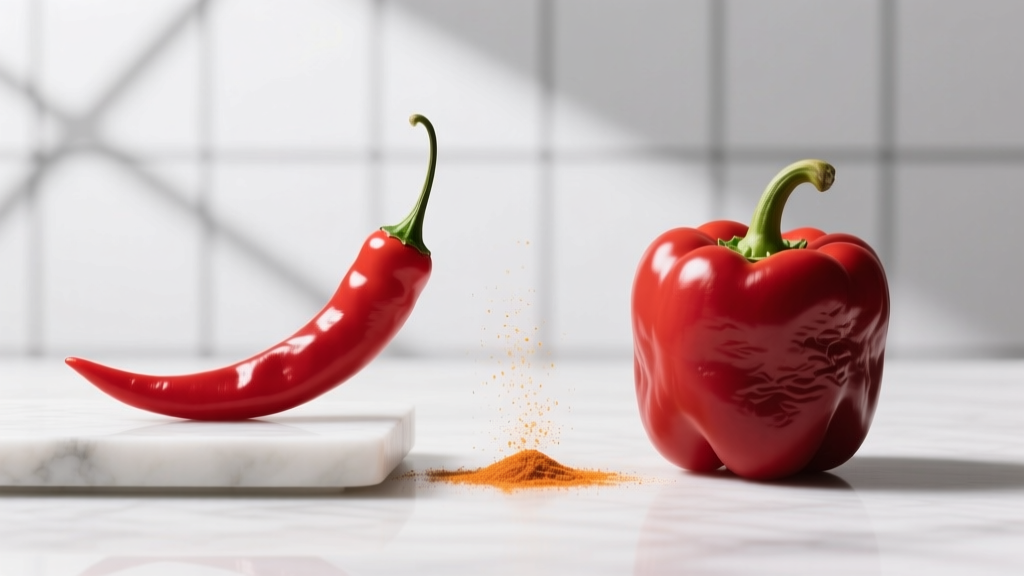
Cayenne Pepper vs Red Chili Pepper: Key Differences Explained
Cayenne Pepper Is Not a Red Chili Pepper Substitute—And That’s Usually Fine
Most people assume cayenne and red chili pepper are interchangeable because both are dried, ground, and red. That assumption comes from supermarket labeling: bulk bins labeled "red chili powder", spice aisle jars marked "chili powder" (often a blend), and online listings that use the terms without distinction. The consequence? A stew that burns the tongue but lacks depth; a marinade that tastes flat despite visible heat; or a child refusing dinner because the 'mild' chili powder was actually cayenne at full strength. These aren’t flavor failures—they’re misaligned expectations baked into packaging and habit. No one teaches you that ‘red chili pepper’ is a category, not a species—and cayenne is one narrow, high-heat member of it. You don’t need botany to notice the gap—you feel it when your sauce turns sharp instead of rounded, or when your ‘spicy’ taco seasoning leaves no aftertaste beyond burn.
The distinction doesn’t matter when heat is the only goal and flavor complexity is irrelevant. If you’re boosting oil for a quick stir-fry, adding pinch-to-taste heat to scrambled eggs, or dusting roasted nuts before serving, cayenne delivers predictable fire with no baggage. Likewise, if your red chili powder is a commercial blend heavy in cumin and garlic (common in many U.S. grocery brands), substituting pure cayenne won’t break the dish—it’ll just shift the profile toward clean, linear heat. In these cases, the ‘substitution question’ is noise. What matters is whether the dish tolerates a single-note burn. Many do. Most weeknight meals do. The boundary isn’t botanical—it’s functional: when flavor architecture is thin or absent, heat source becomes fungible.
Two common fixations are actively unhelpful. First: ‘Which is hotter?’ Heat units (Scoville) mean little in practice because grind fineness, age, and batch variance swamp any theoretical ranking. A stale cayenne can be milder than fresh, coarse-ground Kashmiri chili—even though cayenne is nominally hotter. Second: ‘Which has more capsaicin?’ That’s like asking which hammer delivers more force—without knowing how hard you swing it. Capsaicin concentration tells you nothing about how much ends up in your mouth per teaspoon, nor how evenly it disperses in oil or binds to fat. Neither metric changes what you taste, smell, or serve. They’re lab facts masquerading as kitchen logic.
The real constraint isn’t heat level or origin—it’s storage stability in home conditions. Cayenne degrades faster than broader red chili powders because its fine grind and high volatile oil content accelerate oxidation. In a warm, humid pantry (common in many homes), cayenne loses aromatic lift within 4–6 months—leaving mostly burn. Generic red chili powder, especially coarser or blended versions, holds usable flavor longer. That means your ‘old cayenne jar’ may be delivering 80% less nuance than the label implies, while your ‘generic chili powder’ still carries earth and fruit notes. This isn’t about shelf life dates—it’s about how your actual cabinet environment reshapes potency before you even reach for the spoon.
Here’s where judgment flips: For a quick tomato-based pasta sauce simmered under low heat for 20 minutes? Use cayenne—it integrates cleanly and won’t muddy the base. For a raw garnish on avocado toast or yogurt dip? Choose a milder red chili powder (e.g., ancho or New Mexico style)—cayenne overwhelms cold applications. For a family meal where one person tolerates heat and another doesn’t? Skip both and use whole dried chilies you can control by seeding and toasting—then grind fresh. In each case, the decision isn’t about authenticity or accuracy—it’s about how heat behaves *in that specific thermal and textural context*. Heat isn’t a number. It’s a behavior—shaped by temperature, fat content, acidity, and time.
The simplest filter isn’t a chart or a Scoville scale. It’s this: If you’re tasting heat before aroma, it’s probably cayenne. If you’re tasting fruit, smoke, or earth before burn, it’s likely another red chili powder. That’s not a rule—it’s a sensory triage. You don’t need to identify the cultivar. You just need to know whether your mouth registers flavor first or fire first. That split-second perception tells you more about suitability than any label ever could. And it works regardless of brand, country of origin, or grinding method—because it’s calibrated to your palate, not a database.
| What people fixate on | What it affects | When it matters | When it doesn't |
|---|---|---|---|
| “Cayenne is hotter” | Perceived burn intensity | In cold dishes, raw salsas, or dairy-free sauces where heat isn’t tempered | In long-simmered stews, oil-infused bases, or dishes with sugar/fat buffers |
| “Red chili powder is a blend” | Flavor layering and salt balance | When used as primary seasoning (e.g., dry rubs, spice pastes) | When added late for color only, or diluted in large-volume soups |
| “They’re both ‘chili powder’” | Label compliance and recipe fidelity | In commercial food production or standardized teaching kitchens | In home cooking where recipes adapt to available stock and taste memory |
| “Which one is ‘more authentic’?” | Cultural alignment (not flavor outcome) | When recreating a specific regional dish with documented ingredient norms | In hybrid meals, fusion experiments, or meals built around pantry surplus |
Quick verdicts for home cooks
- If your chili powder smells sweet and dusty—not sharp and medicinal—you’re safer using it where cayenne would dominate.
- For chili con carne simmered over 90 minutes, cayenne’s brightness fades; a broader red chili powder holds up better.
- When doubling a recipe, never double cayenne—its heat compounds nonlinearly in extended cooking.
- If your toddler eats from the same pot, avoid cayenne entirely unless you’re willing to serve two versions.
- When reheating leftovers, cayenne’s bite intensifies; red chili powder tends to mellow further.
- If your spice jar has no harvest date and smells faintly rancid, replace it—neither type performs well oxidized.
Frequently asked questions
Why do people think cayenne and red chili pepper are the same thing?
Because grocery labels rarely distinguish them—and many “red chili powders” sold globally are either cayenne-labeled or cayenne-dominant blends. Visual similarity (red, fine, dusty) reinforces the idea, even though their flavor origins differ sharply.
Is it actually necessary to keep both in your pantry?
No. In a home kitchen, cayenne is rarely the thing that ruins a dish—but keeping both creates decision fatigue without measurable flavor gain for most weekly meals.
What happens if you ignore the difference while making hot sauce?
You’ll get reliable heat, but lose control over finish: cayenne gives abrupt, clean burn; other red chilies add lingering warmth, fruit, or smoke that shapes how the heat recedes.
Lately, more home cooks are noticing the mismatch—not through blogs or videos, but because they’ve tasted the same recipe twice with different jars and gotten wildly different results. That quiet, repeated dissonance is shifting behavior: fewer automatic swaps, more sniff-tests before stirring, and growing willingness to discard old cayenne without guilt. It’s not a trend. It’s recalibration.
More Articles
 What Is a Clove of Garlic? Simple Cooking Guide
 Cheese Potato Casserole Recipe: Creamy Inside Crispy Top
 Mastering the Classic American Potato Salad Recipe
 How to Cook Brie: Simple Baked Method Guide
 Black Cumin vs Cumin: Clear Botanical & Culinary Differences
 Perfect Garlic Butter String Beans in 15 Minutes | Simple Recipe
 Cilantro vs Coriander: Same Plant, Different Names Explained
 Perfect Basic Potato Salad Recipe: Simple & Foolproof
 Best Substitutes for Garlic Chives: Practical Cooking Alternatives
 Sweet Potato Chocolate Cake: Moist & Healthy Recipe