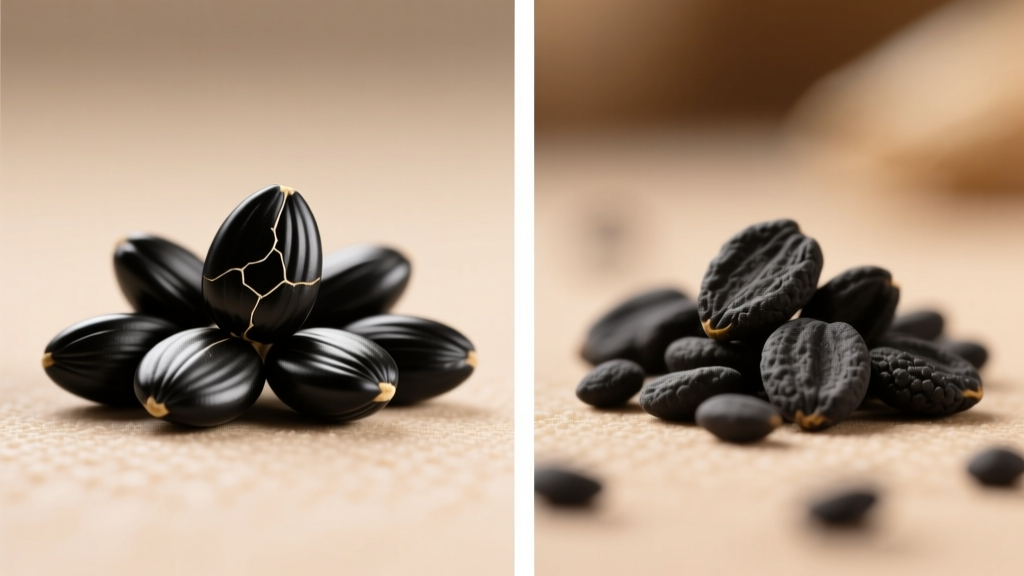
Black Seeds vs Black Sesame: Key Differences (2026)
Black Seeds Are Not Black Sesame Seeds — And That Confusion Rarely Matters
Most people assume black seeds and black sesame seeds are interchangeable because both appear as tiny, matte-black specks in spice jars or on bakery toppings. That visual shorthand has stuck: grocery labels blur them; recipe blogs omit clarification; even some ‘health food’ packaging leans into ambiguity. The real-world consequence? A loaf of homemade bread topped with black seeds tastes faintly medicinal and slightly bitter — not nutty and toasty — and no one knows why. It’s not that the dish fails. It’s that the eater feels subtly misled, as if the kitchen promised warmth and delivered austerity. This isn’t about authenticity or purity. It’s about expectation alignment — and how easily it fractures when two ingredients share a color but nothing else.
The core judgment is narrow and situational: Black seeds vs black sesame seeds only matters when flavor continuity or sensory intention is non-negotiable — not when texture, appearance, or general ‘dark seed’ symbolism suffices. In a tahini-based salad dressing where sesame dominates, adding black seeds introduces a sharp, volatile oil note that doesn’t integrate — it interrupts. But in a dense rye loaf where seeds are structural punctuation, not protagonists, the swap passes unnoticed. The boundary isn’t botanical or nutritional. It’s perceptual: does the ingredient carry semantic weight in the dish, or just visual weight? If it’s the former, substitution fails quietly. If it’s the latter, it often succeeds silently.
Two common, unproductive fixations dominate home use: first, whether black seeds are ‘healthier’ than black sesame seeds — a comparison that collapses under scrutiny because their bioactive profiles serve different physiological pathways, and neither delivers measurable impact in typical household serving sizes. Second, whether black sesame seeds must be toasted before use — a ritual that adds nuance but rarely alters functional outcome in baked goods or stir-fries. Neither fixation changes what ends up on the plate. Both distract from actual leverage points: how long the seeds sit in your pantry, how humid your kitchen is, or whether your teenager refuses anything with a ‘medicinal’ aroma. These aren’t philosophical questions. They’re storage conditions, ambient variables, and household taste thresholds — all of which shape real-world outcomes more than any label claim.
The single reality constraint that consistently overrides theory is pantry longevity under typical home conditions. Black sesame seeds contain high polyunsaturated fat content and oxidize visibly within weeks if stored at room temperature in non-airtight containers — turning rancid before they look suspicious. Black seeds, by contrast, have lower oil content and higher thymoquinone stability; they retain usable flavor for months longer under identical conditions. So when a home cook reaches for ‘black seeds’ after forgetting to restock black sesame, the decision isn’t about preference — it’s about avoiding a stale, off-note batch. Budget, time, and device limits matter less here than humidity exposure and container integrity. No blender, oven setting, or budget tier fixes rancidity once it begins. This constraint doesn’t care about culinary intent — it enforces itself through smell and mouthfeel.
Here’s how the call shifts across everyday scenarios — not as steps, but as quiet, irreversible decisions:
- In a last-minute brioche topping: black sesame seeds win — their toasty depth reads immediately, while black seeds read as ‘off’ against buttery richness.
- In a lentil stew simmered for 45 minutes: black seeds win — their volatile compounds survive heat better, and their bitterness softens into earthiness.
- In a smoothie bowl garnish meant to signal ‘superfood’: black seeds win — their cultural association with wellness carries more weight than flavor fidelity.
- In a sesame oil–based marinade: black sesame seeds win — their oil solubility matches the base; black seeds release disjointed, water-soluble notes instead.
- In a child’s school snack bar: black sesame seeds win — their neutral sweetness avoids triggering picky-eater resistance.
- In a fermented black rice porridge served warm: black seeds win — their warming, digestive association aligns with traditional usage, even if flavor is muted.
The simplest filter for home cooks isn’t ‘which is better?’ or ‘what does the recipe say?’ It’s: Does this dish rely on a recognizable, expected flavor signature — or does it rely on visual rhythm, textural contrast, or symbolic resonance? If it’s the first, choose deliberately. If it’s the second, choose pragmatically — and stop checking the label twice.
| What people fixate on | What it affects | When it matters | When it doesn't |
|---|---|---|---|
| Color uniformity in finished dish | Visual cohesion | When serving guests or posting photos | In weekday meals eaten alone or with family |
| Nutritional ranking (e.g., calcium, antioxidants) | Perceived health value | When selecting for targeted supplementation | In normal cooking volumes — neither delivers clinically relevant doses |
| Whether seeds are hulled or unhulled | Mouthfeel and subtle mineral notes | In raw applications like dressings or sprinkles | In baked goods or long-simmered stews |
| Origin (e.g., Ethiopian vs Indian) | Aromatic intensity and oil profile | In cold-pressed oil production or ceremonial use | In home roasting or grinding for daily use |
Quick verdicts for home cooks
- If your black sesame seeds smell faintly paint-like, discard them — black seeds won’t rescue the dish.
- When baking for someone with digestive sensitivity, black seeds offer gentler stimulation than raw black sesame.
- For a glossy, dark sauce glaze, black sesame paste works; black seed paste separates and clouds.
- If you’ve toasted black sesame seeds but forgot to grind them, black seeds can’t substitute — their cell walls resist shearing.
- When seasoning roasted vegetables, black sesame seeds add sweetness; black seeds add dry warmth — choose based on desired finish.
- If your pantry is humid and unairconditioned, black seeds stay viable longer — don’t force black sesame use just because the recipe says so.
Frequently asked questions
Why do people think black seeds and black sesame seeds are nutritionally interchangeable?
Because both are marketed with overlapping wellness language — ‘ancient’, ‘powerhouse’, ‘rich in antioxidants’ — without clarifying that their active compounds behave differently in digestion and storage.
Is it actually necessary to toast black sesame seeds before using them in savory dishes?
No — toasting deepens flavor but doesn’t unlock nutrients or improve digestibility in home cooking volumes; raw black sesame still contributes texture and mild nuttiness.
What happens if you ignore the difference in a cold noodle salad?
Black seeds introduce a sharp, cooling bitterness that clashes with soy-vinegar balance; black sesame seeds lend roundness and umami support — the dish doesn’t fail, but its harmony unravels.
More Articles
 Italian Pizza Sauce Recipe: 3-Ingredient Simplicity
 Miso Soup Nutrition Facts: Complete Breakdown Per Serving
 Best Substitutes for Chili Paste: Practical Alternatives
 Tomato Chutney with Onion: Homemade Guide & Tips
 Spice Strength and Shelf Life Guide
 Simple Garlic Fried Rice Recipe: Perfect Every Time
 12 Creative Roll Ideas: Sushi to Breakfast Buns
 Sweet Potato Au Gratin: Recipe & Pro Tips
Best Pepper Varieties: Uses & Sourcing
Sweet Potato Au Gratin: Recipe & Pro Tips
Best Pepper Varieties: Uses & Sourcing
 Spinach Orzo: Simple Weeknight Dinner Done Right