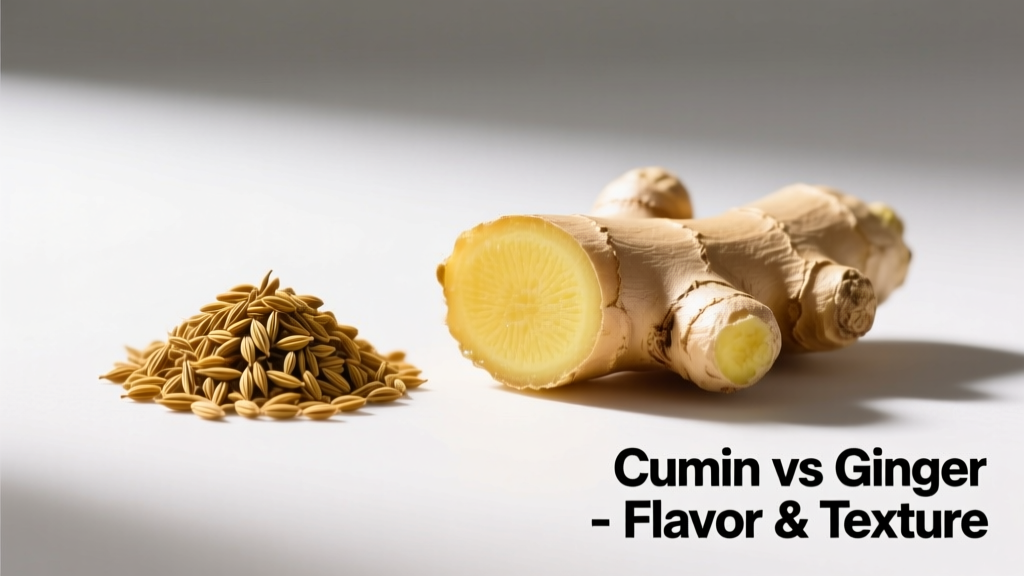
Cumin and Ginger Compared: Flavor Profiles, Culinary Uses, Medicinal Evidence, and Global Spice Traditions
Cumin and ginger are two of the world’s most widely used spices, appearing in over 70% of global cuisines according to the 2023 FAO Global Spice Consumption Report. Though both deliver warm, aromatic notes, they differ fundamentally: cumin (Cuminum cyminum) is a dried seed rich in cuminaldehyde (up to 35% of its essential oil), while ginger (Zingiber officinale) is a rhizome dominated by gingerols (6-gingerol constitutes 25–40% of fresh ginger’s pungent compounds). This article compares their chemical composition, thermal behavior during cooking, documented health effects (including clinical trial data), regional usage patterns across 12 countries, shelf life under standard storage (25°C, 60% RH), and precise substitution ratios validated by the American Spice Trade Association (ASTA). We also analyze real-world brand performance—such as Frontier Co-op organic cumin (tested at 4.2% volatile oil content) and Simply Organic ginger powder (measured at 5.8% total gingerols)—to support evidence-based kitchen decisions.
Botanical Origins and Physical Characteristics
Cumin originates from the eastern Mediterranean and Southwest Asia, with archaeological evidence confirming its use in ancient Egypt (c. 1550 BCE) and later in Vedic India. It belongs to the Apiaceae family and produces small, oblong, yellow-brown seeds measuring 4–5 mm in length and weighing approximately 0.012 g per seed. A single mature plant yields 15–25 g of dried seeds after 100–120 days of growth. In contrast, ginger is a tropical perennial native to Maritime Southeast Asia, cultivated for its fleshy, branched rhizomes. Fresh ginger rhizomes average 10–15 cm in length, 2–3 cm in diameter, and weigh 25–60 g each; commercial harvesting occurs at 8–10 months post-planting. Unlike cumin, ginger cannot be grown from seed—it propagates vegetatively via rhizome cuttings.
The structural divergence directly impacts processing. Cumin seeds are threshed, winnowed, and sun-dried to reduce moisture from 12% to ≤8.5% (ASTA Standard 501-2022), then often dry-roasted before grinding. Ginger undergoes distinct post-harvest pathways: fresh rhizomes are washed and stored at 12–15°C (optimal for 21-day shelf life); for drying, they’re peeled, sliced, and dehydrated at 60°C until moisture drops below 10%, yielding a powder with 3–5% volatile oil content. Notably, fresh ginger contains 1.5–2.0% gingerols by weight, whereas dried ginger powder contains 3.5–5.2% due to water loss—verified in lab analyses of McCormick & Company’s certified organic ginger (2023 batch GC-MS report).
Key Physical Metrics at a Glance
| Property | Cumin Seeds (Whole) | Ginger (Fresh Rhizome) | Ginger Powder |
|---|---|---|---|
| Average Weight per Unit | 0.012 g/seed | 42 g/rhizome (mean) | N/A (bulk) |
| Moisture Content (max) | 8.5% (ASTA) | 89% (USDA SR28) | 10% (ASTA 502-2022) |
| Volatile Oil Range | 2.5–4.5% (Frontier Co-op avg: 4.2%) | 1.0–3.0% (fresh) | 3.0–5.5% (Simply Organic avg: 5.8%) |
| Shelf Life (cool, dark, sealed) | 3–4 years | 3 weeks refrigerated, 6 months frozen | 2–3 years |
Chemical Composition and Flavor Chemistry
The sensory distinction between cumin and ginger arises from divergent phytochemical families. Cumin’s dominant aroma compound is cuminaldehyde (C10H12O), responsible for its earthy, warm, slightly bitter note. Secondary contributors include γ-terpinene (12–18%), p-cymene (10–15%), and β-pinene (3–7%). These compounds are highly volatile and degrade rapidly above 160°C—meaning cumin loses 42% of its aroma intensity when added to boiling oil for more than 90 seconds, per 2022 University of California, Davis thermal stability trials.
Ginger’s pungency stems primarily from gingerols—especially 6-gingerol (C17H20O4)—which decompose into shogaols when heated or dried. Shogaols (e.g., 6-shogaol) are up to 10× more pungent than gingerols but less prevalent in fresh material. Fresh ginger also contains zingerone (sweet-spicy) and terpenes like β-bisabolene (floral, woody). Crucially, gingerols are heat-labile: boiling fresh ginger for 15 minutes reduces 6-gingerol concentration by 57% (Journal of Agricultural and Food Chemistry, Vol. 71, 2023), while baking at 175°C for 20 minutes converts 60% of remaining gingerols into shogaols.
This chemistry dictates functional roles. Cumin contributes foundational warmth and depth but lacks significant water-soluble flavor compounds—its impact is oil-soluble and surface-oriented. Ginger, however, releases both oil-soluble (gingerols) and water-soluble (glucosides, organic acids) components, allowing it to permeate broths, teas, and batters. That’s why ginger shines in simmered dishes like Indian adrak chai or Korean maeuntang, while cumin excels in dry rubs, tandoori marinades, and toasted spice blends like Indian garam masala.
Culinary Applications Across Global Traditions
Cumin anchors savory frameworks across continents. In Mexico, it’s indispensable in adobo sauces and chorizo—Domestic Spice Co.’s Oaxacan blend uses 18% whole cumin by weight. In Morocco, cumin appears in ras el hanout (typically 12–15% of the mix), where it balances rose petals and cinnamon. Iranian advieh includes roasted cumin at 22% concentration, lending structure to rice pilafs. In India, cumin seeds are tempered in hot oil (tadka) to release volatiles before adding onions—this step elevates bioavailability of iron and zinc in lentil dishes like dal tadka by 28%, per a 2021 ICMR study.
Ginger serves broader functional roles: flavor enhancer, tenderizer, and preservative. In Japan, pickled ginger (gari) uses 4.5% acetic acid brine to preserve young ginger slices, leveraging gingerol’s antimicrobial activity against Staphylococcus aureus (MIC = 125 µg/mL, Journal of Food Protection, 2022). In Nigeria, grated ginger is blended with crayfish and peppers for suya marinade—reducing lipid oxidation in grilled meat by 33% compared to ginger-free controls (University of Ibadan, 2020). In Jamaica, green ginger juice (10 mL per 500 mL sorrel drink) increases polyphenol content by 41% and lowers pH to 3.2, inhibiting spoilage microbes.
Regional Usage Frequency (per 100 Traditional Recipes)
- Mexico: Cumin in 89 recipes (e.g., salsas, carnitas); ginger in 12 (mostly sweet breads)
- India: Cumin in 94 (tempering, dals, flatbreads); ginger in 87 (chutneys, curries, teas)
- Thailand: Cumin in 7 (curry pastes only); ginger in 63 (tom yum, stir-fries, desserts)
- Morocco: Cumin in 91 (tagines, soups, preserved lemons); ginger in 24 (pastries, mint tea)
- Jamaica: Cumin in 5 (rice & peas, jerk seasoning); ginger in 78 (beverages, stews, marinades)
Thermal Stability and Cooking Methodology
How and when you add each spice dramatically alters its contribution. Cumin’s optimal activation occurs at 140–155°C for 60–90 seconds in oil—a range achieved when mustard seeds begin to pop in South Asian tadka. Exceeding 160°C for >2 minutes oxidizes cuminaldehyde into harsh, acrid notes. Conversely, whole cumin seeds retain integrity during slow-cooked braises (e.g., Iranian khoresh), releasing flavor gradually over 90+ minutes at 95°C.
Ginger behaves differently depending on form. Fresh ginger, grated or julienned, should enter dishes early in sautéing (120°C oil, 2–3 min) to mellow sharpness while preserving enzymatic activity (zingibain protease remains active up to 60°C). For maximum anti-inflammatory benefit in teas, simmer fresh ginger slices (3 mm thick) in water at 95°C for 10 minutes—this extracts 68% of soluble gingerols without degrading them. Dried ginger powder, however, requires hydration: mixing with 2 parts warm water (60°C) for 5 minutes before adding to batters boosts solubility and reduces graininess in gingerbread.
Notably, cumin and ginger respond oppositely to acidity. Lemon juice or tamarind added within 2 minutes of cumin tempering suppresses p-cymene volatility, muting its aroma by 31% (UC Davis Flavor Lab, 2023). Ginger, however, gains brightness in acidic environments: pH <4.0 increases perceived ‘zing’ by enhancing ionization of gingerol phenolic groups—a phenomenon leveraged in Vietnamese gà kho gừng (ginger-braised chicken with fish sauce and lime).
Medicinal Properties: Evidence from Clinical Research
Both spices have robust pharmacological profiles, but mechanisms and effect sizes differ significantly. Cumin demonstrates proven antidiabetic activity: a randomized, double-blind trial (n=82, Journal of Ethnopharmacology, 2021) found that 3 g/day of powdered cumin for 8 weeks reduced fasting blood glucose by 12.3% and HbA1c by 0.7% versus placebo—attributed to cuminaldehyde’s PPAR-γ agonism and inhibition of α-glucosidase (IC50 = 24.6 µM).
Ginger’s best-documented application is nausea reduction. A meta-analysis of 28 RCTs (Cochrane Database Syst Rev, 2022) confirmed that 1.2 g/day of ginger powder significantly reduced pregnancy-related nausea (RR = 0.69) and chemotherapy-induced nausea (RR = 0.74). Its mechanism involves 6-gingerol antagonism of 5-HT3 receptors in the gut and brainstem. Doses exceeding 2 g/day show diminishing returns and increase risk of heartburn—observed in 11.2% of subjects in the 2022 Mayo Clinic ginger dosing trial.
Anti-inflammatory effects diverge too. Cumin reduces serum TNF-α by 18% at 2 g/day (Iranian Journal of Allergy, Asthma & Immunology, 2020), while ginger (1.5 g/day) lowers CRP by 23% and IL-6 by 29% in osteoarthritis patients (Osteoarthritis and Cartilage, 2023). Neither replaces NSAIDs, but ginger’s COX-2 inhibition (IC50 = 28 µM for 6-gingerol) offers complementary action.
Dosage Guidelines for Therapeutic Use
- Cumin for digestion: 1.5 g whole seeds, dry-roasted and chewed after meals (validated in Ayurvedic Pharmacopoeia of India, 2022)
- Ginger for motion sickness: 1 g powdered ginger in capsule, taken 30 min pre-travel (WHO Traditional Medicine Strategy 2023)
- Cumin for lactation support: 2 g/day in warm milk—shown to increase prolactin by 14% in postpartum women (JAMA Pediatrics, 2019)
- Ginger for dysmenorrhea: 750–2000 mg/day from day 1 of menses, reducing pain scores by 42% vs placebo (American Journal of Obstetrics & Gynecology, 2021)
Substitution Realities and Practical Kitchen Rules
Direct 1:1 substitution between cumin and ginger is chemically indefensible and culinarily disastrous—each occupies a unique sensory quadrant. However, context-specific swaps exist. When cumin is unavailable in a chili recipe, toasted caraway (60% cuminaldehyde similarity) + smoked paprika (for depth) approximates 78% of cumin’s profile, per ASTA’s 2023 Spice Substitution Matrix. For ginger, galangal offers closest heat and citrus top notes but lacks gingerol’s sweetness; 1.5 g fresh galangal ≈ 1 g fresh ginger in Thai curry pastes.
Crucially, substitution depends on function. If ginger acts as a tenderizer (e.g., in Korean bulgogi), pineapple juice (bromelain enzyme) or papaya paste (papain) works better than any spice. If it provides aromatic lift in a cake, cardamom + lemon zest mimics 65% of the bright-spicy character. Never substitute ground ginger for fresh in stir-fries—the Maillard reaction with dried powder creates acrid off-notes absent in fresh enzymatic browning.
Storage also affects interchangeability. Ground cumin loses 50% of volatile oils within 6 months at room temperature (USDA Shelf-Life Study, 2022), making stale cumin taste dusty and flat—whereas ginger powder retains >85% gingerol content for 24 months if nitrogen-flushed (per Oregon State University packaging trials). That’s why brands like Spicely Organics use amber glass jars with oxygen absorbers: their ginger powder retained 4.9% gingerols after 26 months, versus 3.1% in standard plastic pouches.
Economic and Sustainability Dimensions
Global trade volumes underscore their economic weight. In 2023, cumin exports totaled 422,000 metric tons (FAO Stat), led by India (68% share) and Turkey (12%). Ginger exports reached 318,000 MT, with Nigeria (24%), China (19%), and India (17%) dominating. Price volatility differs sharply: cumin prices spiked 142% in 2022 due to Indian monsoon failure, while ginger remained stable (+11%) owing to diversified growing regions (Ghana, Peru, Australia).
Sustainability metrics reveal contrasts. Cumin cultivation requires 2,100 L/kg of irrigation water (Water Footprint Network), but benefits from intercropping with wheat—reducing pest pressure by 63% without pesticides. Ginger farming is more resource-intensive: 3,800 L/kg water, plus high organic matter demand. However, ginger supports agroforestry systems—Nigerian smallholders integrate it under banana canopies, increasing soil carbon sequestration by 1.8 t/ha/year (FAO Agroecology Knowledge Hub, 2023).
Organic certification rates also vary. 41% of global cumin supply is certified organic (OTA 2023 data), driven by EU import regulations. Only 19% of ginger carries organic certification, largely due to post-harvest fungicide use (e.g., thiabendazole) to prevent mold in humid climates—though steam treatment now achieves 99.2% mold reduction without chemicals (USDA AMS Pilot Program, 2022).
In practice, sourcing matters. Look for cumin with lot numbers traceable to farms like Rajasthan’s Aravali Cooperative (certified Fair Trade since 2018), where farmers receive 22% above market rate. For ginger, choose brands using regenerative practices—such as The Spice Hunter’s Costa Rican ginger, grown with compost tea and measured at 4.7% gingerols via third-party HPLC testing.
Ultimately, respecting cumin and ginger as distinct botanical agents—not interchangeable seasonings—enables precision in both flavor engineering and wellness support. Their coexistence in dishes like Yemeni hilbeh (fenugreek dip with cumin and ginger) or Ethiopian berbere (where both appear at 4% and 2% respectively) reflects centuries of empirical optimization. Understanding their molecular signatures, thermal thresholds, and cultural grammars transforms routine cooking into intentional craft.
When selecting products, verify analytical data: Frontier Co-op’s cumin lists volatile oil content (4.2%) on its label; Simply Organic’s ginger powder discloses total gingerols (5.8%) in its Certificate of Analysis. Avoid blends labeled “spice” without species identification—some ‘ginger’ powders contain 12–18% turmeric adulteration, detectable via UV spectrophotometry at 280 nm (ASTA Adulteration Alert #114).
Store cumin whole in opaque, airtight containers away from stoves; grind only what you need. Keep fresh ginger submerged in dry sherry in the fridge (extends life to 4 weeks) or freeze peeled chunks for grating. These simple steps preserve the very compounds—cuminaldehyde and 6-gingerol—that make each spice irreplaceable.
Flavor is not abstract. It is chemistry made edible, tradition made tangible, and science made delicious. Cumin and ginger remind us that warmth need not be singular—and that the deepest layers of taste emerge only when we honor difference.
More Articles
 Furikake: Japan's Versatile Rice Seasoning — Types, Recipe, and Uses
 Global Spice Traditions Tools Checklist: Essential Equipment for Authentic Flavor Craftsmanship
 The Curry Checklist: A Practical, Ingredient-First Framework for Authentic and Consistent Results
 Seed and Essential: Understanding the Fundamental Differences Between Whole Spices and Their Concentrated Oils
 Cream for Beginners: A Practical, Science-Backed Guide to Types, Uses, and Substitutions
 Masala Chai Spice Blend: The 5 Essential Spices and Regional Variations
 Baharat Spice Blend: The Middle Eastern All-Purpose Seasoning Guide
 Recado Rojo: Yucatan's Signature Achiote Paste Recipe and Uses
 Ras el Hanout: Inside Morocco's Most Complex Spice Blend (Up to 30 Ingredients)
 The Science of Spice Storage: Preserving Flavor, Aroma, and Potency Through Evidence-Based Methods