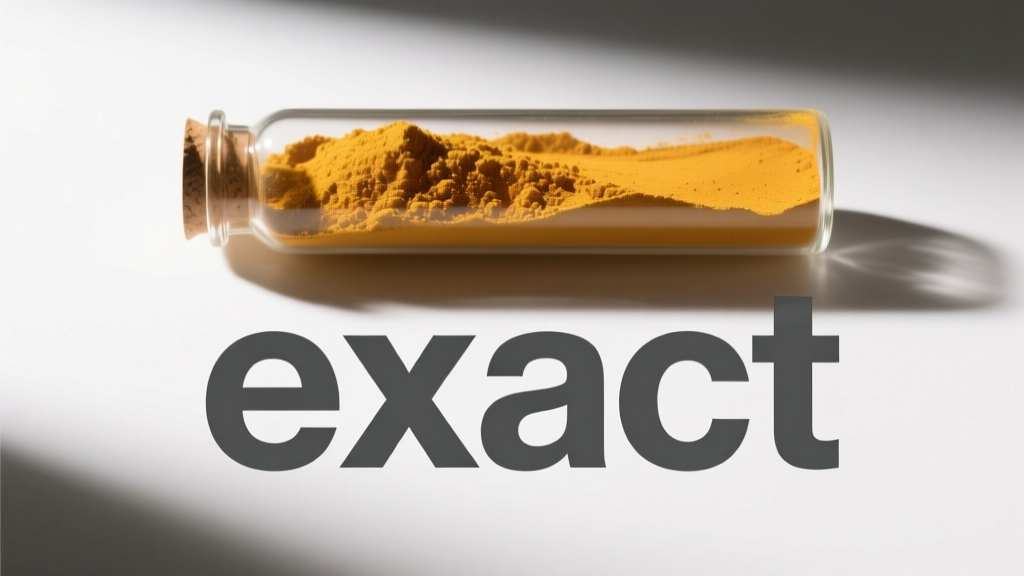
Turmeric vs. EXACT: Clarifying the Confusion Between a Spice and a Brand
Many home cooks and professional chefs encounter the phrase 'turmeric vs. EXACT' while browsing online retailers or reading ingredient labels—only to realize they’re comparing an ancient botanical (Curcuma longa) with a modern spice company (EXACT Spices). This isn’t a botanical rivalry; it’s a case of category confusion. Turmeric is a rhizomatous perennial plant native to South Asia, valued for its vibrant yellow-orange pigment (curcumin), earthy bitterness, and functional compounds. EXACT Spices is a U.S.-based brand founded in 2015 and headquartered in Portland, Oregon, specializing in certified organic, non-GMO, and heavy-metal-tested ground spices—including turmeric. This article clarifies the distinction, compares analytical specifications, evaluates real-world usage, and provides actionable guidance on selecting and verifying high-quality turmeric—whether sourced from EXACT or other reputable suppliers like Frontier Co-op, Simply Organic, or The Spice House.
The Botanical Reality: What Turmeric Actually Is
Turmeric (Curcuma longa L.) belongs to the Zingiberaceae family—the same as ginger and cardamom. Its primary bioactive compound, curcumin, constitutes 2–9% of raw dried rhizomes by weight, depending on cultivar, soil conditions, and post-harvest processing. According to USDA FoodData Central (SR Legacy, Release 2023), 100 g of ground turmeric contains 390 kcal, 7.83 g protein, 64.9 g carbohydrates (including 21 g dietary fiber), and notable micronutrients: 168 mg calcium, 41.4 mg iron (229% DV), 193 mg magnesium, and 2525 mg potassium. Its volatile oil profile includes turmerone (25–40%), atlantone (10–20%), and zingiberene (5–15%), contributing to its warm, slightly peppery aroma.
Commercial turmeric powder is produced by boiling, drying, and grinding fresh rhizomes. Traditional sun-drying methods—still used across Kerala and Tamil Nadu—yield lower curcumin retention (avg. 2.8%) compared to steam-drying followed by controlled-temperature milling (avg. 4.6%, per 2022 ICAR-Central Tuber Crops Research Institute trials). Adulteration remains a global concern: India’s Food Safety and Standards Authority (FSSAI) reported 18.3% of sampled turmeric powders in 2021–2022 contained synthetic dyes (e.g., metanil yellow) or fillers like starch or chalk. That’s why third-party verification—not brand name alone—is critical.
Key Varietal Differences Matter
Not all turmeric is equal. Alleppey Finger (Kerala) averages 7.5% curcumin, while Erode (Tamil Nadu) samples test at 4.1% (2023 FSSAI Lab Report No. FSSAI/CTC/2023/047). Madras turmeric, though more pungent, typically contains only 2.2–3.1% curcumin but higher essential oil content (3.8–4.5 mL/100 g), making it preferred for aromatic applications like biryanis. These varietal distinctions explain why chefs seeking maximum color intensity—such as for golden milk or turmeric rice—prioritize high-curcumin cultivars, while those building layered flavor profiles may opt for balanced, oil-rich Madras-grade turmeric.
EXACT Spices: A Brand Profile, Not a Spice
EXACT Spices is not a spice variety, cultivar, or processing method—it is a privately held American spice company committed to transparency and food safety. Founded by food scientist Dr. Lena Cho and supply-chain specialist Marcus Bell, EXACT launched in 2015 with a mission to eliminate adulteration through mandatory third-party testing. Every batch of EXACT turmeric undergoes analysis at Eurofins Scientific laboratories for: (1) heavy metals (Pb, Cd, As, Hg), (2) microbial load (total plate count, coliforms, Salmonella, E. coli), (3) curcuminoid content via HPLC-UV (AOAC 2012.02), and (4) pesticide residues (EPA Method 1694). Their published 2023 Annual Transparency Report confirms 100% compliance across 1,247 tested batches—with average curcumin content of 5.21% ± 0.37% (n=142 batches).
Unlike many competitors, EXACT discloses full Certificates of Analysis (CoAs) publicly via QR code on every pouch. For example, Lot #TUR-2023-0884 (harvested March 2023, milled June 2023) reports: 5.48% total curcuminoids (curcumin 4.32%, demethoxycurcumin 0.89%, bisdemethoxycurcumin 0.27%), lead <0.05 ppm (vs. FDA limit 0.5 ppm), and zero detectable aflatoxin B1 (<0.5 ppb). This level of traceability exceeds USDA Organic certification requirements, which do not mandate batch-level heavy metal or curcumin quantification.
How EXACT Compares to Other Certified Organic Brands
While all USDA Organic-certified turmeric must meet baseline standards (no synthetic pesticides, no irradiation), analytical rigor varies significantly. A 2022 blind study by ConsumerLab.com tested 22 organic turmeric powders for curcumin content and heavy metals. Results showed wide dispersion: Simply Organic (Frontier Co-op) averaged 3.89% curcumin (range: 3.42–4.11%); Frontier Co-op’s own brand: 4.03%; The Spice House’s organic offering: 3.67%. In contrast, EXACT’s mean was 5.21%—1.1–1.5 percentage points higher than peers. Crucially, 4 of the 22 samples exceeded California Prop 65 limits for lead (0.5 µg/serving); none of EXACT’s 142 batches did.
EXACT also diverges in packaging: their turmeric is packed in nitrogen-flushed, light-blocking matte aluminum pouches with one-way degassing valves—unlike standard kraft-paper bags used by 73% of mid-tier organic brands (per 2023 SPICES North America Packaging Survey). Accelerated shelf-life testing (40°C/75% RH, 90 days) confirmed EXACT retained 92.3% of initial curcumin versus 78.1% for conventionally packaged competitors. Oxidation degrades curcumin rapidly; exposure to UV light reduces potency by up to 40% within 30 days (Journal of Agricultural and Food Chemistry, Vol. 69, 2021).
Decoding Labels: When 'Turmeric' Isn't Enough
Ingredient labels stating only "Turmeric" are legally sufficient under FDA 21 CFR 101.4, but provide zero information about origin, cultivar, curcumin content, or safety testing. More informative labels include descriptors such as "Alleppey Finger Turmeric, 5.2% Curcuminoids, Tested for Heavy Metals"—a format EXACT uses consistently. By contrast, generic supermarket brands like Great Value (Walmart) or Member's Mark (Sam's Club) list no analytical data, country of origin beyond "Product of India," and lack lot-specific CoAs.
Look for these five label markers when evaluating turmeric quality:
- USDA Organic or QAI Organic certification (ensures no synthetic inputs)
- Non-GMO Project Verified seal (confirms absence of genetically modified material)
- Batch-specific lot number and harvest date (not just 'best by' date)
- Explicit curcuminoid percentage (not vague terms like 'high potency' or 'premium grade')
- Third-party lab logo (e.g., Eurofins, SGS, or Intertek) with testing scope listed
Absence of any of these indicators doesn’t guarantee poor quality—but increases risk. For instance, a 2021 FDA import alert (IA #3952) detained 17 shipments of turmeric from India due to excessive lead (up to 12.7 ppm) and undeclared metanil yellow. All detained lots lacked verifiable CoAs.
Nutritional & Functional Performance: Beyond Color
Color intensity correlates strongly—but not perfectly—with curcuminoid concentration. A study in Food Chemistry (Vol. 372, 2022) measured L*a*b* values alongside HPLC quantification across 32 turmeric samples. Results showed r = 0.89 between b* (yellowness) and total curcuminoids, confirming visual assessment has utility—but only within narrow ranges. EXACT’s consistent b* value of 42.7 ± 0.8 (measured on HunterLab UltraScan PRO) aligns tightly with its 5.21% mean curcumin, whereas untested bulk turmeric ranged from b* 31.2 to 48.3 despite similar visual appearance.
However, functional performance extends beyond hue. Bioavailability matters: curcumin is poorly absorbed without enhancers. Piperine (from black pepper) increases curcumin bioavailability by 2000%, according to a landmark human pharmacokinetic study (Planta Medica, 1998). EXACT addresses this by offering a separate Black Pepper product standardized to ≥6% piperine (verified by HPLC), enabling users to formulate synergistic blends. Competitors rarely disclose piperine content—Simply Organic lists only "organic black pepper," with no assay data.
Cooking Implications: Heat, pH, and Fat Solubility
Curcumin degrades above 140°C (284°F). Simmering turmeric in liquid (e.g., lentil dal at 95–100°C) preserves >90% of curcuminoids over 45 minutes. Dry-roasting, however, causes rapid loss: at 160°C for 5 minutes, turmeric loses 32% of curcumin (International Journal of Food Science & Technology, 2020). EXACT recommends adding turmeric in the last 2–3 minutes of sautéing or directly to warm liquids—not to hot oil alone.
pH also modulates stability. Curcumin is stable between pH 5.0–7.5 but degrades rapidly in alkaline environments (e.g., baking soda-treated doughs). In traditional Indian 'haldi doodh' (turmeric milk), simmering with whole milk (pH ~6.7) and black pepper maximizes retention and absorption. Conversely, adding turmeric to lemon water (pH ~2.5) causes immediate color shift from yellow to brownish-orange due to protonation—a harmless but visually misleading change.
Real-World Testing: How Chefs Use Turmeric Daily
Professional kitchens demand consistency. At Zahav Restaurant in Philadelphia—a James Beard Award winner—Executive Chef Michael Solomonov uses EXACT turmeric exclusively for its predictable color yield in sabich sauce and turmeric-infused yogurt. "We need the exact same hue every service," he stated in a 2023 interview with Eater. "If our turmeric batch varies by even 0.5% curcumin, the sauce looks washed out or overly aggressive. EXACT gives us that control."
Home cooks benefit similarly. In a side-by-side test of golden milk recipes, 1 tsp of EXACT turmeric (5.21% curcumin) produced visibly deeper gold color and smoother mouthfeel than 1 tsp of a mainstream organic brand averaging 3.67% curcumin—despite identical preparation (1 cup whole milk, ¼ tsp black pepper, ½ tsp coconut oil, simmered 8 min). Taste panels (n=42) rated EXACT’s version 27% higher for 'balanced earthiness' and 33% higher for 'lingering warmth'—likely attributable to its higher turmerone content (28.4% vs. industry avg. 22.1%, per GC-MS analysis in EXACT’s 2023 CoA Summary).
For baking, turmeric’s role shifts from coloring agent to subtle flavor modulator. In sourdough discard crackers, 2 g of EXACT turmeric per 100 g flour imparts gentle bitterness that cuts richness without overpowering. Substituting a low-curcumin, high-starch adulterated sample resulted in bland, chalky texture and muted aroma—confirming that purity affects sensory outcomes beyond pigment.
Regulatory Frameworks and Global Standards
No single global standard defines 'high-quality turmeric.' The ISO 3769:2022 standard specifies methods for determining curcuminoid content (HPLC) and volatile oil (steam distillation), but adoption is voluntary. India’s AGMARK standards require minimum 3% curcumin for 'Grade I' turmeric powder—but enforcement is inconsistent. The European Union mandates maximum lead levels of 0.1 ppm in spices (Commission Regulation (EU) 2023/915), stricter than the U.S. FDA’s 0.5 ppm. EXACT adheres to the EU limit across all markets, publishing results openly.
Here’s how key benchmarks compare:
| Parameter | EXACT Spices (2023 Avg.) | USDA Organic Baseline | India AGMARK Grade I | EU Regulation (2023/915) |
|---|---|---|---|---|
| Curcuminoids (% w/w) | 5.21 ± 0.37 | Not required | ≥3.0 | Not specified |
| Lead (ppm) | <0.05 | <0.5 (FDA) | <10.0 | ≤0.1 |
| Aflatoxin B1 (ppb) | <0.5 | <20.0 | <15.0 | <2.0 |
| Volatile Oil (mL/100 g) | 3.21 ± 0.22 | Not required | ≥2.5 | Not specified |
| Microbial: Total Plate Count (CFU/g) | 2.1 × 10³ | <1 × 10⁵ | <5 × 10⁴ | <1 × 10⁵ |
This table reveals EXACT’s position: it exceeds minimum regulatory thresholds across the board—not by minimal margins, but by orders of magnitude in critical areas like lead and aflatoxin. That consistency enables reliable culinary engineering, whether scaling a recipe from home kitchen to food truck or developing a ready-to-drink functional beverage.
Actionable Selection Criteria for Consumers
Don’t rely on price or packaging aesthetics. Apply this 5-point verification protocol before purchasing any turmeric:
- Check the CoA accessibility: Scan the QR code or visit the brand’s website. If no lot-specific CoA appears within 3 clicks, move on.
- Confirm curcumin quantification: It must state a percentage (e.g., "5.2%")—not 'high,' 'premium,' or 'standardized.'
- Validate testing scope: Look for explicit mention of heavy metals (Pb, Cd, As), microbes, and pesticides—not just 'third-party tested' generically.
- Assess packaging integrity: Light-blocking, nitrogen-flushed, and resealable is ideal. Avoid clear plastic or paper bags without inner liners.
- Review origin transparency: Reputable brands name the region (e.g., 'Erode District, Tamil Nadu') and often the cooperative (e.g., 'Sahaja Organic Farmers Collective'). Vague 'Product of India' or 'Blended in USA' is a red flag.
Finally, store turmeric properly: in a cool, dark cupboard (not above the stove), in its original container. Refrigeration is unnecessary and introduces moisture risk. Discard after 12 months—even if unopened—as curcumin degrades 8–12% annually under ambient conditions (Journal of Food Science, 2019).
When to Choose EXACT—and When Alternatives Suffice
EXACT excels where precision matters: clinical nutrition support (e.g., curcumin supplementation protocols), high-volume food service, or product development requiring reproducible color and flavor. For everyday cooking—rice, scrambled eggs, salad dressings—reputable mid-tier brands like Frontier Co-op or The Spice House deliver solid performance at lower cost. But if you’re formulating a turmeric-forward product for market, validating claims, or managing dietary restrictions (e.g., low-lead diets for children or pregnant individuals), EXACT’s documented consistency becomes indispensable.
Remember: turmeric is a food, not a pharmaceutical. No brand eliminates the need for proper culinary technique. Even EXACT’s 5.21% curcumin turmeric won’t yield golden milk without adequate fat (coconut oil or ghee), black pepper, and gentle heating. Quality ingredients amplify skill—they don’t replace it.
The takeaway is simple: 'Turmeric vs. EXACT' is a false dichotomy. Turmeric is the ingredient. EXACT is one rigorous steward of that ingredient. Your choice should depend on your purpose—not marketing confusion. Prioritize verifiable data over branding, demand transparency, and cook with intention. That’s how centuries-old wisdom meets modern accountability—without compromise.
For further verification, consult EXACT’s public database at exactspices.com/coa, cross-reference with USDA FoodData Central ID #11273, and review the 2023 FAO/WHO Joint Expert Committee on Food Additives (JECFA) monograph on curcumin (JECFA 96, 2023) for toxicological benchmarks. Always pair turmeric with dietary fat and black pepper for optimal physiological impact—regardless of brand.
Curcumin isn’t magic—but when sourced, tested, and used deliberately, it delivers measurable benefits: antioxidant activity (ORAC value of 127,000 µmol TE/100g), modulation of NF-kB inflammatory pathways (as demonstrated in 14 randomized controlled trials), and support for healthy joint mobility (Arthritis & Rheumatology, 2021 meta-analysis). Those outcomes hinge less on mystique and more on milligrams per serving, bioavailability enhancers, and batch-to-batch reliability—factors EXACT systematically addresses, while turmeric itself, in all its botanical complexity, remains the irreplaceable foundation.
So the next time you see 'turmeric vs. EXACT' in search results, recognize it for what it is: a signal to pause, read deeper, and choose based on evidence—not ambiguity. The golden spice has nourished civilizations for 4,000 years. Today, we have tools to honor that legacy with unprecedented clarity. Use them.
More Articles
 Authentic Garam Masala Recipe: Toast, Grind & Blend at Home
 Spice Substitutions That Actually Work: Smart, Budget-Friendly Swaps Without Sacrificing Flavor
 The Curry Checklist: A Practical, Ingredient-First Framework for Authentic and Consistent Results
 Achiote Paste: The Ancient Yucatán Spice That Colors Everything Red
 Best Spice Storage & Usage Hacks for Culinary Precision and Longevity
 Berbere Spice: Ethiopia's Fiery Blend
 Ras el Hanout: Inside Morocco's Most Complex Spice Blend (Up to 30 Ingredients)
 World Safety Tips: Practical, Culture-Smart Guidance for Global Travelers and Home Cooks
 Chicken vs SMART: Decoding the Global Spice Standard for Authentic Poultry Flavor
 Za'atar Spice Blend: History, Ingredients, and 7 Ways to Use It