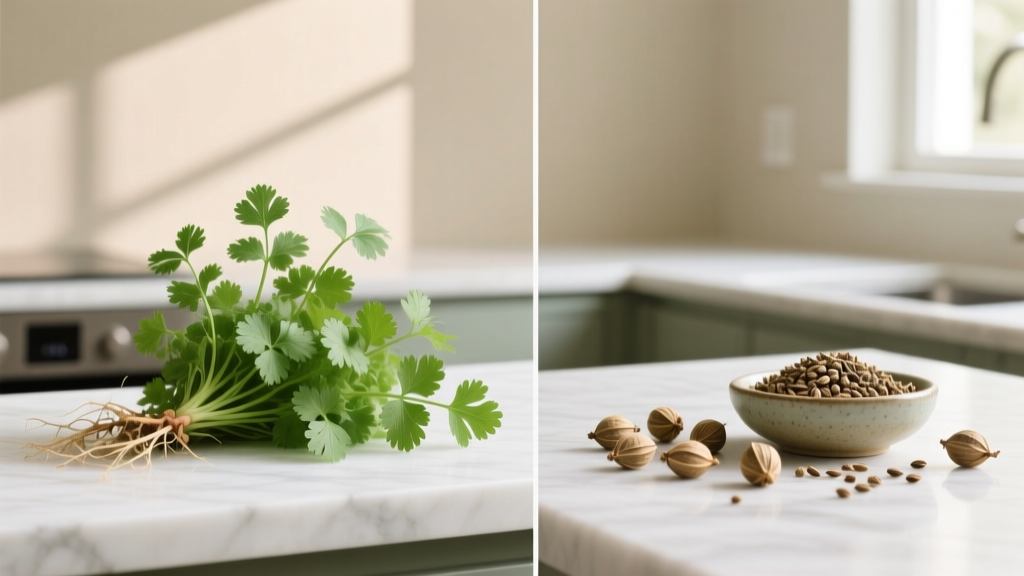
Cilantro Coriander
Cilantro and Coriander Are Not a Naming Problem — They’re a Timing Problem
Most people think the cilantro/coriander confusion stems from regional naming — American English versus British English. That’s half-true, but it misleads: the real fracture isn’t dialect, it’s developmental stage. What grows on the plant is two chemically distinct materials — one leafy and volatile, one dried and stable — harvested at different times, stored under different rules, and substituted only when context overrides chemistry. In many homes, this misunderstanding leads to flat-tasting salsas, bitter curries, and unexplained aversion in guests who’ve never tasted fresh leaves but were served ground seed in a garnish role.
The naming debate becomes irrelevant the moment you’re holding a bunch of green stems at the supermarket checkout. At that point, what matters isn’t whether your cookbook says ‘coriander leaves’ or ‘cilantro’ — it’s whether those leaves were cut yesterday or three days ago, and whether your fridge has a crisper drawer with consistent humidity control. In a home kitchen, freshness decay is rarely tracked by label; it’s tracked by aroma loss and stem softening — cues no packaging explains and no glossary defines.
There are two persistent, low-value debates that drain decision energy without improving outcomes. First: ‘Should I grow my own to guarantee freshness?’ Not unless you harvest daily and discard unused plants weekly — otherwise, home-grown often sits longer than supermarket-bought due to delayed picking. Second: ‘Do I need separate spice jars for whole vs. ground coriander?’ No — grinding whole seed just before use improves aroma, but the difference is imperceptible in stews simmered over 45 minutes, and negligible if your family prefers milder spice profiles anyway.
The real constraint isn’t botany or terminology — it’s refrigerator humidity variability. Most standard home fridges cycle between 30–60% relative humidity depending on door openings, defrost cycles, and produce load. Cilantro leaves wilt or blacken within 48 hours under low-humidity conditions, regardless of how carefully they’re wrapped. Ground coriander, meanwhile, degrades fastest not from heat but from ambient light exposure — yet few home pantries have opaque, airtight containers. This isn’t about discipline; it’s about equipment mismatch. You can’t fix cilantro shelf life with better labeling — only with better storage infrastructure.
Here’s where judgment shifts: substituting dried coriander for fresh cilantro works only when the dish relies on background warmth (e.g., lentil dal), fails catastrophically when freshness delivers texture and top-note volatility (e.g., Vietnamese pho garnish), and backfires entirely when used as a visual cue (e.g., topping a chilled avocado soup). Likewise, using fresh cilantro in place of ground coriander in dry-rubbed meats introduces unwanted moisture and burns at high sear temperatures — a physical limitation, not a flavor preference.
A more reliable filter emerges when you stop asking ‘What should I call it?’ and start asking ‘What phase of its life am I interacting with?’ Fresh leaves are a perishable herb — treat them like cut flowers. Dried seeds are a shelf-stable spice — treat them like black pepper. Ground coriander occupies a middle zone: aromatic but fragile, best measured out just before cooking, never pre-mixed into dry rubs more than 2 hours ahead. In a home kitchen, X is rarely the thing that ruins Y — inconsistent storage conditions are.
| What people fixate on | What it affects | When it matters | When it doesn't |
|---|---|---|---|
| Whether the label says "cilantro" or "coriander leaves" | Initial identification at point of purchase | When buying from vendors with inconsistent labeling (e.g., ethnic grocers without bilingual signage) | In supermarkets with standardized produce tags — both terms appear interchangeably on identical bunches |
| Using “fresh” vs. “dried” interchangeably in recipes | Volatility delivery and mouthfeel | In raw applications (chutneys, garnishes, cold salads) where aroma lifts the dish | In long-simmered braises where leaf structure disintegrates and seed oil infuses gradually |
| Storing fresh cilantro upright in water like flowers | Leaf crispness and stem integrity | When fridge humidity is below 45% and crisper drawers lack adjustable vents | When humidity is stable >55% — paper-towel wrap performs equally well and takes less space |
| Grinding whole coriander seed yourself | Aroma intensity and oil retention | In quick-cook applications (stir-fries, finishing oils) where volatile compounds drive impact | In slow-cooked legume dishes where extended heat erases aromatic distinction |
Quick verdicts for home cooks
- If your cilantro wilts in 24 hours, check crisper humidity — not the label.
- Substituting ground coriander for fresh leaves works only in dishes where texture doesn’t matter.
- Dried coriander seed stays usable for 2 years — freshness loss is gradual, not binary.
- Buying “organic cilantro” won’t prevent bitterness if stems were cut during hot afternoon harvest.
- Using fresh cilantro in marinades adds water — it dilutes acid concentration and slows penetration.
- Coriander root paste is irreplaceable in Thai curry pastes — no leaf or seed substitution compensates.
Frequently asked questions
Why do people think cilantro and coriander are interchangeable terms?
Because recipe writers often omit whether they mean leaf, stem, seed, or root — and many home cooks assume “coriander” refers to the whole plant.
Is it actually necessary to toast whole coriander seed before grinding?
No — toasting enhances aroma but isn’t required for safety or function; un-toasted seed still delivers full flavor in long-cooked dishes.
What happens if you ignore the difference between fresh and dried in a garnish role?
The dish loses brightness and structural contrast — dried coriander cannot mimic the cooling, citrusy lift of fresh leaves.
Why does some cilantro taste soapy while other bunches don’t?
Genetic variation in OR7D4 receptor sensitivity interacts with aldehyde content — but harvest time and storage temperature also shift aldehyde ratios significantly.
Can you freeze fresh cilantro without losing utility?
Yes — frozen leaves retain aroma in cooked applications, but lose texture and volatile top notes needed for raw use.
More Articles
 Grains of Paradise: Pepper's Citrusy Cousin
 Practical Potato Side Dish Recipes: Proven Techniques
 What Is Fenugreek? The Spice That Tastes Like Maple Syrup
 Simple Garlic Bread Recipe with Regular Sandwich Bread
 Is Lentil a Bean? Clearing Up the Confusion
 Sweet Storage Ideas: Keep Sugar Fresh and Clump-Free
 Licorice Root Isn’t a Herb—And That Changes Everything
 Turmeric: Fresh vs Dried (What to Know)
 Onion Fritters: Crispy Recipe Guide & Expert Tips
 Sichuan Peppercorn Guide (2026)