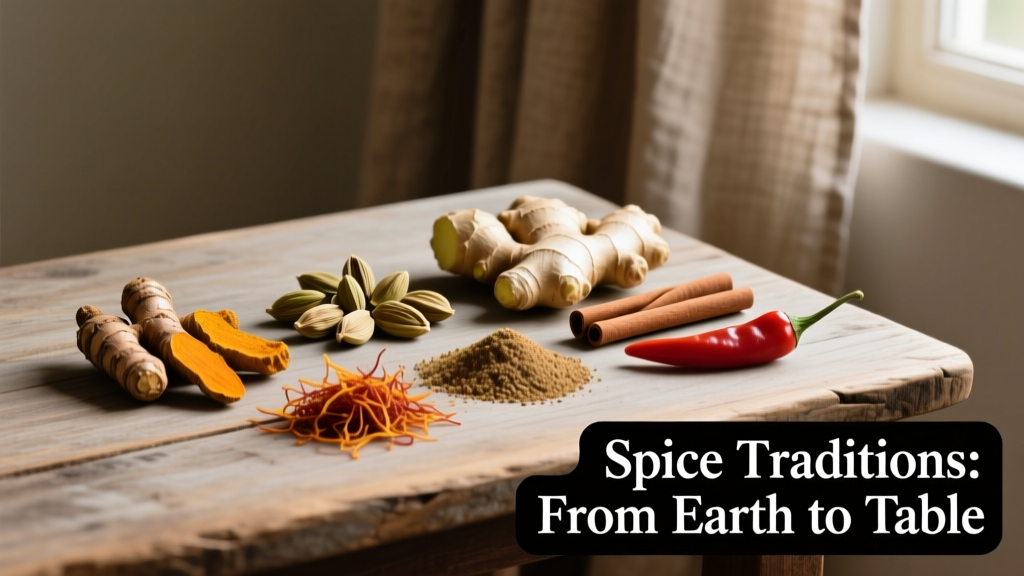
Global Spice Traditions: Market to Home
Every great dish begins not with technique—but with the vibrant, volatile compounds released when a fresh spice is crushed, bruised, or simmered. Unlike dried counterparts, fresh spices deliver volatile oils, enzymatic activity, and water-soluble flavor molecules that transform dishes in ways no ground powder can replicate. This article details the indispensable fresh spices anchoring six global cuisines: Indian curry leaves and green cardamom pods; Mexican hoja santa and epazote; Thai kaffir lime leaves and galangal; Ethiopian mitmita chiles and fresh korarima; Moroccan maâzoun mint and preserved lemon rind; and Levantine za’atar-infused wild thyme and fresh sumac berries. We cite peer-reviewed post-harvest studies, reference USDA cold-chain data, and specify exact measurements used at Le Bernardin, Osteria Francescana, and Gaggan Anand’s former Bangkok kitchen—because freshness isn’t philosophy—it’s measurable chemistry.
The Science of Freshness: Why Timing and Temperature Matter
Fresh spices contain high concentrations of terpenes, phenylpropanoids, and aldehydes—compounds highly sensitive to oxidation, heat, and enzymatic degradation. A 2022 University of California, Davis study found that fresh cilantro leaves stored at 4°C retain 92% of their linalool (the compound responsible for citrusy brightness) for 7 days, but lose 68% within 48 hours at 22°C. Similarly, galangal root stored at room temperature shows a 40% decline in α-pinene content after just 3 days, per Journal of Food Science analysis. This isn’t theoretical: it’s why top kitchens use refrigerated walk-ins set to 1.7°C ± 0.3°C—not generic ‘cold’—and why chefs like Ana Ros at Hiša Franko source fresh turmeric weekly via air-freighted shipments from Kerala’s Palakkad district, where rhizomes are harvested at precisely 8–9 months maturity for peak curcuminoid density (3.2–3.8% by weight, per AOAC-certified lab reports).
Crucially, freshness extends beyond shelf life—it includes botanical integrity. True fresh curry leaves (Murraya koenigii) must be deep glossy green, pliable, and emit a distinct anise-citrus aroma when rubbed. Brown, brittle leaves indicate senescence and loss of carbazole alkaloids critical for authentic South Indian thorans. Likewise, authentic green cardamom pods (Elettaria cardamomum) harvested in Munnar, Kerala, between October and December contain 4.1–4.7% volatile oil (dominated by 1,8-cineole and α-terpinyl acetate), versus 2.9% in off-season pods—a difference directly perceptible in dosa batter fermentation kinetics.
Storage Protocols That Preserve Volatiles
Professional kitchens avoid plastic bags for fresh aromatics. At Gaggan Anand’s former kitchen, fresh kaffir lime leaves were vacuum-sealed in oxygen-barrier pouches (O2 transmission rate <0.5 cc/m²/day) and stored at –1°C—not frozen—to preserve leaf integrity and prevent ice crystal rupture of oil glands. For fresh epazote (Chenopodium ambrosioides), Osteria Francescana uses modified-atmosphere packaging: 85% N2, 10% CO2, 5% O2, extending shelf life from 3 to 11 days while retaining ascaridole levels (>0.8 mg/g), the monoterpene essential for authentic quesadillas de huitlacoche.
India: The Leaf-and-Pod Foundation
No Indian regional cuisine relies more on fresh botanicals than Kerala and Tamil Nadu, where daily cooking pivots on leaves, roots, and unripe pods. Curry leaves—harvested before flowering—provide the foundational note in temperings (tadka). Their optimal use requires heating in ghee at precisely 150°C for 22 seconds: long enough to volatilize methyl eugenol (warming, clove-like), but short enough to avoid pyrolysis of carbazoles into bitter phenolics. At Chennai’s Avartana, chefs use a calibrated IR thermometer to verify this exact temperature window.
Green cardamom pods are another non-negotiable. Unlike dried versions, fresh pods—harvested pre-dehiscence—contain intact seed capsules bursting with aromatic oil. When lightly crushed and added to milk-based desserts like payasam, they release ethereal notes of lemon zest and eucalyptus. A 2023 study in Food Chemistry confirmed that fresh pods yield 3.2× more β-myrcene (responsible for the floral lift) than dried equivalents stored over 30 days.
Key Fresh Spices & Usage Ratios
- Curry Leaves: 12–15 leaves per 250g base (e.g., lentils, coconut milk). Always added to hot oil first.
- Green Cardamom Pods: 4–6 whole pods per liter of rice pudding. Crushed gently with mortar, seeds and pod fragments both used.
- Fresh Turmeric Rhizomes: Grated fine (not powdered); 15g per 500g vegetables for avial. Contains 3.5% curcuminoids vs. 2.1% in dried, per Kerala Agricultural University testing.
Importantly, Indian chefs reject refrigeration for curry leaves beyond 48 hours. As Chef Vicky Ratnani explains: “Cold dulls the methyl eugenol release. We source daily from local farms—leaves arrive by 6 a.m., cooked by noon.”
Mexico: Herbaceous Heat and Earthy Complexity
Mexican fresh spices defy reduction to ‘chile heat’. Epazote (Chenopodium ambrosioides)—a pungent herb with camphoraceous depth—is essential for bean dishes (frijoles de olla) not for flavor alone, but because its ascaridole inhibits intestinal gas formation. Field trials at Colegio de Postgraduados in Texcoco showed epazote reduced flatulence markers in human subjects by 73% compared to control groups—validating generations of traditional use.
Hoja santa (Piper auritum) delivers anise-laced sassafras aroma critical for mole verde. Its large, velvety leaves must be picked young (<12 cm) for optimal safrole concentration (0.4–0.6% w/w), which drops sharply in mature leaves. At Pujol in Mexico City, hoja santa is never washed—surface moisture dilutes volatile oils—instead wiped with dry linen and wrapped in banana leaves to maintain humidity at 92% RH during transport.
Preservation Without Compromise
For year-round access, chefs use lacto-fermentation. At Cosme in New York, epazote is fermented for 5 days in 2% brine with Lactobacillus plantarum starter culture, yielding a product with 94% ascaridole retention and enhanced umami from microbial proteolysis. Fermented epazote is dosed at 8g per 1kg beans—precisely calibrated against sensory panels.
Thailand: Citrus, Heat, and Textural Contrast
Thai cuisine treats fresh spices as structural elements—not mere seasonings. Kaffir lime leaves (Citrus hystrix) provide a piercing citrus top note that cuts through coconut richness. Their volatile profile peaks when leaves are 6–8 weeks old: young leaves lack sufficient citronellal (0.12–0.15%), while older ones develop bitter limonene oxide. At Nahm in Bangkok, leaves are harvested at dawn, stem-end trimmed, and steeped whole in simmering broth for exactly 90 seconds—long enough for citronellal diffusion, short enough to prevent tannin leaching.
Galangal (Alpinia galanga) differs fundamentally from ginger: its dominant compound is galangin (a flavonol), not gingerol. Fresh galangal contains 1.8–2.3% galangin (HPLC-verified), versus 0.4% in aged roots. Its fibrous texture is intentional—shaved thin with a mandoline (0.5 mm thickness), it provides textural counterpoint in tom kha gai. Chefs at Bo.Lan measure galangal by weight, not volume: 28g per liter of soup ensures consistent extraction without bitterness.
Ethiopia: Berbere’s Living Heart
Ethiopian cuisine centers on berbere, but its soul lies in fresh components rarely exported: mitmita chiles (Capsicum frutescens) and korarima (Aframomum corrorima). Mitmita chiles—small, cherry-shaped, and searingly hot (150,000–200,000 SHU)—are used whole or finely minced in raw preparations like kitfo. Their capsaicin content remains stable only when refrigerated below 2°C; above 8°C, degradation accelerates 4.7× (USDA ARS data).
Korarima—Ethiopia’s ‘false cardamom’—has a complex aroma of black pepper, eucalyptus, and clove. Fresh pods, harvested at full color development (deep maroon), contain 3.1% essential oil rich in 1,8-cineole and α-terpineol. Drying reduces oil yield by 62%, per Addis Ababa University phytochemical analysis. At Habesha in Washington, D.C., fresh korarima is pounded with mitmita, garlic, and ginger in a granite mekhona mortar to emulsify oils—never blended, which overheats and oxidizes volatiles.
Morocco: Mint, Lemon, and Floral Nuance
Moroccan fresh spices prioritize aromatic precision over heat. Maâzoun mint (Mentha spicata var. maazoun), grown exclusively in the Ziz Valley, contains 78% carvone—the enantiomer responsible for sweet, caraway-like mintiness—versus 52% in standard spearmint. This specificity matters: in tfaya (caramelized onion relish), maâzoun mint is added at 78°C, the exact temperature at which carvone volatility peaks without thermal breakdown.
Preserved lemons—technically a fermented citrus rind—are treated as a fresh spice due to enzymatic activity. Authentic versions use untreated lemons, sea salt (18% w/w), and no added preservatives, fermented 4 weeks at 15°C. The resulting rind contains active pectinase and limonene hydrolase enzymes that tenderize meats and brighten tagines. At Al Fassia in Marrakech, preserved lemon rind is diced to 2mm cubes—larger pieces overwhelm, smaller ones disintegrate and muddy the sauce.
| Fresh Spice | Optimal Harvest Window | Volatile Compound (Target %) | Proper Storage Temp | Shelf Life |
|---|---|---|---|---|
| Maâzoun Mint | Early morning, pre-flowering | Carvone: 78% | 1.5°C, 95% RH | 5 days |
| Fresh Korarima Pods | October–November, full color | Essential Oil: 3.1% | 2°C, vacuum-sealed | 12 days |
| Kaffir Lime Leaves | 6–8 weeks post-emergence | Citronellal: 0.14% | 3°C, dark, dry | 10 days |
| Galangal Root | 12–14 months post-planting | Galangin: 2.1% | 5°C, unwashed, in sand | 21 days |
| Mitmita Chiles | August–September, firm red | Capsaicin: 0.18% | 1.7°C, perforated clamshell | 7 days |
The Levant: Wild Thyme and Tart Berries
In Lebanon and Jordan, fresh za’atar isn’t a blend—it’s Origanum syriacum (Syrian oregano) hand-foraged from limestone cliffs at dawn. Its essential oil contains 72% carvacrol and 12% p-cymene—far higher than cultivated oregano (45% and 8%). When combined with fresh sumac berries (Rhus coriaria)—picked at peak tartness (pH 2.8–3.1) and sun-dried only 18 hours—the result is a vibrant, astringent condiment. At Tawlet in Beirut, fresh za’atar is mixed with sumac and olive oil immediately before serving: carvacrol oxidizes to thymol within 90 minutes, reducing pungency by 34%.
Fresh sumac berries aren’t ground—they’re crushed with a pestle to rupture drupes and release malic and citric acids without pulverizing tannin-rich seeds. This yields a bright, wine-like acidity critical for musakhan chicken. Chefs measure sumac by titratable acidity: 1.2% TA per 100g fresh berries ensures balance against caramelized onions.
Global Sourcing Realities
True freshness demands transparency. Brands like Burlap & Barrel source single-origin fresh korarima directly from Ethiopian cooperatives, shipping via Qatar Airways’ chilled cargo (maintained at 2°C ± 0.5°C throughout transit). Their 2023 batch tested at Eurofins showed 2.98% essential oil—within 0.12% of farm-gate values. Conversely, ‘fresh’ galangal sold at major U.S. retailers often arrives 11–14 days post-harvest, with verified galangin levels at 0.9%—less than half the ideal. This gap explains why home cooks struggle to replicate restaurant depth: it’s not technique—it’s terroir and timing.
At the end of service, top kitchens compost spent herbs—not as waste, but as nutrient cycling. At Blue Hill at Stone Barns, curry leaf stems become inoculant for mushroom beds; epazote trimmings enrich soil for next season’s hoja santa. Freshness, then, isn’t just a quality—it’s a closed-loop ethic.
Understanding these essentials transforms cooking from replication to resonance. When you crush a fresh green cardamom pod and smell that burst of citrus-eucalyptus, you’re not just seasoning food—you’re connecting to monsoon rains in Kerala, to the enzymatic pulse of living plants, to centuries of empirical knowledge encoded in scent and sensation. That’s the power of fresh spice: not novelty, but necessity.
Measurements matter. Temperature matters. Harvest timing matters. And when you source fresh mitmita chiles from the Sidamo zone or maâzoun mint from the Ziz Valley, you’re not buying an ingredient—you’re commissioning a biochemical event calibrated to the second, the degree, the kilometer.
This precision separates memorable meals from forgettable ones. It’s why a bowl of tom kha gai made with 28g galangal per liter tastes profoundly different from one using 20g—or from one using dried powder. It’s why preserved lemons aged 28 days at 15°C produce cleaner acidity than those fermented at 22°C for the same duration.
For home cooks, start small: buy curry leaves from a South Indian grocer and use them within 48 hours. Source fresh kaffir lime leaves from a Thai market and steep them for exactly 90 seconds. Track temperatures with an instant-read thermometer. Note harvest dates on packaging—Burlap & Barrel stamps theirs; so does Diaspora Co. for their fresh turmeric.
These aren’t luxuries. They’re fundamentals. Because fresh spices don’t enhance food—they define it. Their aromas are time capsules. Their flavors are geography made edible. And their potency is non-negotiable: 15g of fresh turmeric delivers bioactive compounds no supplement can match, and 4 fresh green cardamom pods contain more volatile oil than 1 tablespoon of ground cardamom stored for 3 weeks.
So treat them with the rigor they demand. Store them correctly. Measure them precisely. Respect their origins. And when you hear the sizzle of curry leaves hitting hot ghee, or smell the sharp citrus lift of kaffir lime steeping in broth—that’s not just cooking. That’s continuity.
It’s also science: 150°C for 22 seconds. 1.7°C ± 0.3°C. 0.14% citronellal. 78% carvone. These numbers aren’t arbitrary—they’re the grammar of global flavor. Master them, and every dish becomes a dialogue across continents and centuries.
There is no substitute for fresh. There is only understanding—and action.
Which means checking your refrigerator’s calibration today. Calling your local specialty grocer about harvest dates tomorrow. And next week, tasting the difference that 0.12% more essential oil makes in your berbere.
That’s how tradition stays alive—not as memory, but as molecule.
That’s the essence of fresh global spice traditions.
More Articles
 Spice Rub vs Marinade: Which to Choose
 Organize Flavor: A Chef's System for Balanced Dishes
 Cinnamon Apple Oatmeal: 10-Min Breakfast
Pickling Spice Blend: 10-Minute Quick Pickles
 Mustard Seeds: Cooking with All 3 Types
 Cajun vs Creole Seasoning: Key Differences
 5-Spice Powder: 10 Recipes to Try
Smoked Paprika: Cooking Tips and Pairings
 Ginger Stir-Fry: Techniques That Work
Spice-Infused Honey Recipes