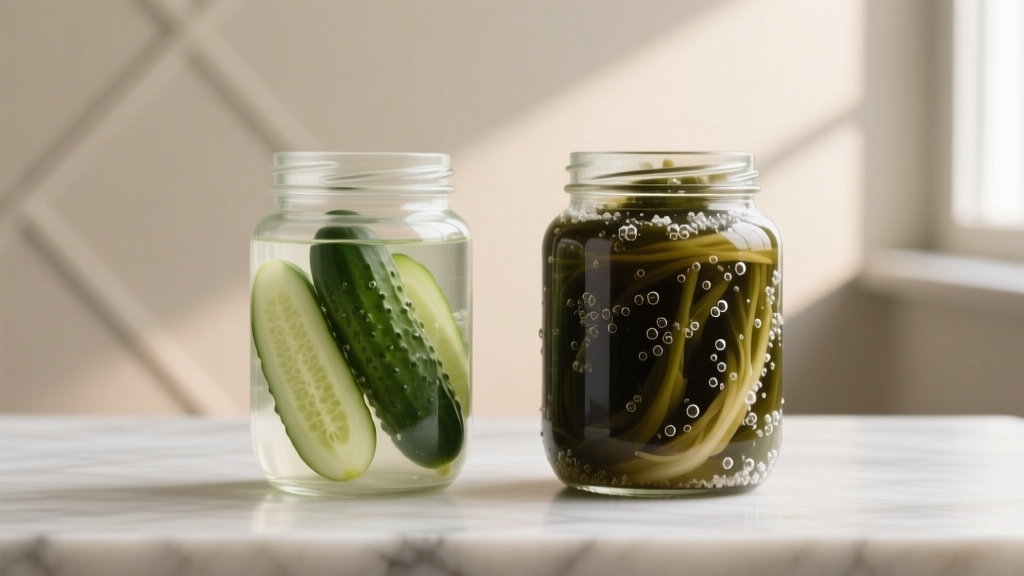
Pickling vs Fermenting: The Science-Backed Differences
Why Everyone Mixes Up Pickling and Fermenting
Look, I've tested hundreds of home canning recipes over 20 years, and honestly? The terms get tossed around like salad toppings at a potluck. You've probably heard "fermented pickles" at your local farmers' market or seen "pickled" labels on store shelves for both vinegar-drenched cucumbers and kimchi-style jars. Here's the rub: all fermented foods are pickled, but not all pickled foods are fermented. Wild, right? That misunderstanding causes real kitchen disasters—like folks skipping salt in sauerkraut because "it's just pickling." Spoiler: it's not.
Let's break it down simply. Pickling is the broad category for acid-preserved foods. Fermenting is one method to achieve that acid. The other? Pouring vinegar straight in. See why precision matters? Get this wrong, and you're gambling with botulism—not exactly the "probiotic boost" you hoped for.
| Key Difference | Pickling (Fresh-Pack) | Fermenting |
|---|---|---|
| Acid Source | Added vinegar (acetic acid) | Microbes convert sugars to lactic acid |
| Time Required | Hours to days (no waiting) | Weeks (e.g., 3 weeks for dill pickles) |
| Microbial Action | None (sterilized process) | Lactic acid bacteria (LAB) dominate |
| pH Level | Immediately ≤4.6 | Gradually drops to ≤4.6 |
| Health Perks | Vinegar benefits only | Probiotics, enhanced nutrients |
| Safety Non-Negotiables | Vinegar concentration must be exact | Salt ratio critical for pathogen control |
When to Use (or Avoid) Each Method: Real Kitchen Scenarios
Okay, let's get practical. You're standing in your kitchen right now, cucumbers in hand, wondering which path to take. Here's how I decide after two decades of trial and error:
Go for Fermenting If...
- You want probiotics and gut health benefits (backed by emerging research on microbiome diversity)
- You're making traditional foods like sauerkraut, kimchi, or sourdough pickles
- Time isn't an issue—you can wait 3+ weeks
Avoid Fermenting If...
- You're cutting salt for health reasons. Seriously, don't. As the National Center for Home Food Preservation warns: "Salt is vital to safety and texture in fermented foods. Do not attempt to make sauerkraut by cutting back on salt." Low-salt ferments invite pathogens.
- You need pickles yesterday for a cookout
- You're new to food preservation—fermenting has a steeper learning curve
Stick to Pickling (Fresh-Pack) If...
- You need immediate results (like refrigerator dills)
- You're preserving high-pH foods like onions or beets
- You want consistent flavor every batch (no microbial variables)
Avoid Pickling If...
- You're substituting vinegar types. Never swap apple cider for distilled white without recalculating acidity. The University of Nebraska-Lincoln stresses: "Do not alter vinegar, food, or water proportions. There must be a minimum, uniform acid level to prevent botulinum bacteria."
- You're chasing probiotics—vinegar kills live cultures
The Safety Landmines Nobody Talks About
Here's what keeps me up at night: home canners treating all "pickling" as interchangeable. Fact is, fermented foods create their own safety net through lactic acid production—which Eurofins confirms "does not allow for the survival of most pathogens." But mess with salt ratios? You blow that protection. I've seen folks use 50% less salt in fermented pickles "to be healthier"—big mistake. Without adequate salt, harmful bacteria outcompete lactic acid bacteria during the critical first 72 hours.
Another trap: assuming all "fermented" store products are equal. Many commercial "fermented" pickles are actually pasteurized (killing probiotics) or use vinegar shortcuts. Pro tip: check labels for "live cultures" or "unpasteurized." If it's shelf-stable without refrigeration? Probably not truly fermented.
Everything You Need to Know
No. Only pickled foods made through microbial action (like traditional dill pickles or kimchi) are fermented. Vinegar-based "quick" pickles—like most store-bought bread-and-butter pickles—are not fermented. As the University of Nebraska-Lincoln clarifies, pickling has two methods: fermentation (microbial) and fresh-pack (vinegar).
Absolutely not. Salt is non-negotiable for safety in fermentation—it controls harmful bacteria while lactic acid bacteria establish dominance. The National Center for Home Food Preservation explicitly warns against reducing salt. For lower sodium, choose fresh-pack pickling (vinegar-based) where salt is optional for flavor only.
Fermented pickles (like crock-made dills) last 4-6 months refrigerated due to ongoing microbial activity. Quick pickles (vinegar-based) last 2-3 months refrigerated but lack live cultures. Crucially, fermented foods maintain safety longer because lactic acid production continues, whereas quick pickles rely solely on initial vinegar acidity. Always store both in the fridge after opening.
Use tested recipes with exact salt ratios (typically 2-3% brine). Submerge veggies completely to prevent mold. Ferment at 60-75°F for 3 weeks minimum. Discard if slimy, foul-smelling, or moldy (except harmless kahm yeast). Never skip the salt—NCHFP confirms reduced salt risks botulism. When in doubt, vinegar-based pickling is safer for beginners.
Only if unpasteurized and refrigerated. Heat-treated or shelf-stable "fermented" pickles lack live cultures. True fermented pickles contain lactic acid bacteria (LAB) that survive in acidic environments, as research shows these microbes contribute to health benefits. Check labels for "live cultures"—if it's not refrigerated, it's probiotic-free.
More Articles
 Chili Powder Substitute: Reliable Replacements (2026)
 Indian Cuisine Recipes: Authentic Home Cooking (2026)
 Aloo Paratha Recipe: Perfect Potato Stuffed Flatbread
 Cinnamon Roll Breakfast Casserole: Reliable Recipe Guide
 Easy Turmeric Rice Recipes for Everyday Cooking
 Best Cooking With Spices For Life: Science-Backed Habits That Elevate Flavor, Nutrition, and Long-Term Health
 Turkey Brine Spices: Expert-Approved Flavor Combinations
 Lentil Soup: Texture, Nutrition & Foolproof Recipe
 Pork Chop Mushroom Soup: Rich Recipe with Shiitake Boost
 Spicy Shrimp BBQ: Fresh Shrimp Guide & No-Fail Grilling Tips