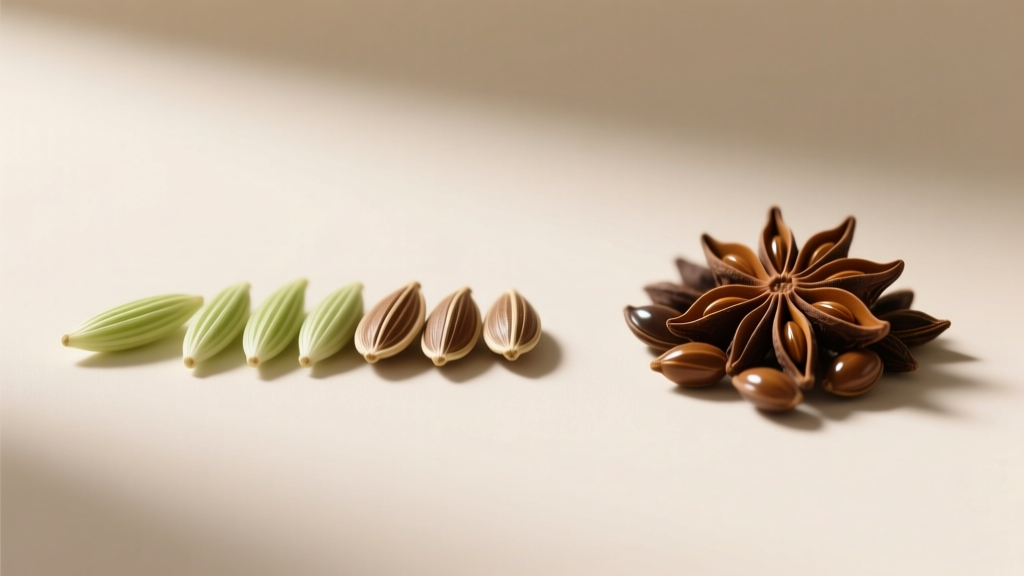
Fennel Seeds vs Anise Seeds: Clear Differences Explained
Fennel Seeds Aren’t a Substitute for Anise Seeds — Unless You’re Not Baking
Most people fixate on the shared licorice note and assume interchangeability. That assumption survives because both seeds appear in spice racks side by side, labeled vaguely as ‘licorice-flavored’, and because dried fennel is often sold in bulk bins where packaging offers no usage context. The real consequence isn’t flavor failure — it’s misaligned texture timing and unmet aromatic release patterns. In a slow-simmered Italian sausage mix, fennel’s mild, rounded warmth builds gradually; anise’s sharp, volatile top-note flashes early and fades fast. When a home cook substitutes one for the other in a bread dough meant to rise overnight, the difference rarely registers in taste — but the yeast activity shifts subtly under that volatile oil layer, and the crumb ends up denser than expected. It’s not ruined. It’s just quietly inconsistent with what the recipe promised — and that inconsistency compounds across repeated attempts until confidence in the whole category erodes.
The core judgment has a strict boundary: fennel and anise seeds are functionally interchangeable only when the dish relies on background aroma, not structural timing. That means they swap cleanly in stews where herbs simmer for hours, or in braised meats where fat carries and blunts volatility. But the moment heat is brief (roasting, quick sauté), or when dry-heat application dominates (baking, grilling), the divergence becomes decisive. Fennel’s essential oil degrades slower and integrates more evenly; anise’s oil volatilizes within seconds at 180°C. In a home oven preheating unevenly, that gap widens — not because of technique, but because domestic equipment lacks the thermal precision to compress that volatility window. So the ‘swap’ works only in contexts where time and temperature are forgiving — not where they’re defining.
Two ‘invalid’ debates dominate home discussions — and both distract from actual outcomes. First: ‘Which is stronger?’ This assumes linear intensity, but the two oils don’t scale the same way. Anise’s impact peaks then drops; fennel’s rises, plateaus, and lingers. Comparing them like volume knobs misleads. Second: ‘Can I grind them together to balance?’ Grinding doesn’t harmonize — it homogenizes volatility, making both behave worse in baking. The resulting powder loses anise’s flash and dulls fennel’s depth, giving neither benefit. Neither question changes the outcome in practice. What matters isn’t strength or blending — it’s whether the dish needs a burst or a base. Fixating on strength or synergy ignores how each seed interacts with moisture loss, fat absorption, and starch gelation — all conditions present in every home kitchen, but rarely named in recipes.
The real constraint isn’t flavor preference or pantry stock — it’s shelf life under typical home storage. Anise seeds lose their volatile oil within 6–9 months in a warm, light-exposed cupboard — a condition common in many homes. Fennel holds usable aroma for 12–18 months under the same conditions. So when a cook reaches for ‘the licorice one’ six months after purchase, they’re almost certainly grabbing degraded anise — and blaming the wrong seed for flatness. This isn’t about freshness discipline; it’s about physics. Anise’s oil is simply less stable. In a household where spices sit on open shelves near a stove or window, this degradation is inevitable — and it makes substitution feel like failure even when the original choice was correct. No amount of grinding or toasting compensates for that chemical attrition.
Over the past year, home cooks have begun labeling jars with purchase dates — not as a habit, but as a reaction to repeated mismatches between recipe photos and their own results. It’s not driven by food blogs or influencers; it’s a quiet, tactile correction emerging in kitchen notes and margin scribbles. The shift isn’t toward expertise — it’s toward calibration. People aren’t learning chemistry; they’re learning that ‘licorice spice’ isn’t one thing, and that time stamps matter more than origin stories. This isn’t trend adoption — it’s error containment. The signal isn’t louder talk about anise vs fennel; it’s fewer substitutions made without checking the jar’s date first.
In a home kitchen, using fennel instead of anise in biscotti won’t ruin texture — but it will mute the bright top note that defines the category’s signature snap. In contrast, substituting anise for fennel in a lamb kofta marinade risks overwhelming the meat’s natural sweetness before the fat renders. And in a simple tomato sauce where both could work, the deciding factor isn’t origin or oil content — it’s whether the sauce will be frozen. Anise’s volatile profile fractures under freeze-thaw cycles; fennel’s holds. None of these outcomes depend on skill level. They depend on matching seed behavior to thermal and temporal conditions — not to flavor labels. In a home kitchen, X is rarely the thing that ruins Y — but mismatched volatility timing *is*.
| What people fixate on | What it affects | When it matters | When it doesn't |
|---|---|---|---|
| Licorice flavor intensity | Initial aroma perception | Baking, quick roasting, garnishing | Slow braises, long-simmered soups |
| Origin (India vs Egypt) | Trace mineral content, negligible oil variation | None — no documented sensory or functional impact in home use | All home cooking scenarios |
| Grinding before use | Oil release speed and surface exposure | Dry rubs, short-cook applications | Whole-seed infusions, pickling brines |
| Color or size differences | Visual consistency only | Plated dishes where appearance is primary | Any dish served mixed or chopped |
Quick verdicts for home cooks
- If your recipe bakes for >25 minutes and uses whole seeds, fennel and anise behave nearly identically — choose based on what’s fresher.
- Substituting anise for fennel in Indian or Middle Eastern savory dishes usually overpowers — stick with fennel unless the recipe explicitly calls for anise’s sharper edge.
- When freezing a spiced sauce or paste, fennel retains its character better — anise will flatten unpredictably after thawing.
- If you’re seasoning ground meat for grilling, anise’s volatility gives faster surface impact — but fennel integrates deeper during longer cook times.
- For tea or digestive infusions, fennel’s milder, longer-lasting effect suits daily use — anise’s potency demands lower dosage and shorter steeping.
- When cooking for children or sensitive palates, fennel’s gentler profile rarely triggers aversion — anise’s intensity can polarize even before tasting.
Frequently asked questions
Why do people think fennel and anise seeds are interchangeable in baking?
Because recipes rarely specify oil volatility — they list ‘licorice spice’ and assume uniform behavior. But anise’s rapid flash and fennel’s gradual bloom interact differently with yeast activity and starch gelation during oven spring.
Is it actually necessary to toast either seed before use?
No — toasting amplifies existing oil but doesn’t create new compounds. In home kitchens, it mainly compensates for stale stock, not inherent weakness.
What happens if you ignore the difference in a slow-cooked lentil soup?
Almost nothing perceptible — both integrate fully over 45+ minutes of simmering, and their divergent release curves converge under prolonged heat and liquid.
More Articles
 Colman's Mustard Powder: Uses, Substitutes & Storage Guide
 Cinnamon Types: Origins and Uses
 Bitter Greens: 25 Types With Cooking Tips
 Chicken Soup Spices: 8 Best Additions
 How to Cook Brie: Simple Baked Method Guide
 Can Sausage Be Pink? Food Safety Facts Explained
 Sichuan Peppercorn: Numbing Spice Guide
 Can Ginger Go Bad? Signs, Shelf Life & Storage Tips
 Creamy Cauliflower Puree Recipe: Simple & Healthy Side Dish
 What Does a Mustard Seed Grow Into? Complete Growth Guide