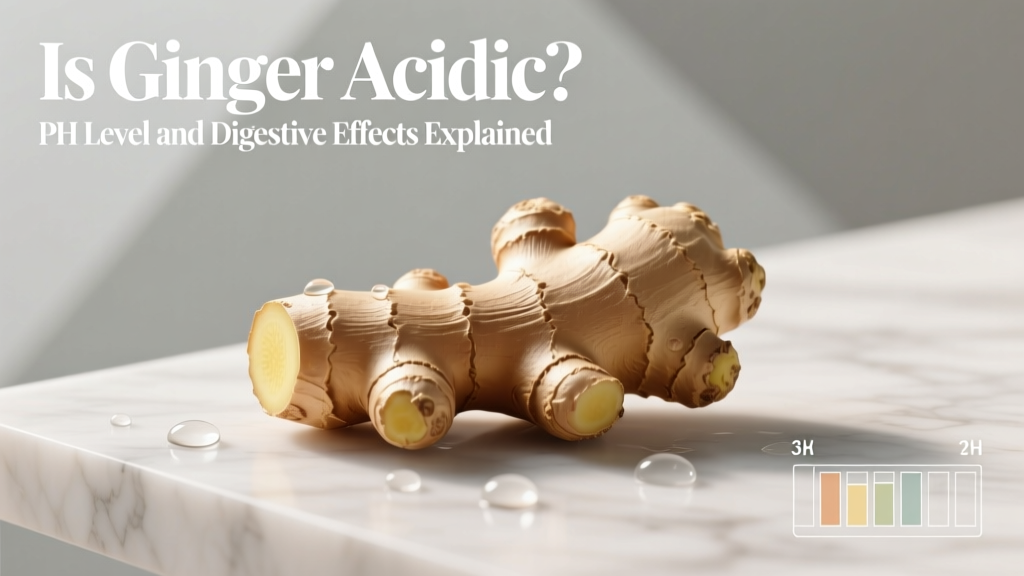
Is Ginger Acidic? pH Level and Digestive Effects Explained
Ginger Is Not Acidic—And That Mislabeling Breaks Real Cooking Decisions
Most people assume ginger is acidic because it’s sharp, pungent, and often grouped with lemons, vinegar, or chilies in ‘bright’ or ‘zesty’ flavor categories. This misattribution spreads through food blogs, label copy (“adds acidity!”), and even nutrition apps that auto-categorize all spicy-tasting ingredients as acid-forming. In practice, this leads to real consequences: families avoiding ginger for reflux concerns despite no clinical link; cooks overcompensating with baking soda in gingerbread (altering texture without need); or substituting milder spices in marinades based on false pH assumptions—not taste or chemistry.
Ginger’s actual pH sits between 5.6–5.9 when freshly grated—a range shared by carrots, green beans, and ripe bananas. It is mildly acidic by lab measurement, yes—but not functionally acidic in the way vinegar (pH ~2.4) or lemon juice (pH ~2.0) are. The distinction collapses outside controlled lab conditions. In a home kitchen, pH only becomes operationally relevant when ginger interacts with other ingredients at scale and over time—like soaking in citrus juice for 12+ hours, or fermenting with whey where microbial activity depends on ambient acidity. Otherwise, its tartness comes from volatile compounds (gingerols, shogaols), not proton concentration. You taste heat and bite—not acidity.
The first invalid fixation is whether ginger ‘increases stomach acid’. It doesn’t—and no credible gastroenterology guideline ties fresh ginger intake to gastric pH shifts in healthy adults. The second is whether ginger must be ‘balanced’ with alkaline foods (e.g., spinach, cucumber) to ‘neutralize’ its supposed acidity. That framing ignores how digestion works: gastric acid production is hormonally regulated, not ingredient-triggered. Neither fixation changes outcomes in daily cooking. They consume mental bandwidth better spent on actual variables: grating fineness, freshness, or thermal exposure time—all of which alter ginger’s aromatic profile far more than any imagined pH effect.
The one constraint that *does* shift outcomes is refrigerator storage duration—not for safety, but for volatile loss. Fresh ginger degrades fastest when peeled and submerged in water (a common hack). Within 3–5 days, gingerol oxidation accelerates, yielding sharper, more acrid notes that *mimic* acidity in perception—even though measured pH barely moves. This isn’t chemistry; it’s sensory drift. Families relying on prepped ginger for weekly stir-fries notice this drop-off most: the same quantity tastes harsher, less rounded, and triggers mistaken assumptions about ‘increased acidity’. No pH meter needed—just smell and mouthfeel tell the story.
Over the past year, fewer home cooks are asking ‘Is ginger acidic?’ in search. Instead, queries like ‘why does my ginger taste sour after 4 days?’ or ‘ginger making my smoothie bitter’ have risen—shifting focus from abstract classification to observable behavior. This signals a quiet pivot: users are trusting their senses over labels. They’re noticing that ginger’s edge changes with age, prep method, and co-ingredients—not inherent acidity. That’s progress. It means the question isn’t wrong—it’s just been asked at the wrong level of granularity for home use.
Here’s where judgment splits—not by pH, but by physical context:
• In a hot tea steeped 10 minutes? Ginger’s pH is irrelevant; extraction temperature and cut size dominate flavor release.
• In a raw mango-ginger salsa served same-day? Its mild acidity blends seamlessly; no balancing act required.
• In a lacto-fermented carrot-ginger relish held 7 days? Then yes—ginger’s organic acids contribute to the overall titratable acidity that supports safe fermentation. But even there, it’s not ginger alone—it’s the cumulative acid load from all components.
| What people fixate on | What it affects | When it matters | When it doesn't |
|---|---|---|---|
| Ginger’s measured pH (~5.6–5.9) | Laboratory proton concentration | In long-term fermentation or pH-sensitive canning protocols | In teas, stir-fries, baked goods, or fresh salsas |
| ‘Acidic taste’ of raw ginger | Sensory perception (gingerol volatility) | When used raw in high-moisture, low-pH dressings | When cooked, dried, or paired with fats/dairy |
| Label claims like ‘acid-forming’ | Dietary myth propagation | For clinical acid-reflux management under supervision | In everyday meal planning for healthy adults |
| Substituting with turmeric or galangal | Flavor continuity, not pH alignment | When replicating regional recipes requiring specific pungency | When seeking ‘less acidic’ alternatives (they aren’t) |
Quick verdicts for home cooks
- If your ginger tastes sour after refrigeration, discard it—it’s oxidized, not ‘more acidic’.
- Adding ginger to lemon water won’t meaningfully lower pH; citric acid dominates.
- For reflux-prone family members, fresh ginger is usually tolerated—unless raw and very fibrous.
- Ginger powder in cookies doesn’t require alkaline balancing; Maillard reactions override pH effects.
- Pairing ginger with yogurt neutralizes perceived sharpness—not acidity—via fat coating.
- In fermented hot sauce, ginger contributes flavor and mild acidity, but never drives safety margins.
Frequently asked questions
Why do people think ginger is acidic?
Because its pungent, biting sensation is conflated with sourness—and many assume ‘spicy = acidic’, especially when ginger appears alongside citrus or vinegar in recipes.
Is it actually necessary to test ginger’s pH before using it in preserves?
No. Standard canning guidelines rely on added acid (vinegar, citric acid), not ingredient pH. Ginger’s contribution is negligible in that context.
What happens if you ignore ginger’s pH in homemade kombucha?
Nothing measurable. Kombucha’s acidity comes from bacterial metabolism—not ginger’s baseline pH. Flavor may shift, but safety remains unchanged.
Does cooking ginger make it less acidic?
Its measured pH changes minimally with heat. What drops is volatile gingerol intensity—making it taste smoother, not chemically less acidic.
Can ginger trigger acid reflux even if it’s not acidic?
Rarely—and only when raw, coarse-grated, and consumed on an empty stomach by sensitive individuals. It’s mechanical irritation, not pH-driven.
Forget pH meters. In a home kitchen, ginger’s behavior is dictated by three things: how fresh it is, how finely it’s cut, and what it touches—not its position on a logarithmic scale. If it smells clean, grates easily, and tastes warm-not-sharp, its acidity is functionally zero. That’s not simplification. It’s precision calibrated to real use.
More Articles
 Grains of Paradise: Pepper's Citrusy Cousin
 Air Fryer Baked Potatoes: Faster, Better Texture (2026)
 Spice Powder Quality Checklist (2026 Guide)
 SPAM Food Meaning: Not an Acronym - Here's the Truth
 How to Choose Beef: A Science Guide
 Can You Eat Cinnamon Sticks? Safety Guide
 McCormick Cinnamon: Cassia vs Ceylon (2026)
 Japanese Sweet Potato Calories & Nutrition (2026)
 How to Make Garlic Sauce: Simple 5-Ingredient Recipe
 Anise vs Star Anise: Key Differences