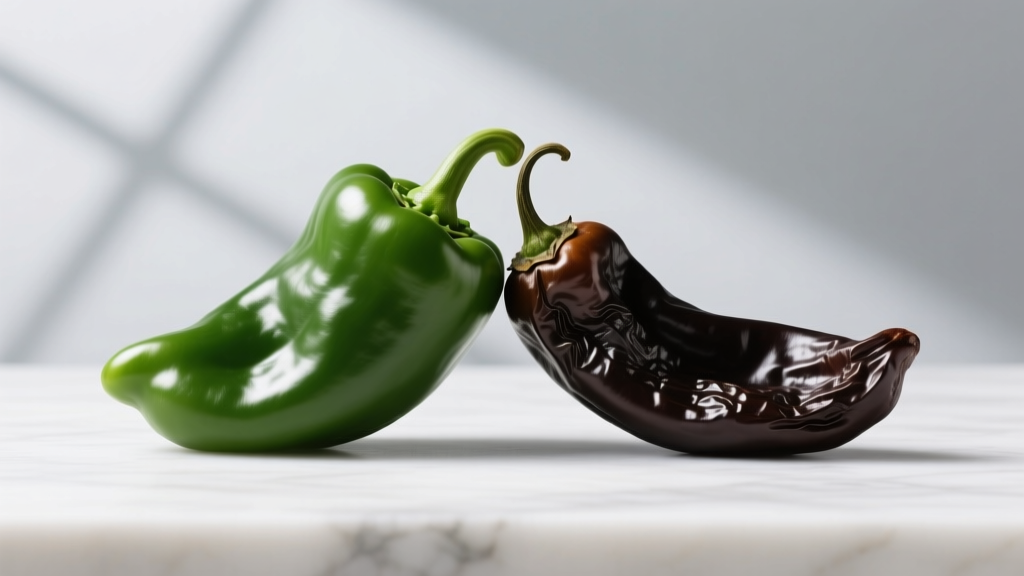
Poblano vs Pasilla Pepper: Key Differences Explained
Poblano and Pasilla Are Not Interchangeable—Unless You’re Not Serving Anyone
Most people assume poblano and pasilla are regional aliases—like ‘zucchini’ and ‘courgette’—and treat them as drop-in substitutes. That assumption isn’t wrong because of botany or labeling; it’s wrong because of how flavor settles in a real meal. When a parent roasts poblanos for chiles rellenos on a Sunday afternoon, they’re counting on that mild, grassy sweetness to hold up under cheese and egg batter. If they accidentally use dried pasillas instead—thinking ‘it’s just the same pepper, aged’—the dish gains a raisin-like depth and tannic dryness that clashes with the custard texture. The result isn’t ‘spicier’ or ‘darker’; it’s tonally dissonant. Kids push the plate away. Guests pause mid-bite. No one says why—but the meal loses its quiet authority. This isn’t about authenticity. It’s about sensory coherence in low-stakes, high-intimacy cooking.
The distinction stops mattering only when flavor impact is intentionally suppressed: in heavily spiced stews where both peppers vanish into cumin and oregano, or in blended sauces where texture and aroma are homogenized before serving. In those cases, the difference between fresh poblano and dried pasilla becomes background noise—not because the peppers taste alike, but because other elements dominate so completely that the pepper’s individual voice is muted. This doesn’t mean substitution is ‘fine.’ It means the consequence is absorbed, not avoided. That absorption only works when at least two conditions hold: the sauce simmers for over 45 minutes, and the final dish serves four or more people. In a two-person weeknight taco night? There’s no buffer. The pepper’s character remains exposed—and misalignment shows immediately.
First invalid fixation: ‘They’re both green when fresh, so they must be the same stage.’ Not true. Poblanos are harvested immature and sold fresh; pasillas are the fully ripened, dried form of the *chilaca* pepper—not the poblano. Confusing them stems from supermarket labeling errors (‘pasilla’ stamped on bags containing dried poblanos) and bilingual menu shorthand that flattens botanical lineage into convenience. Second invalid fixation: ‘If I rehydrate a pasilla, it’ll taste like a fresh poblano.’ Rehydration restores pliability, not chemistry. A soaked pasilla still carries oxidized capsaicin derivatives and Maillard compounds from drying—flavor notes that fresh poblano lacks entirely. Neither error breaks the dish outright. But both delay recognition of what’s actually shaping the taste: not moisture content or skin texture, but developmental timing and post-harvest transformation.
The real constraint isn’t availability or heat tolerance—it’s pantry decay. Most home cooks store dried pasillas in open jars or paper bags, where volatile oils evaporate within three months. What remains is a brittle, leathery chip with muted fruit and amplified bitterness. Meanwhile, fresh poblanos last only 5–7 days in crisper drawers—even with damp paper towels. So the practical question isn’t ‘which pepper is more authentic?’ It’s ‘which one will still have flavor when I reach for it tonight?’ In many homes, the answer shifts weekly: pasillas lose nuance fast unless vacuum-sealed and frozen; poblanos lose structure fast unless roasted and frozen whole. Budget rarely dictates choice here—time does. Roasting, peeling, and freezing poblanos takes 25 minutes you may not have. Buying pasillas pre-ground saves zero time if they’ve gone stale.
Here’s where judgment fractures by context: If you’re making rajas con crema, use fresh poblano—its vegetal snap balances the cream’s richness. If you’re building a mole negro base, use pasilla—its fermented-dried depth anchors chocolate and toasted nuts. If you’re stuffing peppers for dinner *tonight*, and only pasillas are in the pantry, skip stuffing altogether—make a quick pasilla-and-onion sauté instead. Don’t force equivalence. If you’re meal-prepping for lunches all week, roast and freeze poblanos *now*, even if you won’t use them for days. If you’re adapting a family recipe passed down with ‘pasilla’ written in faded ink, check whether the original was made in Oaxaca (where true pasillas grow) or central Mexico (where ‘pasilla’ often meant dried poblano). And if your partner hates smoky notes but loves earthiness, skip pasilla-based salsas—poblano delivers earth without smoke.
Stop asking which pepper is ‘correct.’ Ask instead: ‘What does this dish need to feel resolved—not spicy, not complex, but *settled*?’ That resolution comes from alignment between pepper maturity, preparation method, and eating context—not from matching Latin names to English labels. In a home kitchen, mismatched peppers rarely ruin food technically. They erode confidence. You second-guess the seasoning. You wonder if you misread the recipe. That hesitation is the real cost—not heat level, not color, not even flavor loss. It’s the quiet friction between intention and outcome. The simplest filter isn’t origin or Scoville range. It’s this: if the pepper’s role is structural (holding filling, defining texture), use poblano. If its role is atmospheric (layering depth, anchoring aroma), use pasilla. Everything else is negotiation with diminishing returns.
| What people fixate on | What it affects | When it matters | When it doesn't |
|---|---|---|---|
| Color (green vs black/brown) | Visual expectation of freshness or roast level | In stuffed dishes or charred-topping applications | In blended moles or long-simmered soups |
| Heat level (mild vs medium) | Immediate mouthfeel, not overall balance | In raw salsas or quick sautés | When paired with dairy, sugar, or acid in finished dish |
| Label wording (“pasilla” on bag) | Assumed botanical identity | In recipes specifying regional technique (e.g., Oaxacan mole) | In improvised weeknight cooking with pantry-only ingredients |
| Drying status (fresh vs dried) | Moisture contribution and textural role | In dishes where pepper provides body (rajas, rellenos) | In sauces reduced to paste or oil infusion bases |
Quick verdicts for home cooks
- If you’re roasting peppers for tacos tonight and only have pasillas, make a quick oil-infused salsa instead—don’t try to mimic roasted poblano texture.
- When doubling a chile relleno recipe, buy fresh poblanos—even if pasillas are cheaper—because structural integrity collapses with dried substitutes.
- If your mole tastes flat despite correct spices, swap in pasilla for ancho: its fermented-dried profile adds dimension ancho can’t replicate.
- For kid-friendly stuffed peppers, skip pasilla entirely—even rehydrated—its tannic edge reads as ‘bitter’ before ‘complex’ to undeveloped palates.
- If you find ‘pasilla’ labeled on a bag of wrinkled dark peppers in your local market, assume it’s dried poblano unless verified by origin stamp or vendor confirmation.
- When meal-prepping roasted peppers for the week, freeze poblanos whole after charring—pasillas gain no benefit from freezing and lose aroma faster once thawed.
Frequently asked questions
Why do people think poblano and pasilla are the same pepper?
Because U.S. grocery labeling often misapplies “pasilla” to dried poblanos—a decades-old retail shortcut that conflates maturity stage with species. Botanically, they’re distinct cultivars with different harvest timing and drying behavior.
Is it actually necessary to seek out true pasilla for mole negro?
Only if the mole relies on layered fermentation notes and slow-building umami. Substituting ancho or dried poblano yields a sweeter, flatter base—functional, but missing the quiet resonance that defines traditional versions.
What happens if you ignore the poblano/pasilla difference in a simple sauté?
You’ll get edible food, but the aromatic arc changes: poblano offers green-vegetal lift; pasilla contributes dried-fruit gravity. One supports brightness; the other pulls toward depth. Neither is wrong—both are consequential.
More Articles
 Allspice vs Pumpkin Pie Spice: What's the Difference?
 Garlic For Flavor: Unlocking Depth, Complexity, and Culinary Precision
 Chipotle vs Ancho vs Guajillo: Chili Guide
 Cream Cheese Potato Soup Crock Pot: Foolproof Recipe Guide
 Can Ginger Go Bad? Signs, Shelf Life & Storage Tips
 Sweet Potato Au Gratin: Recipe & Pro Tips
 How to Cook in an Air Fryer: Step-by-Step Guide
 What Does Fresh Dill Look Like: Visual Identification Guide
 Potato Croquettes: Crispy Outside, Fluffy Inside
 How to Identify a Bad Sweet Potato: 5 Clear Warning Signs