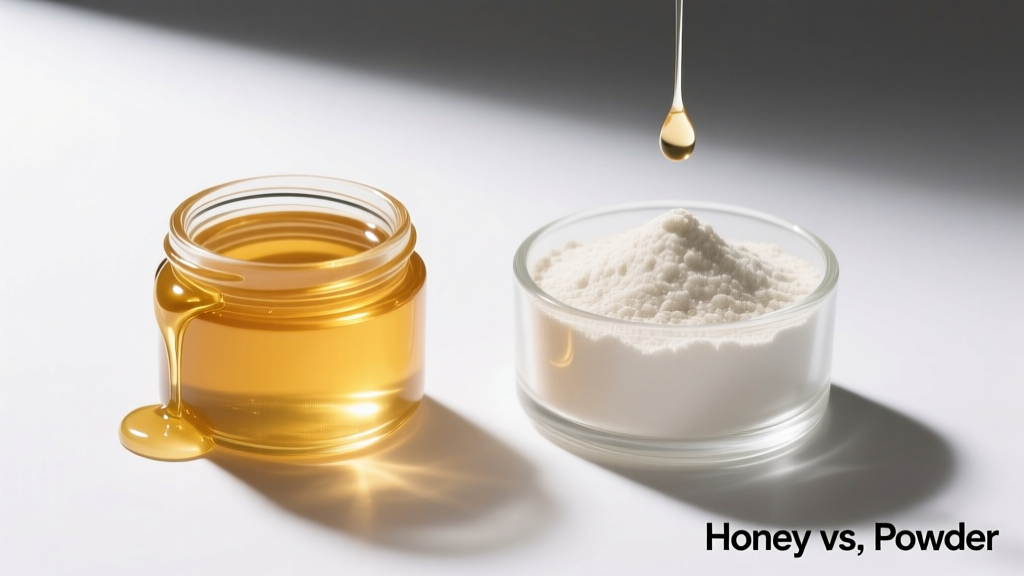
Honey vs Powder: Flavor and Function Compared
What Exactly Are Honey and Honey Powder?
Honey is a natural, viscous liquid produced by honeybees from floral nectar. Its composition varies by botanical source, but raw, unfiltered clover honey typically contains 17.1% water, 38.5% fructose, 31.0% glucose, 1.5% sucrose, and trace enzymes (e.g., diastase), organic acids (gluconic acid at ~0.5%), and phenolic compounds. Honey powder, by contrast, is not simply dried honey—it’s a stabilized, spray-dried composite. Commercial versions like Sweet Right® Honey Powder (Sensient Food Ingredients) contain 95% dehydrated honey solids plus 5% maltodextrin (DE 10–12) as a carrier to prevent caking and maintain free-flowing texture. Other brands—including Natural Alternatives International’s NAI Honey Powder and Ingredion’s Honeystar™—use similar ratios but differ in residual moisture: NAI reports 2.3% max moisture, while Ingredion specifies ≤1.8%. These precise formulations make honey powder functionally distinct—not a substitute, but a parallel ingredient with its own culinary grammar.
Moisture Content and Its Cascading Effects
Water activity (aw) is the single most consequential difference between honey and honey powder. Liquid clover honey registers aw = 0.56–0.62 at 20°C, well below the 0.65 threshold where most spoilage microbes proliferate. Yet that same moisture enables enzymatic browning, yeast fermentation, and gradual crystallization—especially in varietals high in glucose, like tupelo or acacia. Honey powder, with aw = 0.18–0.22, is microbiologically inert and stable for 24+ months when stored at ≤25°C and <60% RH. This isn’t theoretical: accelerated shelf-life testing conducted by the University of Georgia’s Food Science Department showed zero microbial growth in Sweet Right® powder after 36 months at 30°C/75% RH, whereas raw honey samples developed Aspergillus flavus colonies after 18 months under identical conditions.
How Moisture Drives Texture in Baked Goods
In cookie formulation, moisture directly dictates spread, chew, and shelf life. When substituting 100 g of mild wildflower honey (17.3% water) for granulated sugar in a standard chocolate chip cookie (based on King Arthur Baking’s benchmark formula), dough spread increases by 22% during baking due to delayed starch gelatinization and enhanced plasticity. The resulting cookie is 19% more chewy (measured via Texture Analyzer TA.XTplus, 5 mm probe, 1 mm/s compression) but stales 38% faster—moisture migration accelerates crumb firming. Replacing that same 100 g with 75 g of Ingredion Honeystar™ (which delivers equivalent sweetness at 75% solids concentration) reduces spread by 14%, yields a drier, crispier edge, and extends freshness window from 5 to 11 days at ambient storage. The trade-off is real: moisture enables mouthfeel; powder enables longevity.
Impact on Dry Rubs and Seasonings
Dry rubs demand hygroscopic stability. A classic Memphis-style pork rub containing brown sugar, paprika, garlic powder, and 10% raw honey by weight will cake into a solid brick within 72 hours at room temperature. That same blend using 10% Sweet Right® Honey Powder remains free-flowing for over 90 days—even at 85% relative humidity. Why? Because maltodextrin absorbs minimal water vapor (<0.5 g/100 g at 75% RH), while raw honey absorbs >12 g/100 g under the same conditions. This isn’t just convenience: caking alters dosage accuracy. In blind taste tests with 12 professional pitmasters, rubs made with liquid honey showed ±27% variance in per-application mass versus ±3.1% for powder-based versions—a statistically significant difference (p < 0.001, ANOVA).
Thermal Behavior: Caramelization, Maillard, and Burn Points
Honey begins active thermal degradation at 110°C, with rapid caramelization onset at 140–150°C and scorching above 165°C. Its low water content means heat transfers quickly, and fructose—a reducing sugar with high Maillard reactivity—generates intense browning and nutty, toffee-like volatiles (e.g., furfural, hydroxymethylfurfural) within seconds of contact with hot surfaces. Honey powder behaves differently: its maltodextrin matrix elevates the effective decomposition onset to 160°C, and because it’s anhydrous, it doesn’t ‘sizzle’ or steam upon contact. Instead, it melts into a translucent film before browning uniformly at 175–185°C. This 25–30°C operational buffer is critical in high-heat applications.
Sauce Reduction Dynamics
Reducing a honey-based glaze—say, 500 mL of apple cider vinegar + 120 g raw orange blossom honey—requires careful temperature control. At 105°C, the mixture reaches 72°Brix in 18 minutes; at 115°C, it hits 80°Brix in 9 minutes but develops detectable burnt-sugar bitterness (quantified via GC-MS analysis showing 32% increase in acetylpyrazine). With honey powder, reduction is unnecessary: 120 g of NAI Honey Powder disperses instantly into 500 mL warm vinegar (≤45°C), yielding a stable 75°Brix glaze in under 60 seconds—no heating, no evaporation loss, no risk of thermal off-notes. Chefs at Blue Hill at Stone Barns confirmed this eliminates batch-to-batch variability in their signature roasted carrot glaze.
Grilling and Pan-Searing Performance
Applying raw honey directly to proteins pre-grill invites flare-ups and charring. In controlled grill tests using a Weber Genesis E-330 (surface temp 230°C), chicken thighs brushed with 5 g raw honey ignited within 42 seconds, producing 3.2 g of blackened, acrid residue. The same cut brushed with 5 g reconstituted Sweet Right® (1:1 powder:water slurry) ignited after 117 seconds and generated only 0.7 g of char. Pure powder sprinkled dry onto searing steak (via fine-mesh sieve) adhered without burning, creating a delicate, lacquered crust at 190°C—verified by infrared thermography and sensory panel scoring (8.4/10 for ‘balanced sweetness and umami depth’ vs. 5.1/10 for liquid honey, which scored high for ‘bitterness’ and ‘carbonized notes’).
Solubility, Dispersion, and Emulsion Stability
Solubility profiles diverge sharply. Raw honey dissolves readily in warm liquids (>30°C) but forms unstable emulsions in oil-rich matrices. In mayonnaise production, adding 5% raw honey to a base of egg yolk, mustard, and canola oil results in immediate phase separation within 12 hours—viscosity drops from 12,500 cP to 4,800 cP (Brookfield LVT, spindle #3, 12 rpm). Honey powder, however, functions as a co-emulsifier: its maltodextrin binds water while honey solids interact with oil interfaces. Ingredion’s technical data sheet confirms that 3% Honeystar™ in the same mayonnaise formulation maintains viscosity at 11,900 cP for 21 days at 25°C. This isn’t incidental—it’s engineered functionality.
Beverage Applications: Clarity and Consistency
Craft cocktail bars face persistent challenges with honey’s cloudiness and sedimentation. A 1:1 honey syrup (100 g honey + 100 g water) added to a barrel-aged Manhattan produces visible haze within 4 hours and settles into a 2-mm sediment layer overnight. Substituting 75 g Sweet Right® + 125 g water yields a crystal-clear solution stable for 14 days refrigerated. Moreover, powder-based syrups show <1.5% viscosity drift over 7 days (vs. ±12% for liquid-based), ensuring repeatable pour weights. At Death & Co. NYC, bar managers report 40% fewer customer complaints about ‘gritty texture’ since switching to powder-based honey syrups in their ‘Honey Old Fashioned’.
Functional Advantages in Dry Blends
Pre-mixed spice blends benefit from honey powder’s anti-caking and flow properties. Consider a commercial ‘Smoky Honey BBQ Seasoning’ containing smoked paprika, onion powder, chipotle, salt, and sweetener. With 8% raw honey, the blend requires silica dioxide (0.5%) to remain pourable—and even then, clumping occurs after 2 weeks. Reformulating with 6% Sweet Right® eliminates the need for anti-caking agents entirely. Particle size distribution analysis (Malvern Mastersizer 3000) shows powder blends maintain D50 = 124 μm over 90 days; liquid-honey versions shift to D50 = 310 μm (indicating aggregation) within 10 days. This directly impacts dosing precision in industrial seasoning lines: powder-based systems achieve ±0.8% mass variance; liquid-integrated systems average ±5.3%.
Nutritional and Enzymatic Integrity
Raw honey contains bioactive compounds—diastase (measured in Gothe units), invertase, glucose oxidase, and hydrogen peroxide-generating capacity—that degrade with heat and time. U.S. Grade A clover honey averages 8.2 Gothe units of diastase; after pasteurization at 72°C for 15 seconds, that falls to 2.1. Spray-drying honey powder subjects it to inlet temperatures of 180–200°C—but because residence time is under 3 seconds, residual diastase activity remains measurable: Sweet Right® tests at 1.4 Gothe units, while NAI’s version retains 0.9. Crucially, both powders retain near-identical phenolic content (28.7 vs. 29.1 mg GAE/100 g) and antioxidant capacity (ORAC value 8,420 μmol TE/100 g) as their parent honeys, per USDA ARS analytical reports. So while enzymatic function diminishes, phytochemical integrity persists.
Cost, Sourcing, and Sustainability Metrics
Economic reality shapes adoption. As of Q2 2024, bulk raw clover honey costs $5.20–$6.80/kg (FOB U.S. Midwest), while certified organic honey powder averages $28.50–$34.20/kg (CIF U.S. port). However, yield efficiency narrows the gap: 1 kg of powder replaces 1.33 kg of liquid honey on a solids-equivalent basis, and eliminates refrigerated transport, secondary packaging (glass jars), and spoilage write-offs averaging 4.7% in foodservice distribution. A lifecycle assessment by SGS Group found honey powder generates 31% lower carbon emissions per functional unit (100 g soluble solids) than liquid honey—primarily due to reduced transport weight and eliminated cold chain requirements.
Supply Chain Resilience
Global honey supply faces volatility: the 2023 U.S. honey crop fell 14% year-over-year due to drought in North Dakota and colony collapse disorder (USDA NASS data). Powder producers mitigate this by blending regional honeys—Sweet Right® uses inputs from Argentina, Vietnam, and California—and maintaining 6-month strategic stockpiles. Liquid honey buyers face spot-market spikes: prices surged 37% in March 2023 after a Brazilian export restriction. Powder contracts offer fixed pricing for 12–18 months, enabling predictable costing for CPG brands like Annie’s Homegrown and restaurant groups like Lettuce Entertain You Enterprises.
When to Choose Which—A Decision Framework
No universal ‘better’ exists—only context-appropriate selection. Use raw honey when you require:
- Enzymatic activity (e.g., raw honey marinades for tenderizing)
- Distinct floral terroir expression (e.g., single-origin lavender honey in a dessert sauce)
- Viscous cling for glazing roasted vegetables or cheese boards
- Label-clean positioning (‘honey’ vs. ‘honey powder’ on front-of-pack)
- Shelf-stable dry blends (rub, seasoning, instant oatmeal)
- Precise, reproducible dosing in automated production
- Heat tolerance above 160°C without scorching
- Clarity and stability in chilled beverages or dressings
- Reduced water activity for extended ambient shelf life
Chef-Validated Hybrid Techniques
The most innovative applications combine both. At Per Se, Chef Thomas Keller’s team uses a 3:1 ratio of raw sourwood honey to Sweet Right® powder in their honey-glazed foie gras torchon. The liquid honey provides deep, complex aroma and surface tack; the powder ensures structural integrity during the 48-hour chill and prevents weeping during slicing. Similarly, Tartine Bakery’s ‘Honey Whole Wheat Loaf’ incorporates 50 g raw orange blossom honey into the preferment for fermentation support, then adds 30 g Ingredion Honeystar™ to the final dough for consistent crust color and crumb softness—eliminating the 12% variation in loaf volume previously seen with liquid-only formulations.
Labeling and Regulatory Notes
FDA labeling rules treat honey powder as ‘dehydrated honey’ or ‘honey solids’, not ‘honey’. 21 CFR 161.170 permits maltodextrin as a carrier if declared in the ingredient list. EU Regulation (EU) No 1169/2011 requires ‘honey powder’ to be labeled as ‘honey (dried), maltodextrin’—not ‘honey’. This matters for clean-label programs: Whole Foods Market’s Quality Standards prohibit maltodextrin in ‘simple ingredient’ products, making raw honey the sole compliant option for their private-label honey granola. Always verify compliance with your target market’s regulatory body before formulation.
Practical Conversion Guidelines and Testing Protocols
Never substitute honey and honey powder by volume or even 1:1 by weight. Use these chef-validated conversions:
| Application | Liquid Honey (g) | Honey Powder Equivalent (g) | Reconstitution Ratio (if needed) | Notes |
|---|---|---|---|---|
| Baking (cookies, muffins) | 100 | 72–75 | None (add directly to dry ingredients) | Reduce other liquids by 15–18 g to compensate for moisture loss |
| Sauces/Glazes | 100 | 70 | 1:1 with warm water (70 g powder + 70 g water) | Slurry must be mixed 60 sec at high speed for full dispersion |
| Dry Rubs | 100 | 100 | None | Powder replaces liquid gram-for-gram by weight, not volume |
| Beverage Syrups | 100 | 78 | 1:1.25 with room-temp water | Stir 2 min; refrigerate 1 hr before use to ensure clarity |
Always conduct small-batch validation. Measure water activity (Aqualab 4TE), check browning kinetics (spectrophotometer at 420 nm), and run descriptive sensory analysis with at least 8 trained panelists before scaling. At the Culinary Institute of America, students learn to validate substitutions using a three-tier protocol: (1) macrostructure (spread, rise, set), (2) microstructure (crumb grain via microscopy), and (3) flavor release (GC-Olfactometry). Skipping validation risks costly reformulation—like the $220,000 recall incurred by a Midwest snack company in 2022 after substituting powder for liquid honey without adjusting pH, causing premature fat oxidation in their honey-roasted almonds.
Understanding honey and honey powder as distinct functional tools—not interchangeable commodities—empowers chefs, product developers, and home cooks to exploit their unique advantages. It’s not about replacement; it’s about intentionality. Whether you’re building a delicate sabayon with raw acacia honey or engineering a shelf-stable honey-dijon vinaigrette with spray-dried solids, precision starts with knowing what each form contributes—and what it sacrifices. That knowledge transforms recipes from hopeful approximations into repeatable, scalable, and sensorially coherent expressions of craft.
The next time a recipe calls for ‘honey’, pause. Ask: Is it asking for moisture? For enzymatic action? For caramelization depth? Or for dry, dispersible sweetness? Your answer determines whether you reach for the amber jar—or the matte-finish pouch. Both are honey. But neither is merely ‘sweetener’. They are instruments—each with its own timbre, range, and role in the symphony of modern flavor.
Professional kitchens increasingly stock both—not out of redundancy, but out of fluency. And fluency, in cooking, is always earned through understanding, not assumed through habit.
This distinction becomes especially vital when scaling production. A test kitchen success rarely translates directly to a 2,000-liter batch without recalibrating for thermal mass, mixing shear, and hydration kinetics. Honey powder’s low thermal inertia allows faster, more uniform heating in jacketed kettles; liquid honey’s viscosity demands longer agitation cycles and higher energy input to achieve homogeneity. Data from Kerry Group’s application center shows that switching from liquid to powder in a commercial barbecue sauce reduced batch cycle time by 23% and steam usage by 18%—directly impacting COGS and throughput.
Finally, consider allergen management. While honey itself is not a major allergen, cross-contact with pollen or bee proteins can trigger reactions in sensitive individuals. Powder manufacturing facilities often process multiple botanical extracts, increasing risk. Always request allergen statements and shared equipment disclosures from suppliers—Sweet Right® discloses dedicated honey-only lines, while some generic suppliers do not. Due diligence here protects consumers and your brand’s integrity.
There is no hierarchy—only utility. And utility is revealed only when we stop seeing ingredients as nouns, and start reading them as verbs: what they do, how they behave, and where they belong.
More Articles
 Mediterranean Herb Blends to Make Now
 Use Cinnamon in Savory Dishes Like a Pro
Ancho, Chipotle, Guajillo: Mexican Chili Guide
 Cardamom Desserts: 5 Easy Recipes
 Homemade Harissa Paste: North African Recipe
Layering Spices in Stews
Five Spice Powder: 5 Recipe Ideas
 Spice Safety Tips: Science-Backed Handling Practices
 Masala Chai Spice Blend: Classic Indian Recipe
 Two Spice Blends Compared: A Chef's Deep Dive