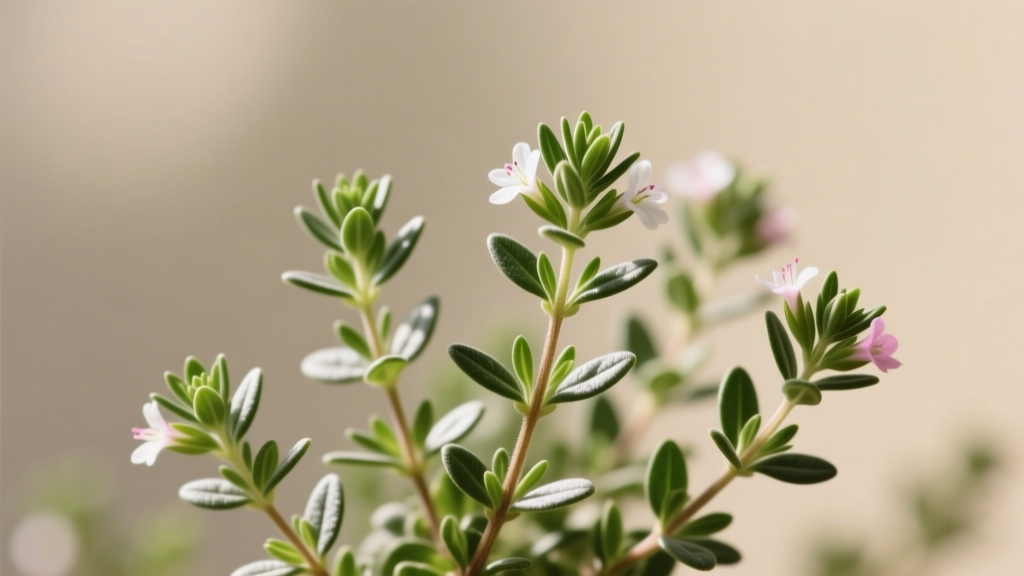
What Does Thyme Look Like: Visual Identification Guide
Thyme Looks Nothing Like What You Think It Does — And That’s Usually Fine
In most supermarkets, fresh thyme arrives bundled in limp, pale-green sprigs—often with yellowing leaf tips and stems that snap too easily. People assume this signals age or poor quality, so they pass it up for brighter, stiffer specimens. But in practice, that ‘freshness’ is rarely the thing that ruins a stew, roast, or simple vinaigrette. The visual cues shoppers fixate on—leaf gloss, stem rigidity, color saturation—are almost never the bottleneck in home cooking. Instead, what matters is whether the leaves still cling to the stem when rubbed gently, and whether they release a clean, earthy aroma—not whether the sprig stands upright in a vase.
Where the Misreading Starts—and Why It Costs Time, Not Flavor
The confusion begins with grocery photography: stock images show thyme as dense, dewy, and uniformly green—like something grown under studio lights, not in a commercial greenhouse. Home cooks internalize that image as the baseline for ‘usable’. In reality, thyme harvested for mass retail is often packed and shipped within 48 hours of cutting; minor discoloration reflects transit stress, not decay. The real consequence isn’t flavor loss—it’s hesitation at the produce aisle, followed by substitution (often dried oregano or rosemary), which *does* change outcomes. That substitution, not the leaf hue, is where home kitchens lose consistency.
The Boundary: When Appearance Stops Mattering Entirely
Thyme’s look stops being relevant the moment it’s dried, frozen, or cooked beyond 160°F (71°C). At that point, chlorophyll breaks down, stems soften irreversibly, and volatile oils migrate. A sprig that looked tired raw may yield more aromatic depth after 90 minutes in a braising liquid than one that looked pristine but was picked two days earlier and stored poorly. In a home kitchen, visual freshness is only a proxy—and a weak one—for oil retention, not a direct predictor of performance. If you’re simmering, roasting, or steeping, the plant’s structural integrity matters less than its dry weight and storage history.
Two Invalid Obsessions (and Why They Waste Mental Bandwidth)
First: Stem thickness. Many assume thick, woody stems mean older, more bitter thyme. But stem lignification depends more on harvest timing and variety (French vs. German) than age—and bitterness only emerges if stems are chewed whole, not removed before serving. Second: Leaf size uniformity. Small, clustered leaves are standard for common Thymus vulgaris; larger, spaced leaves usually indicate lemon thyme or caraway thyme—different species entirely. Confusing them isn’t about ‘getting it right’—it’s misidentifying a different herb altogether. Neither fixation affects how thyme behaves in soup, marinade, or compound butter.
The Real Constraint: Your Freezer Drawer, Not the Produce Section
What actually limits thyme’s usefulness at home isn’t its appearance on day one—it’s how long it sits unwrapped in the crisper. Moisture loss accelerates aroma fade far faster than surface browning. A sprig that looks slightly dull but is wrapped in damp paper towel and sealed in a zip-top bag will outperform a ‘perfect’ one left loose for 36 hours. This isn’t about technique—it’s about household infrastructure: most homes lack dedicated herb drawers or vacuum sealers. So the real variable isn’t what thyme looks like when you buy it, but whether your storage routine preserves volatiles. If your fridge runs warm or your bags leak air, appearance becomes noise.
Counterintuitive裁决: Same Herb, Opposite Verdicts
For a quick pan sauce? Use thyme that looks slightly faded—its oils have begun migrating toward the leaf surface, making them easier to release on contact with hot fat. For garnishing a chilled tomato salad? Only use bright-green, taut-leaved sprigs—the visual mismatch undermines perception of freshness, even if flavor is identical. For freezing whole sprigs? Prioritize stem flexibility over color; brittle stems shatter in the bag and scatter leaves. For infusing vinegar? Ignore appearance entirely—heat and time extract regardless. For blending into butter? Pick stems with minimal leaf drop—even if color is uneven—as loose leaves won’t emulsify cleanly. For tossing into roasted vegetables pre-oven? Any intact sprig works; heat equalizes variance.
A Simpler Filter for Next Time
Rub one leaf between thumb and forefinger: if it releases a clear, camphorous scent without grassy or musty notes, the rest of the bunch is functionally sound—regardless of stem color, leaf curl, or bundle tightness.
| What people fixate on | What it affects | When it matters | When it doesn't |
|---|---|---|---|
| Deep green leaf color | Perceived freshness, not oil concentration | Garnishing raw dishes (e.g., salads, chilled soups) | Braising, stewing, baking, or drying |
| Stem stiffness | Structural handling, not flavor release | Using whole sprigs as skewers or infusion bundles | Chopping, mincing, or steeping in liquid |
| Uniform leaf size | Species identification, not culinary behavior | Selecting for specific aroma profiles (e.g., lemon thyme) | General savory seasoning in stews or roasts |
| Presence of flowers | Subtle sweetness, not potency | Infusing honey or delicate desserts | Savory sauces, meat rubs, or stocks |
Quick verdicts for home cooks
- If you’re adding thyme to soup an hour before serving, leaf color and stem snap are irrelevant—only aroma matters.
- For garnishing a finished dish, choose sprigs with intact, glossy leaves—even if they cost 20% more.
- When freezing thyme, prioritize flexible stems over bright green color—they’ll hold together better in the bag.
- If your fridge lacks humidity control, ignore appearance at purchase and focus on immediate damp-paper-towel storage.
- For compound butter, avoid sprigs with loose or crumbly leaves—they won’t incorporate evenly.
- When substituting dried thyme, don’t match fresh appearance—match weight, not volume or color.
Frequently Asked Questions
Why do people think thyme must be vivid green to be usable?
Because packaging, food blogs, and recipe photos consistently show idealized specimens—creating a visual expectation that has no bearing on oil content or thermal stability.
Is it actually necessary to discard thyme with brown leaf tips?
No—brown tips indicate minor dehydration or light exposure, not spoilage. As long as the stem bends without snapping and the leaves smell clean, it’s fully functional.
What happens if you ignore thyme’s appearance and just smell it?
You’ll often select more reliable material—because aroma degrades before visible signs appear, and persists after color fades.
Lately, more home cooks are skipping visual inspection entirely and going straight to the rub-and-sniff test—even in mainstream supermarkets. Not as a trend, but as quiet recalibration: they’ve learned that thyme’s reliability lives in its volatility, not its veneer.
More Articles
 Ancho vs Guajillo vs Chipotle: Chile Guide
 How to Organize Techniques: A Practical System for Home Cooks and Professional Chefs
 Lowest Carb Potato: Yukon Gold vs Sweet Potato Facts
 Baking and Spices: A Flavor Pairing Guide
 Cinnamon vs Cassia: Know the Difference
 Trader Joe's Minced Garlic: Truth Revealed (2026)
 Garlic Sauce for Chicken: Simple Recipe & Pro Tips
 How to Store Turmeric Root: 3 Best Methods for Freshness
 Perfect Homemade Tomato Basil Sauce Recipe in 20 Minutes
 Garlic Chives Substitutes: Best Cooking Alternatives