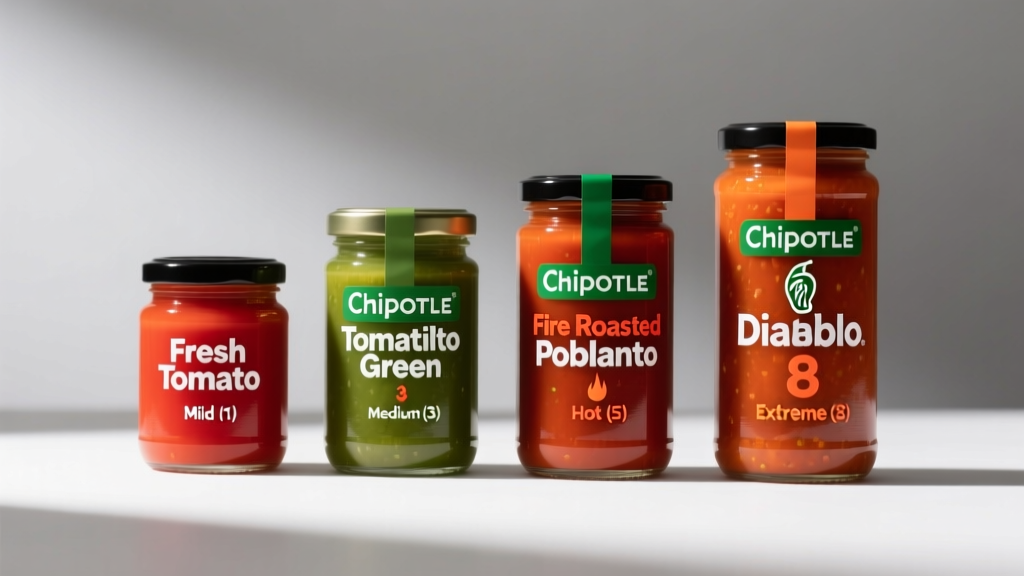
Chipotle Salsa Spice Levels Explained (Actual Heat Ratings)
In most homes, the phrase "chipotle salsa spice level" triggers an immediate mental checklist: "Is this too hot for the kids? Did I buy the mild version? Should I dilute it?" That reflex is built on a quiet assumption — that heat intensity is the primary functional trait of chipotle salsa. But that assumption collapses the moment you open the jar beside a weeknight taco bowl or stir it into baked beans. The real consequence isn’t mouth burn — it’s flavor drift. When families chase “lower heat,” they often reach for watered-down versions, pre-diluted blends, or non-smoked alternatives — all of which mute the defining trait: smoke depth. That loss doesn’t register as spiciness missing; it registers as “something flat” in the sauce, or “why does this taste like ketchup with attitude?” The error isn’t misreading heat — it’s mistaking heat for identity.
The chipotle salsa spice level becomes irrelevant when smoke character is already anchored elsewhere in the dish. If you’re using smoked paprika in the rub, grilling over wood chips, or adding chipotle powder to the marinade, the salsa’s Scoville contribution fades into background noise. In those cases, its role shifts from heat source to flavor echo — and minor variations in heat (mild vs. medium) produce no perceptible difference at the table. This isn’t theoretical: in many homes, the same jar sits on the counter for six weeks while the family rotates between grilled chicken, black bean soup, and scrambled eggs — and no one notices the heat label changing across uses. What matters is consistency of smoke tone, not precision of capsaicin output.
Two common fixations are functionally inert. First: “Which brand’s ‘medium’ matches another’s ‘mild’?” — meaningless, because chipotle heat varies more within a single brand’s batch than across competitors’ labeled tiers. Second: “Should I blend it with sour cream to lower heat?” — unnecessary, because dilution doesn’t reduce perceived heat proportionally; it blurs smoke definition and introduces dairy instability (separation, fridge shelf-life drop). Neither action improves usability. Both consume time and add variables without solving the actual problem — which is rarely heat intolerance, and more often mismatched smoke density across ingredients.
The real constraint isn’t heat tolerance — it’s refrigerated shelf life after opening. Most chipotle salsas contain vinegar and minimal preservatives. Once opened, they begin losing volatile smoke compounds within 7–10 days, even when chilled. That degradation isn’t visible or smellable at first — but by Day 12, the smokiness flattens, acidity sharpens, and residual heat can feel harsher, not milder. This isn’t about capsaicin breakdown (it’s stable); it’s about aromatic collapse. A family that opens a jar every three weeks — typical for low-frequency users — almost always serves salsa past its aromatic prime. No label, no dilution, no brand switch fixes that. It’s a time-and-fridge issue, not a heat-tuning one.
Here’s where judgment flips: if you’re serving salsa straight from the spoon with chips, heat level matters — but only as a binary: “Does anyone at this table avoid capsaicin entirely?” If yes, skip it. If not, any standard jar works. If you’re folding it into chili or folding it into mayo for a sandwich spread, heat level doesn’t matter — smoke integration does. And if you’re using it in a slow-cooked stew where it simmers 45 minutes, heat vanishes entirely; what remains is umami and charred-sugar backbone. These aren’t preferences — they’re chemical outcomes. In a home kitchen, chipotle salsa’s heat is rarely the thing that ruins the dish. What ruins it is using stale-smoke salsa in a raw application, or expecting heat control to compensate for weak foundational smoke.
Stop asking “How hot is it?” Start asking “How fresh is its smoke?” That single pivot eliminates 80% of heat-related decisions. Freshness isn’t about expiration dates — it’s about how recently the jar was opened and whether it’s been stored below 4°C consistently. If it’s been open >10 days and you’re using it raw, swap it — even if the label says “mild.” If it’s been open <5 days and you’re cooking with it, the heat tier is functionally invisible. This isn’t a rule — it’s a sensory triage. You don’t need a thermometer. You need a sniff test: if the aroma reads “campfire + tomato,” keep it. If it reads “vinegar + cardboard,” replace it. That’s the only calibration that holds up across brands, batches, and households.
| What people fixate on | What it affects | When it matters | When it doesn't |
|---|---|---|---|
| Labelled heat tier (mild/medium/hot) | Initial tongue sensation on first bite | When served raw with chips or as a finishing drizzle | When simmered >20 min or blended into dressings/mayo |
| Brand-to-brand heat comparisons | Perceived consistency across purchases | When rotating jars weekly and tasting raw | When using one jar over 3+ weeks — batch variation dominates |
| Diluting with yogurt or lime juice | Acidity balance and texture stability | When serving to children who reject all capsaicin | When aiming for authentic smoke-forward flavor — dilution blurs it |
| Storing unrefrigerated after opening | Smoke compound volatility and microbial safety | Always — room-temp storage degrades smoke within 48 hours | Never — no scenario justifies skipping refrigeration |
Quick verdicts for home cooks
- If your kids eat jalapeños raw, any standard chipotle salsa is fine — heat won’t surprise them.
- If you’re stirring it into rice or beans before reheating, skip checking the heat label entirely.
- If the jar’s been open >9 days and you plan to serve it cold, use it in cooked dishes only.
- If you taste sharp vinegar before smoke, the salsa has lost its functional profile — heat level is irrelevant now.
- If you’re pairing it with grilled meat, prioritize smoke intensity over heat tier — they rarely align.
- If someone in your household avoids capsaicin completely, no chipotle salsa is appropriate — dilution won’t remove it.
Frequently asked questions
Why do people think chipotle salsa heat needs precise matching to other spices?
Because heat is measurable and visible on labels — while smoke depth is intangible and rarely named. That visibility creates false hierarchy: we assume the labeled number governs impact, when in fact smoke compounds drive perception far more than capsaicin alone.
Is it actually necessary to buy different heat tiers for different meals?
No. One medium-tier jar covers 95% of home uses — unless someone refuses all capsaicin. Heat differentiation matters only in raw, uncooked applications — and even then, personal tolerance varies more than label ranges.
What happens if you ignore the heat label and use “hot” salsa in kid-friendly dishes?
Usually nothing — especially if mixed into mac & cheese or folded into meatloaf. Capsaicin disperses and mellows under fat and heat. The bigger risk is using stale salsa, not hot salsa.
More Articles
 Easy Meatloaf Recipe with Lipton Onion Soup Mix
 Star Anise: Spice Basics & Uses (2026)
 Oven-Baked Tuna Steaks: Foolproof Method & Timing
 Honey Baked Ham Guide: Perfect Recipe & Pro Tips
Asafoetida (Hing): A Beginner's Guide
Honey Baked Ham Guide: Perfect Recipe & Pro Tips
Asafoetida (Hing): A Beginner's Guide
 Cumin vs Coriander: Key Differences (2026)
 Five Spice Powder: Ingredients and Uses
 How To Organize Life
Berbere Buying Guide: How to Choose Fresh, Authentic Ethiopian Spice Blend
How To Organize Life
Berbere Buying Guide: How to Choose Fresh, Authentic Ethiopian Spice Blend
 Where to Find Chia Seeds in Grocery Stores: Aisle Guide