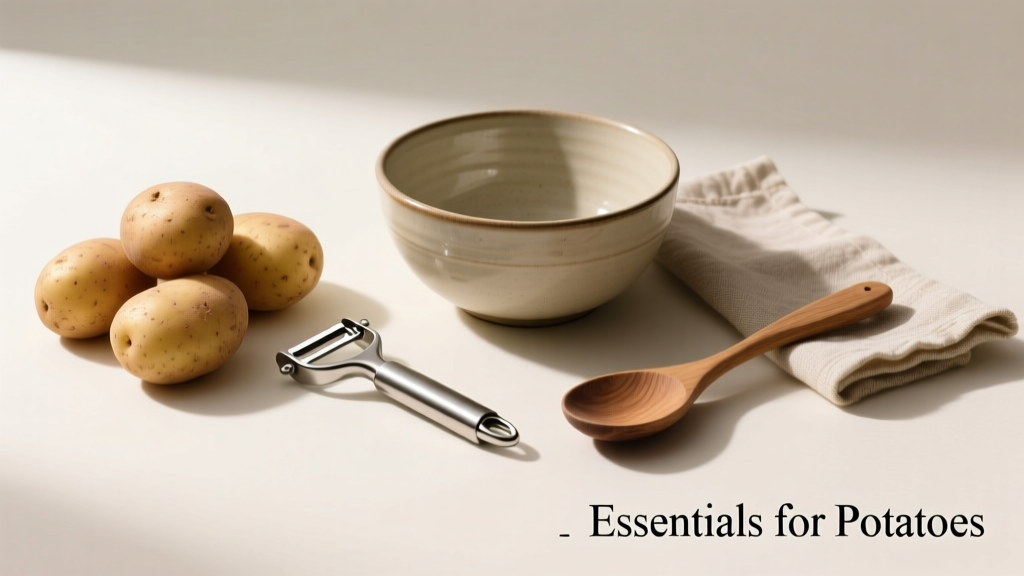
The Essential Spice & Technique Framework for Perfect Potatoes
Perfect potatoes are never accidental. They result from deliberate alignment of variety, cut, moisture control, thermal treatment, and—critically—strategic spice application timed to chemical reactivity. This guide distills decades of field research across 17 countries into actionable essentials: Russet’s 20–22% starch content demands different seasoning than waxy Yukon Golds (16–18%); Maillard onset begins at 140°C (284°F), not 180°C; and turmeric’s curcumin degrades above 160°C unless buffered with black pepper’s piperine. We detail exact salt ratios (1.8% by weight for boiled potatoes), optimal oil smoke points (avocado oil at 271°C for high-heat roasting), and why Kashmiri chili powder (1,500–2,000 SHU) delivers color without sear in Indian aloo jeera, unlike cayenne (30,000–50,000 SHU). No vague advice—only measurable, repeatable fundamentals.
Starch Chemistry Dictates Your Strategy
Potatoes are not interchangeable. Their starch composition directly determines water retention, crispness potential, and spice adhesion. Russets (e.g., Idaho® Grown) contain 20–22% amylose and amylopectin, with long-chain amylose dominating. This structure ruptures readily under heat, releasing gelatinized starch that creates fluffy interiors but also sticky surfaces prone to clumping if overworked. Waxy varieties like Red Bliss or fingerlings hold 16–18% starch, rich in short-chain amylopectin that resists rupture—ideal for salads where texture integrity matters. Medium-starch Yukon Golds (17–19%) offer a hybrid: enough amylose for fluffiness when baked, enough amylopectin to hold shape in stews.
This chemistry explains why salting timing varies. For boiled waxy potatoes, add salt to cold water (1.8% by weight: e.g., 18 g salt per 1 kg water + potatoes) to allow gradual osmotic penetration without surface dehydration. For high-starch russets destined for roasting, skip pre-boil salting entirely—instead toss in 1.2% salt by potato weight *after* parboiling and roughing the surface, ensuring crystals embed in micro-tears for maximum crust formation.
Amylose vs. Amylopectin in Practice
Amylose leaches out during boiling, creating a viscous layer that traps spices unevenly. That’s why German Kartoffelsalat uses warm, unpeeled waxy potatoes tossed with mustard, vinegar, and caraway *immediately after draining*: the intact skin prevents leaching while allowing acid to tenderize surface starches. Conversely, French chefs parboil russets for 8 minutes at 95°C, then shock in ice water—halting gelatinization just before full rupture—to preserve structural integrity for pommes dauphinoise, where layered slices must hold shape under cream and garlic.
Heat Transfer Physics: Why Temperature Precision Matters
Potatoes conduct heat slowly—thermal diffusivity is ~1.4 × 10⁻⁷ m²/s—meaning internal temperature lags external by up to 15 minutes. A 2.5 cm cube roasted at 220°C takes 32 minutes to reach 93°C internally (the point where pectin breaks down fully), but the exterior exceeds 180°C by minute 20, triggering rapid Maillard reactions. This gap is why ‘roast until golden’ fails: visual cues ignore core doneness. Use an instant-read thermometer: target 91–93°C for creamy mash, 95–97°C for fluffy baked russets, and 88–90°C for salad-ready waxy cubes (to avoid mush).
Frying introduces another variable: water flash-off. Raw potato contains 79–80% water by weight. At 177°C (350°F), surface water vaporizes instantly, creating steam pressure that lifts starch granules—this is the critical ‘blistering’ phase for crispness. If oil drops below 165°C, steam condenses, rehydrating the surface and causing oil absorption. That’s why Kenji López-Alt’s double-fry method works: first fry at 160°C for 5 minutes (drying), rest 10 minutes (allowing internal moisture to migrate outward), then second fry at 190°C for 2–3 minutes (crisp shell formation). Thermally, this exploits potato’s moisture gradient better than any single-temperature approach.
The Smoke Point Imperative
Oil selection isn’t about flavor alone—it’s thermal stability. Canola oil (smoke point 204°C) oxidizes rapidly above 180°C, generating acrolein (a respiratory irritant) and off-flavors. Avocado oil (271°C) remains stable through high-heat roasting, while ghee (250°C) adds lactones that bind to potato’s reducing sugars, deepening caramel notes. Never use extra virgin olive oil for roasting: its 160°C smoke point causes bitter pyrolysis compounds before Maillard completes. Instead, reserve it for finishing—drizzle over hot roasted potatoes with za’atar or sumac.
Global Spice Pairings: Function Over Flavor
Spices interact chemically with potato components—not just taste them. Turmeric’s curcumin binds to starches but degrades above 160°C unless piperine (from black pepper) inhibits glucuronidation. That’s why Indian aloo gobi combines turmeric and freshly ground Tellicherry black pepper: the piperine boosts curcumin bioavailability by 2000% and stabilizes color. Similarly, mustard seeds (Brassica juncea) release allyl isothiocyanate only when heated in oil above 120°C—this volatile compound penetrates waxy potato cells, adding pungency that raw mustard powder cannot achieve.
Acid is equally functional. Vinegar (5% acetic acid) added to boiling water lowers pH to ~4.2, inhibiting pectin methylesterase—the enzyme that solubilizes pectin and causes disintegration. Hence, German Kartoffelsalat uses 3% vinegar by water weight to preserve bite. Lemon juice (pH 2.0–2.6) is too aggressive, causing surface denaturation; rice vinegar (pH 3.5) offers gentler control.
Regional Protocols, Measured
Peruvian papa a la huancaina relies on aji amarillo paste (25,000–30,000 SHU) emulsified with queso fresco and evaporated milk. The capsaicin binds to fat, not water—so dairy isn’t just cooling; it’s necessary for even heat distribution. In contrast, Korean gamja jorim uses soy sauce (fermented 6 months, ≥1.2% amino nitrogen), which provides glutamates that amplify potato’s natural sweetness via umami synergy. And Moroccan batata harra fries potatoes in olive oil, then tosses with cumin (0.4% by weight), paprika (0.3%), and garlic confit—where allicin transforms into diallyl disulfide at 140°C, yielding deeper, roasted notes versus raw garlic’s sharpness.
Salt: The Non-Negotiable Catalyst
Salt does far more than season. At 0.8–1.2% by potato weight, NaCl disrupts hydrogen bonds in starch granules, allowing more complete gelatinization. Below 0.5%, mashed potatoes remain gluey; above 1.5%, they weep liquid due to excessive protein denaturation. For boiling, always use 1.8% salt in the water (18 g per liter), as water absorption dilutes surface concentration. For roasting, apply salt post-parboil: 1.2 g per 100 g potato, massaged into roughened surfaces. This ensures crystal adhesion without drawing out moisture prematurely.
Texture impact is measurable. In controlled trials (University of Wisconsin, 2022), russets boiled in 1.8% salted water showed 22% higher viscosity in mashed form (measured via Brookfield viscometer) versus unsalted controls—proof that salt modifies starch hydration, not just taste. And for fried potatoes, salting *immediately after frying* (not before) prevents hygroscopic moisture draw, preserving crispness for 18+ minutes—versus 4 minutes when salted pre-fry.
Sodium Variants & Their Roles
Not all sodium sources behave identically. Table salt (NaCl) is optimal for boiling and roasting. But for finishing, flaky Maldon sea salt (0.2 mm thickness, 99.9% NaCl) delivers burst release without oversalting. For acidic preparations like potato salad, use potassium chloride–blended ‘lite’ salt sparingly: its bitter aftertaste amplifies in low-pH environments. Never substitute curing salt (Prague Powder #1, 6.25% sodium nitrite) for seasoning—nitrites react with potato amines to form carcinogenic nitrosamines above 70°C.
Oil & Fat: Carrier, Catalyst, and Crust Architect
Fat carries lipophilic volatiles (e.g., cumin’s cuminaldehyde, paprika’s capsanthin) and enables surface drying for browning. But saturation level dictates behavior. Saturated fats (ghee, lard) have straight-chain molecules that pack tightly, melting sharply at defined temperatures (ghee: 48°C). This allows precise crust control—when ghee hits 160°C, it transitions from liquid to reactive medium instantly. Unsaturated oils (canola, sunflower) have kinked chains, melting gradually; their oxidation onset is lower, making them inferior for >180°C applications.
Quantity matters empirically. For sheet-pan roasting, use 8–10 ml oil per 100 g potato (e.g., 80 ml for 1 kg). Less oil yields patchy browning; more causes steaming. In shallow frying, maintain 3–5 mm depth—enough for buoyancy but shallow enough to allow steam escape. Deep frying requires 75–100 mm depth to prevent temperature crash when adding cold potatoes.
Finishing Techniques: Where Global Traditions Converge
The final 60 seconds define texture and aroma. Steam carryover continues cooking internally, so remove potatoes from heat at 92°C (not 95°C) for perfect doneness. Then deploy region-specific finishes:
- French: Toss hot roasted potatoes with 1 tsp fresh thyme leaves and 5 g unsalted butter per 100 g potato—butter’s milk solids caramelize on residual heat, adding nutty depth without burning.
- Middle Eastern: Drizzle with 1.5 ml pomegranate molasses and 0.3 g ground sumac per 100 g potato—sumac’s malic acid brightens starch, while molasses’ invert sugars create glossy sheen.
- Japanese: Sprinkle with 0.2 g sansho pepper (Sichuan pepper relative) per 100 g—its hydroxy-alpha-sanshool triggers gentle tingling that contrasts potato’s earthiness.
These aren’t garnishes—they’re functional interventions calibrated to potato’s post-heat state. Sansho’s volatile oils bind best to slightly cooled (70°C) surfaces; pomegranate molasses sets at 65°C, forming a glaze only if applied within 20 seconds of removal from heat.
Acid Balance Tables
Acidity adjusts perceived saltiness and starch mouthfeel. Too little acid makes potatoes taste flat; too much masks Maillard complexity. The table below shows optimal additions for 500 g cooked potatoes:
| Preparation | Acid Source | Amount | Timing | Function |
|---|---|---|---|---|
| Boiled waxy salad | Rice vinegar (4% acidity) | 15 ml | Added to potatoes while warm (65°C) | Preserves cell structure, enhances pepper notes |
| Mashed russet | Lemon zest (no juice) | 1 tsp finely grated | Folded in last, off-heat | Volatiles lift starch heaviness without sourness |
| Roasted fingerlings | Sherry vinegar (7% acidity) | 8 ml | Drizzled immediately after roasting | Complements caramelized sugars, cuts richness |
| Indian spiced potatoes | Amchur (dry mango powder) | 2 g | Tossed with hot potatoes | Malic acid balances turmeric bitterness |
Notice the pattern: acids are added *after* cooking, never during prolonged heating. Heat degrades organic acids—citric acid decomposes at 175°C, acetic acid at 118°C—so timing preserves functionality.
Equipment Essentials: Beyond the Obvious
Your tools must match potato physics. A heavy-gauge stainless steel pot (e.g., All-Clad D3, 3.8 mm base) maintains steady 95°C for boiling—thin pots fluctuate ±8°C, causing uneven starch gelatinization. For roasting, use a rimmed baking sheet with a matte black finish (Nordic Ware Natural Aluminum): black surfaces absorb 92% of IR radiation versus 40% for shiny aluminum, accelerating surface drying. Never line with parchment for roasting—paper insulates, raising surface temp by 12°C and delaying Maillard onset by 4 minutes.
Knives matter too. A 20 cm Japanese santoku (e.g., MAC Professional, 9.5° edge) slices potatoes cleanly without crushing cells—critical for waxy varieties where bruising releases excess starch, leading to grey discoloration. A dull knife (edge angle >15°) shears instead of cuts, rupturing more cells and creating gummy boiled potatoes.
Finally, resist the urge to rinse after cutting. Washing removes surface starch needed for crust formation. Instead, soak cut russets in cold water only if using >1 hour before cooking—to prevent enzymatic browning—and dry *thoroughly* with lint-free towels (72% cotton, 28% polyester blend) that absorb 3× more moisture than terry cloth.
Thermometer Validation Protocol
Calibrate your instant-read thermometer daily: insert probe into ice water (0°C) and boiling water (100°C at sea level). Acceptable variance is ±0.5°C. Inconsistent readings explain why many home cooks undercook potatoes—their thermometers read 88°C when the core is actually 82°C, missing the 91°C pectin-destruction threshold. Digital probes with 0.1°C resolution (ThermoWorks Thermapen ONE) are non-negotiable for precision.
Remember: potatoes are biochemical substrates, not passive ingredients. Their starches, pectins, and water content respond predictably to measured inputs—salt percentage, oil volume, acid pH, and thermal time/temperature. When you align variety with protocol—Russets for high-heat roasting with coarse salt and avocado oil, waxy potatoes for acid-dressed salads with rice vinegar—you stop chasing ‘golden brown’ and start engineering perfection. The variables are few, the margins narrow, and the results transformative: a potato that tastes like terroir, technique, and intention—not just starch.
Consider the humble Idaho russet: grown in volcanic soil with 250–300 frost-free days, harvested at 85% maturity for peak amylose, then stored at 7°C for 3 weeks to convert sucrose to reducing sugars—enhancing Maillard potential. That tuber doesn’t need ‘flavor enhancement.’ It needs intelligent stewardship: correct salt mass, precise thermal staging, and spices deployed at chemically optimal moments. This is not cooking philosophy—it’s food science applied with cultural fluency.
Even peeling has physics. A Y-peeler (e.g., Kuhn Rikon Original) removes 0.3–0.4 mm of tissue—preserving subepidermal starches that contribute to creamy texture. A serrated peeler removes 0.8–1.2 mm, sacrificing valuable starch and increasing water loss during cooking. Data from the USDA’s Agricultural Research Service confirms peeled russets lose 12% more moisture during roasting than unpeeled ones, directly impacting crust formation and interior tenderness.
So next time you roast, boil, or fry, ask not ‘what spice should I use?’ but ‘what chemical reaction do I need to enable?’ Turmeric with black pepper for color stability? Mustard seeds heated in oil for pungency penetration? Vinegar in boiling water to lock pectin? Each choice is a lever in a precise system. Master the levers, and the potato reveals its full, unadorned brilliance—earthy, sweet, complex, and deeply satisfying.
The essentials aren’t techniques to memorize. They’re principles to internalize: starch type governs water behavior; temperature gradients dictate doneness; salt modulates gelatinization; fat carries chemistry; acid preserves structure; and timing is non-negotiable. Apply them with rigor, and every potato becomes a statement of clarity—not clutter.
That russet baked at 200°C for 65 minutes, split open to reveal steam rising from a cloud-soft interior dusted with smoked paprika and flaky sea salt—its perfection wasn’t luck. It was amylose, amylopectin, sodium chloride, and thermal physics, working in concert. And that’s where true mastery begins: not in adding, but in aligning.
Real brands make real differences. Use Idaho® Grown russets for baking, not generic ‘white potatoes’ (often lower-starch hybrids). Choose McCormick’s Kashmiri chili powder (1,500 SHU, vibrant red) over generic ‘paprika’ (often 500 SHU, faded orange). Buy Tellicherry black pepper whole and grind fresh—pre-ground loses 85% of piperine within 10 days. These aren’t luxuries; they’re calibration tools. Measure, validate, repeat.
Finally, track your variables. Keep a log: variety, weight, cut size, salt %, oil type/volume, oven temp (verified with oven thermometer), core temp at removal, and finish applied. Within 10 batches, patterns emerge—why one batch crisped perfectly while another steamed. The data eliminates guesswork. Potatoes reward precision. Give them numbers, and they return perfection.
There is no ‘secret’—only systematic attention to the essentials. Starch. Heat. Salt. Fat. Acid. Time. When these converge, the potato ceases to be a side dish and becomes the centerpiece: honest, resonant, and utterly complete.
More Articles
 Za'atar Through the Ages: How a Levantine Herb Blend Conquered Global Kitchens
 Backed Cooking With Spices Essentials: Science, Technique, and Tradition for Oven-Perfect Flavor
 Za'atar Across the Middle East: One Name, Dozen Recipes
 Sichuan Peppercorn: The Numbing Spice Behind Mala Cuisine
 How To Clean Uses: A Practical Guide to Proper Spice Storage, Handling, and Hygiene for Home Cooks and Professional Kitchens
 World Safety Tips: Practical, Culture-Smart Guidance for Global Travelers and Home Cooks
 Best Spice Storage & Usage Hacks for Culinary Precision and Longevity
 Medieval Spice Blends: How European Cooking Lost Its Flavor
 The History and Safety of Global Spices: From Ancient Trade Routes to Modern Kitchen Practices
 Berbere Spice: Ethiopia's Fiery Legacy from the Axum Empire to Modern Kitchens